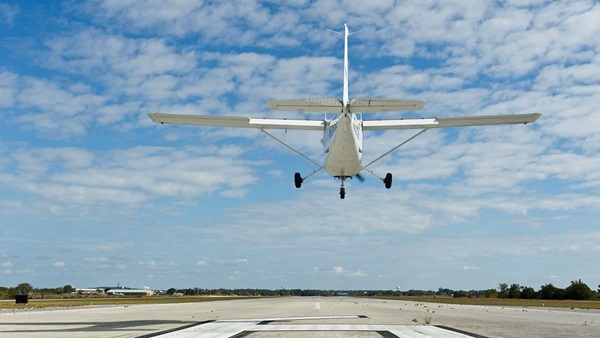
1 . Most U.S. public-use airports have air traffic control towers.
True
False
2 . When taking off and remaining in the pattern, the Aeronautical Information Manual (AIM) recommends climbing to within ____ feet of pattern altitude before turning crosswind.
200
300
400
500
3 . When flying a standard traffic pattern and landing with a left crosswind, you should plan to ____ to help stabilize the approach.
Lead your turn to final
Make a normal turn to final
Delay your turn to final
4 . FAA regulations stipulate that pattern entry shall be made on a 45-degree angle to the downwind leg at pattern altitude.
True
False
5 . Once on final approach at a nontowered field, pilots should ____.
Focus all their attention on the intended touchdown point
Maintain runway alignment while continually listening and scanning for traffic
Verify that the aircraft is in a safe landing configuration appropriate to the landing facility
Both B and C
All of the above
6 . Self-announce transmissions on the common traffic advisory frequency (CTAF) of a nontowered airport should always conclude with ____.
Aircraft type and call sign
Pilot intentions
Airport name
Aircraft position
7 . When approaching to land, begin monitoring the automated surface observing system (ASOS) or automated weather observing system (AWOS), if available, ____ miles out.
5 to 10
20 to 30
30 to 40
8 . In addition to the standard "midfield downwind" call, traffic pattern position announcements should be made ____ onto the next pattern leg.
Just prior to making the turn
When rolling out of the turn
Once established
9 . When operating in the vicinity of nontowered airports, the responsibility for ____ lies solely with the pilot.
Collision avoidance
Aircraft sequencing
Both A and B
10 . When approaching a nontowered airport, pilots should tune in the appropriate CTAF frequency, make a position report, and request, "Traffic in the area, please advise."
True
False