Safety Spotlight

Summer Weather

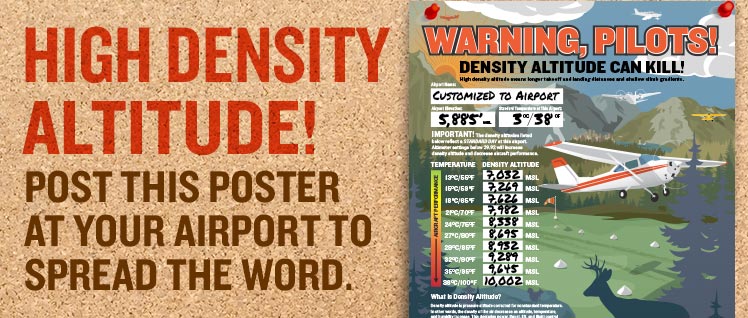
Summer can be great for flying, whether in search of the elusive $100 hamburger, or to just spend some quality time aloft. On the flip side: The sweltering heat that sometimes accompanies summer weather can throw a nasty wrench in the works by creating severe thunderstorms, high density altitudes, and visibility-reducing haze. Print safety tips, brush up on your weather knowledge, and test your newly acquired skills with ASI’s award-winning courses.

Resources

  Weather Wise: Ceiling and Visibility Online Course

Low ceilings and restricted visibilities are aviation's deadliest killers.  With a little knowledge, you can minimize the risk these conditions pose (approx. 45-60 minutes). Take the Course >>>

 Weather Wise: Air Masses and Fronts Online Course

Do you understand the "why" behind the weather?  Find out about the large-scale forces that drive the weather, and learn how to put that knowledge to work before your next flight (approx. 45-60 minutes). Take the course >>>

 SkySpotter: Pireps Made Easy Online Course

Created by pilots, for pilots, pireps are a great source of real-time, in-flight weather conditions-offering a "sneak peek" of what you'll encounter in flight.  This course covers how to get, use, and give pireps to help you become a better SkySpotter (approx. 45-60 minutes).   Take the course >>>

 Ask ATC: Weather Deviating

How can I deviate for weather?

 Ask ATC: Precipitation Intensity

What can ATC tell me about the intensity of precipitation?

Weather Wise: Practical Tips and Tactical Tricks Safety Advisor

Weather is the most critical and complex variable that affects your flying. But you don't have to be a meteorologist to understand what makes weather, and use that understanding to help make sound flight decisions. This is what being weather wise is all about ... the ability to integrate official reports and forecasts with what you can see outside to cope with changing flight conditions in the real world.  (PDF file—358KB) Download it now >>>

ASOS: Automated Surface Observing System Safety Advisor

Automated weather reporting systems have been installed at airports across the country. They provide more weather data than ever before, but also require pilots to interpret the information they receive. This Safety Advisor describes these systems, explains their strengths and weaknesses, and offers weather gathering and interpretation information.  (PDF file—219KB) Download it now >>>

Rate-Of-Climb Table

It is common for non-turbocharged aircraft to climb at only 200 or 300 feet per minute (fpm) in high-density-altitude conditions.  In mountainous terrain, or when hot temperatures and high humidity exist, leave yourself ample room: Calculate your aircraft's climb gradient, which is a function of rate of climb and ground speed, measured in feet-per-nautical-mile. 

The faster an aircraft's groundspeed, the greater the rate of climb (fpm) needed to obtain the required climb gradient and avoid obstacles.

Download a quick reference Rate-of-Climb Table now >>>

ASI Safety Quizzes

  METARs: Beyond Translation

All pilots learn to decode METARs (aviation routine weather reports) early in their training, but simply being able to translate the codes isn't enough:  It's important to understand what all the information means—and how to incorporate it into your preflight planning and decision making. This ASI Safety Quiz will test your knowledge.

Terminal Aerodrome Forecasts (TAFs)

On November 5, 2008, the format for terminal aerodrome forecasts (TAFs) changed to accomodate expanded 30-hour forecasts, which are issued for 32 large U.S. airports.  Test your TAF savvy with this ASI Safety Quiz.

Related Safety Spotlight

 Safety Spotlight: Thunderstorm Awareness Resources

It's simple: Airplanes and thunderstorms don't mix.  The good news is that it's not difficult to avoid these violent storms—if you know how to use the tools at your disposal.  Check out these free resources.

Updated January 2012