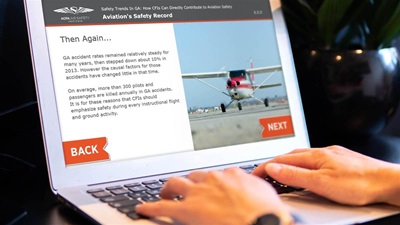
Interactive Safety Courses


Runway Safety

Some of aviation’s worst accidents have happened on the ground. Find out why—and learn how to avoid runway incursions—by taking this course (approx. 45-60 minutes).Take the course

Do The Right Thing: Decision Making for Pilots

In flying, making the right choices isn't always easy. This course offers some simple but effective ways to improve your aeronautical decision making skills—no psychology degree required! (approx. 45-60 minutes)

Take the course >>

*This course qualifies for AOPA Accident Forgiveness and Deductible Waiver Enhancement and the FAA Wings program.

Say It Right: Mastering Radio Communication

Radio communication is one of a pilot's core skills—and a cornerstone of safe flying. This course covers both VFR and IFR radio operations and will help you communicate properly, efficiently, and effectively from the cockpit (approx. 45-60 minutes).

Take the course >>

kneeboard sheet Quick Reference (Adobe PDF file)

*This course qualifies for AOPA Accident Forgiveness and Deductible Waiver Enhancement and the FAA Wings program.

Know Before You Go: Navigating Today’s Airspace

It’s critical to be well versed on any type of airspace that lies in your path. This comprehensive course covers everything you need to know to keep your pilot certificate (and yourself) safe (approx. 60-90 minutes).

Take the course >>

*This course qualifies for AOPA Accident Forgiveness and Deductible Waiver Enhancement and the FAA Wings program.

GPS for VFR Operations

GPS for VFR Operations

This course offers a clear explanation of how GPS works and how you can use it to make your next VFR flight more efficient, enjoyable, and safe (approx. 45-60 minutes). (Read the disclaimer.)

Take the course >>

*This course qualifies for AOPA Accident Forgiveness and Deductible Waiver Enhancement and the FAA Wings program.

GPS for IFR Operations

GPS for IFR Operations

This course is designed for pilots who want a basic introduction to the use of GPS in the IFR system (approx. 45-60 minutes). (Read the disclaimer.)

Take the course >>

*This course qualifies for AOPA Accident Forgiveness and Deductible Waiver Enhancement and the FAA Wings program.

Wx Wise: Air masses and fronts

Weather Wise: Precipitation and Icing

Too many pilots underestimate the dangers of precipitation and icing—and an alarming number add to the accident statistics as a result. Take this course to learn how to recognize the hazards of precipitation and ice, develop a strategy for avoidance, and react appropriately if you encounter unexpected conditions (approx. 45 minutes).

Take the course >>

*This course qualifies for AOPA Accident Forgiveness and Deductible Waiver Enhancement and the FAA Wings program.

Wx Wise: Air masses and fronts

Weather Wise: Air Masses and Fronts

Do you understand the “why” behind the weather? Find out about the large-scale forces that drive the weather, and learn how to put that knowledge to work before your next flight (approx. 45-60 minutes).

Take the course >>

*This course qualifies for AOPA Accident Forgiveness and Deductible Waiver Enhancement and the FAA Wings program.

Weather Wise

Weather Wise: Ceiling and Visibility

Low ceilings and restricted visibilities are aviation's deadliest killers. With a little knowledge, you can minimize the risk these conditions pose (approx. 45-60 minutes).

Take the course >>

*This course qualifies for AOPA Accident Forgiveness and Deductible Waiver Enhancement and the FAA Wings program.

Thunderstorms and ATC

Weather Wise: Thunderstorms and ATC

Learn how ATC describes precipitation, what weather-radar services controllers can offer, and how to effectively communicate with ATC (approx. 45-60 minutes).

Take the course >>

kneeboard sheet Quick Reference (Adobe PDF file)

*This course qualifies for AOPA Accident Forgiveness and Deductible Waiver Enhancement and the FAA Wings program.

SkySpotter: Pireps Made Easy

Created by pilots, for pilots, pireps are a great source of real-time, in-flight weather conditions-offering a “sneak peek” of what you’ll encounter in flight. This course covers how to get, use, and give pireps to help you become a better SkySpotter (approx. 45-60 minutes).

Take the course >>

*This course qualifies for AOPA Accident Forgiveness and Deductible Waiver Enhancement and the FAA Wings program.

Essential Aerodynamics: Stalls, Spins, and Safety

Getting a handle on aerodynamics doesn’t have to involve dry textbooks and dense equations. In this course, you’ll learn need-to-know concepts that will help you avoid unintentional stalls and spins (approx. 45-60 minutes).

Take the course >>

*This course qualifies for AOPA Accident Forgiveness and Deductible Waiver Enhancement and the FAA Wings program.

IFR Insights: Regulations

The regulations may be black and white, but instrument flight is a world of grays. In this course, you'll learn what it takes to stay safe while staying on the FAA's good side (approx. 45-60 minutes).

Take the course >>

kneeboard sheet Quick Reference (Adobe PDF file)

*This course qualifies for AOPA Accident Forgiveness and Deductible Waiver Enhancement and the FAA Wings program.

IFR Insights: Charts

From departure procedures to instrument approaches, this course will get you up to speed on NACO and Jeppesen instrument charts and provide helpful tips for using them in the system (approx. 60-90 minutes).

Take the course >>

*This course qualifies for AOPA Accident Forgiveness and Deductible Waiver Enhancement and the FAA Wings program.

Single-Pilot IFR

Flying solo in the IFR system can be a challenge for even the most experienced pilots. This course will show you how to do it safely (approx. 45-60 minutes). (Read the disclaimer.)

Take the course >>

*This course qualifies for AOPA Accident Forgiveness and Deductible Waiver Enhancement and the FAA Wings program.

Runway Safety

Some of aviation's worst accidents have happened on the ground. Find out why—and learn how to avoid runway incursions—by taking this course (approx. 45-60 minutes).

Take the course >>

*This course qualifies for AOPA Accident Forgiveness and Deductible Waiver Enhancement and the FAA Wings program.

Mountain Flying

Mountain Flying

Learn more about the challenges of high-density-altitude operations, flight planning and performance considerations, mountain weather, and more (approx. 45-60 minutes).

Take the course >>

*This course qualifies for AOPA Accident Forgiveness and Deductible Waiver Enhancement and the FAA Wings program.

Engine and Propeller

Engine and Propeller

Many repairs can only be made by an airframe and powerplant mechanic, but an understanding of engine and propeller operations can help minimize dangerous wear and costly repairs (approx. 60-90 minutes).

Take the course >>

*This course qualifies for AOPA Accident Forgiveness and Deductible Waiver Enhancement and the FAA Wings program.

Aging Aircraft

Aging Aircraft

This course will help you recognize the symptoms of aircraft aging, understand its impact, and mitigate the risks (approx. 45-60 minutes).

Take the course >>

*This course qualifies for AOPA Accident Forgiveness and Deductible Waiver Enhancement and the FAA Wings program.

Mission: Possible—Navigating Today's Special-Use Airspace

Review the key points of navigating special use airspace and learn how military lights-out training could affect you (approx. 45-60 minutes).

Take the course >>

*This course qualifies for AOPA Accident Forgiveness and Deductible Waiver Enhancement and the FAA Wings program.

Note: Before operating within 60 nm of the Washington D.C. SFRA (formerly the Washington D.C. ADIZ), pilots must complete FAA's online training course. For more information about the D.C. SFRA, see ASF’s Know Before You Go online course

.

Pinch-Hitter ®

Nonpilot flying companions can take this course to learn more about the fundamentals of aircraft control and basic emergency procedures (approx. 45-60 minutes). (Read the disclaimer.)

Take the course >>

Buy the Pinch-Hitter ® DVD and Manual >>

Minicourses

Accident Case Study: Airframe Icing

Accident Case Study: Airframe Icing

Ride along for this chilling re-creation and analysis of an accident that occurred when the pilot of a Cirrus SR22 encountered unforecast icing over the Sierra Nevada mountains (approx. 20-30 minutes).

Take the minicourse >>

Accident Case Study: IFR Into IMC

Accident Case Study: VFR Into IMC

VFR flight into instrument meteorological conditions is a leading cause of fatal GA accidents. This minicourse re-creates an actual VFR-into-IMC accident and examines the lessons we can learn from it (approx. 20-30 minutes).

Take the minicourse >>

eAPIS Customs Training

eAPIS Customs Training

Effective May 18, 2009, all pilots who fly internationally into or out of the U.S. must submit passenger and crew manifests electronically at least 60 minutes before departure. This course will guide pilots through the process of using the new electronic Advance Passenger Information System (eAPIS). (Approx. 20-30 minutes).

Take the minicourse >>

Flight Service

A Pilot’s Guide to Flight Service

Do you know how Flight Service has changed? Find out how to navigate the FS21 system and get the most from your preflight and in-flight briefings. (Approx. 20-25 minutes).

Take the minicourse >>

VOR Approach

IFR Chart Challenge: VOR Approach

Knowing what’s on the chart is one thing: Knowing how to apply it in the real world is something else. Will you make the right choices on this approach? (Approx. 15-20 minutes). (Read the disclaimer.)

Take the minicourse >>


ILS Approach

IFR Chart Challenge: ILS Approach

ILS approaches are normally pretty straightforward, but they can still throw you a curveball. See how well your chart knowledge measures up to this approach. (Approx. 15-20 minutes). (Read the disclaimer.)

Take the minicourse >>

RNAV Approach

IFR Chart Challenge: RNAV Approach

RNAV approaches aren’t hard to fly, but they are different than the procedures most pilots are used to. Take this minicourse to learn more while putting your chart knowledge to the test. (Approx. 15-20 minutes). (Read the disclaimer.)

Take the minicourse >>

Datalink

Datalink

Datalink is one of the most useful and promising technologies to enter the GA cockpit in recent years. Learn more about what datalink is, what it can bring to the cockpit, and how to use it safely (approx. 20-30 minutes).

Take the minicourse >>

Pneumatic Systems

Pneumatic Systems

This course offers an overview of vacuum and pressure-powered aircraft systems. It explains how pneumatic systems work, and how to handle and avoid pneumatic system failures (approx. 20-30 minutes). (Read the disclaimer.)

Take the minicourse >>
Take the mechanic's version >>

Presentations

Garmin 430/530

VFR GPS Guide: Garmin 430/530

This self-paced, 15-minute presentation focuses on the few functions regularly used by a typical pilot in VFR flight.

View the presentation >>

Visual Warning System

Visual Warning System

This self-running, four-minute presentation explains the new laser warning system around the Washington, D.C., Air Defense Identification Zone (ADIZ).

View the presentation >>

Note: Before operating within 60 nm of the Washington D.C. SFRA (formerly the Washington D.C. ADIZ), pilots must complete FAA's online training course. For more information about the D.C. SFRA, see ASF’s Know Before You Go online course

.
Real Pilot Stories

Real Pilot Stories

Hear pilot's detailed accounts of what went wrong and, more importantly, what they learned.

View the stories >>

ASF Safety Quiz - How do you measure up?
Get 12 issues of "AOPA Pilot' - Join AOPA now>>
Free Resources for Student Pilots
Apply now - AOPA WorldPoints MasterCard
Take GA to new heights - Join the AOPA Legacy Society
Aviation eBrief - subscribe now