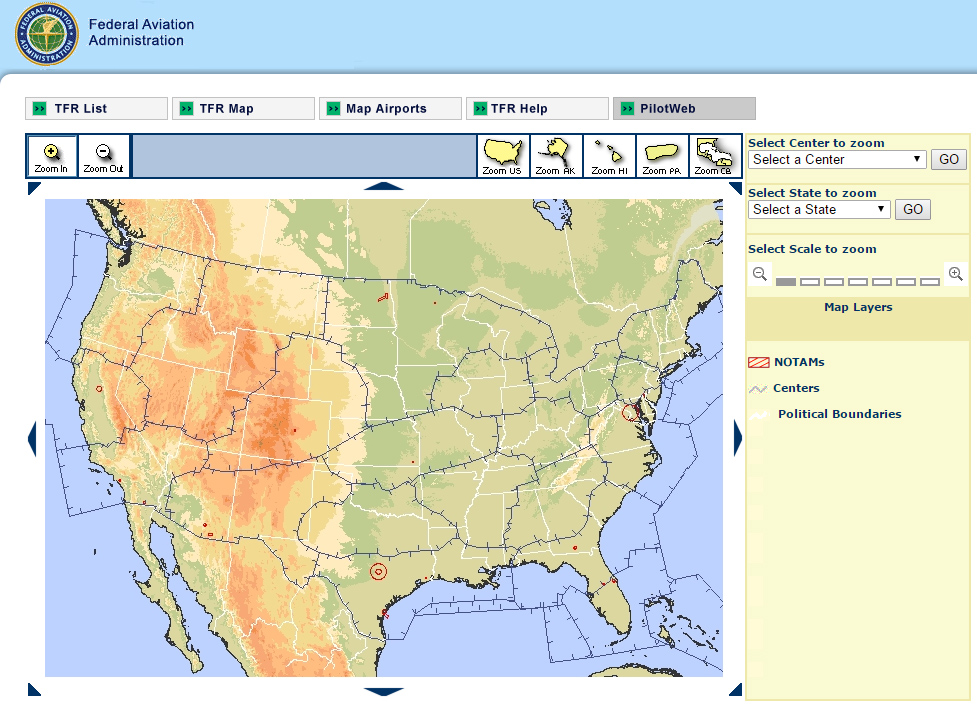
Security Notams and TFRs locator

For the most up-to-date TFR information, follow this link to the AOPA TFR Map.

Presidential/VIP movement TFRs

Please note that due to heightened security measures, AOPA is no longer able to post advance notice of Presidential/VIP movement TFRs until the information is released by the FAA.

Notice to all pilots: Presidential/VIP movement TFRs can be issued with little advance notice. The TFR Map is the most timely and accurate information AOPA can offer. It is not a substitute for a thorough preflight briefing. Its intent is to offer pilots a quick and effective means to assess temporary airspace restrictions prior to obtaining an official briefing.  Pilots must check with flight service for ALL applicable notams immediately prior to flight. The TFR Map includes Presidential/VIP movement notams and other temporary flight restrictions, typically due to events, aerial demonstrations, and fire fighting/disaster/recovery operations. "Blanket" TFR notams do not supersede any other TFR notams. Some TFRs can be very complex in shape, movement, and duration. Please study the TFR Map and all accompanying official text to understand the impact of restricted airspace on your flight plans.

Attention pilots: TFR notams are of utmost importance to each and every operation.  Pilots must familiarize themselves with all notams before flight. Due to rapidly changing conditions, you should obtain notam information from flight service and/or DUATS just prior to flight. There are many temporary flight restrictions (TFRs) throughout the country. In addition, you will see there are "blanket" TFR notams. These do not supersede any other TFR notams.


Blanket notams

9/5151 (#12): Sporting Events


International operations — general

9/2786 became effective August 15, 2009

9/2788 became effective August 15, 2009


Notams by state

California

AOPA has compiled plain-language guidance and a list of airports affetected by NOTAM #9/4986:

3 nm radius no-fly zone

Location:
SLI VOR's 066-degree radial at 6.8 nautical miles
Surface up to and including 3,000-ft-AGL

Times:
12:01 a.m. local Tuesday, February 17, 2009, until further notice

IMPACTED AIRPORTS:
NONE.

Delaware

AOPA has compiled plain-language guidance and a list of airports affetected by NOTAM #9/3124:

1 nm radius no-fly zone

Location:
DQO VOR's 005-degree radial at 5.4 nautical miles
Surface to 1,500-ft-AGL

Times:
Effective immediately, until further notice.

IMPACTED AIRPORTS:
NONE

Florida

AOPA has compiled plain-language guidance and a list of airports affected by NOTAM #9/4985:

3 nm radius no-fly zone

Location:
ORL VOR's 238-degree radial at 14.8 nautical miles
Surface up to and including 3,000-ft-AGL

Times:
12:01 a.m. local Tuesday, February 17 until further notice

IMPACTED AIRPORTS:
NONE.

Maryland, Virginia, and Washington, D.C.

AOPA has compiled plain-language guidance and a list of airports affected by notam 7/0204:

Size and location:
All airspace between 30 nm and 60 nmcentered on 385134N/0770211W or the DCA VOR/DME
Surface up to 17,999 ft
Effective time:
0100 local August 30 until further notice
Requirements for flight in the 30 nm-60 nm area:
Aircraft operations are restricted to an indicated airspeed of 230 knots or less

Airport ID

Name

City

State

Nautical Miles
From

3W3

Kentmorr Airpark

STEVENSVILLE

MD

31.9

1W5

Hoby Wolf

ELDERSBURG

MD

33.5

W29

Bay Bridge

STEVENSVILLE

MD

33.8

RMN

Stafford Regional

STAFFORD

VA

33.8

W66

Warrenton-Fauquier

WARRENTON

VA

35.5

2W2

Clearview Airpark

WESTMINSTER

MD

36.7

W48

Essex Skypark

BALTIMORE

MD

37.2

FDK

Frederick Municipal

FREDERICK

MD

37.3

2W6

St. Mary's County Regional

LEONARDTOWN

MD

39.6

EZF

Shannon

FREDERICKSBURG

VA

40.4

MTN

Martin State

BALTIMORE

MD

40.4

CJR

Culpeper Regional

CULPEPER

VA

43.4

DMW

Carroll County Regional/Jack B Poage Field

WESTMINSTER

MD

45.2

ESN

Easton/Newnam Field

EASTON

MD

45.3

W42

Fallston

FALLSTON

MD

48.5

CGE

Cambridge-Dorchester

CAMBRIDGE

MD

50.8

OKV

Winchester Regional

WINCHESTER

VA

54.6

RJD

Ridgely Airpark

RIDGELY

MD

55.1

MRB

Eastern Wv Regional/Shepherd Field

MARTINSBURG

WV

55.1

P98

Southern Adams County Heliport

GETTYSBURG

PA

55.5

W73

Mid Atlantic Soaring Center

FAIRFIELD

PA

56.1

6W6

Hanover

HANOVER

PA

56.3

W79

Tappahannock Municipal

TAPPAHANNOCK

VA

56.4

FRR

Front Royal-Warren County

FRONT ROYAL

VA

57.1

0W3

Harford County

CHURCHVILLE

MD

57.7

0P2

Shoestring Aviation Airfield

STEWARTSTOWN

PA

59.2

OMH

Orange County

ORANGE

VA

59.9

AOPA has compiled plain-language guidance and a list of airports affetected by NOTAM #9/4399:

The Federal Aviation Administration (FAA) classifies the airspace defined in this notam and in 14 CFR part 93.339 as “National Defense Airspace.”

This notice along with 14 CFR part 93 and a separate notam for the Leesburg Maneuvering Area replace all previous DC SFRA notams due to the final rulemaking establishing 14 CFR part 93.

A. This notice supplements 14 CFR Part 93 with additional instructions and resources.
B. Addition to Definitions 14 CFR section 93.335.

  1. DC Flight Restricted Zone (DC FRZ) Flight Plan will fulfill the requirement for a DC SFRA Flight Plan.
  2. A DC SFRA Flight Plan will not fulfill the requirements for VFR operations in the DC FRZ.  A DC FRZ Flight Plan is required for VFR Operations in the DC FRZ.

C. Additions to operating in the DC Special Flight Rules Area (DC SFRA) 14 CFR section 93.339.

  1. Except FAA approved DOD, FAA approved law enforcement and waivered lifeguard/air ambulance operations flights, all VFR aircraft operations within the DC SFRA/FRZ are restricted to an indicated airspeed of 180 knots or less, if capable.  If unable, the pilot must contact the appropriate ATC facility and advise them of the aircraft’s operational limitations.
  2. Operations in the traffic pattern in the paragraph section 93.339 (D) are limited to practice VFR flight operations within the traffic pattern.
  3. Any person operating an aircraft under VFR within the DC SFR/FRZ who becomes aware of an inability to comply with the requirement to maintain radio contact with AEC shall immediately change the transponder code to 7600 and exit the DC SFRA/FRZ by the most direct lateral route or if the aircraft departure point is closer, return to the departure point by the most direct route.  These procedures do not authorize penetration of restricted or prohibited airspace.
  4. Any person operating an aircraft under IFR within the DC SFRA/FRZ who becomes aware of an inability to comply with the requirement to maintain radio contact with ATC shall continue the flight via the two-way radio communications failure procedures found in the FAA aeronautical information manual.  These procedures do not authorize penetration of restricted or prohibited airspace.

D.  Additions to Operating in the DC FRZ 14 CFR section 93.339.

  1. Part 121, 129, and 135 Air Carrier flights with TSA approved full aircraft operator standard security program/procedures and specific authorization from the department of transportation may land and depart Ronald Reagan Washington National Airport (DCA).
  2. 2.  DOD, federal and state government agency aircraft on an operational mission with prior FAA and NCRCC approval may land and depart DCA.
  3. DCA is not authorized for arrival or departure of foreign diplomatic flights.
  4. Pilots may not file a DC FRZ Flight Plan while airborne.  E. The following operations are not authorized within the DC FRZ: flight training, practice instrument approaches, aerobatic flight, glider operations, parachute operations, ultralight, hang gliding, balloon operation, tethered balloons, agriculture/crop dusting, animal population control flight operations, banner towing operations, model aircraft operations, model rocketry, and unmanned aircraft systems (UAS).

E. Additions to operating in the DC FRZ 14 CFR section 93.341

  1. Authorized DOD, law enforcement, and lifeguard/air ambulance may conduct training flights within the DC FRZ with prior approval and coordination with the NCRCC.
  2. In 14 CFR section 93.343 (A) (2) A DC SFRA flight plan will not fulfill the requirements of a DC FRZ flight plan.

F.  14 CFR section 93.341 ( C)(4) states that prior permission may be required to land or depart Andrews Air Force Base, MD (ADW).  A PPR does not authorize entry into the FRZ.
G. Resources.

  1. The Code of Federal Regulations can be found on the government printing office website at http://www.gpoaccess.gov/cfr/index/index.html.
  2. Direct any questions on the DC FRZ to the FAA representative at the National Capital Region Coordination Center (NCRCC), telephone 866-598-9522.
  3. Information about waiver applications and TSA security authorizations can be found at http://www/tsa.gov/what_we_do/tsnm/general_aviation/airspace_waivers.shtm or by contacting TSA at (571)227-2071.  Individuals may submit a request for a FAA waiver at https://waiver.c3.faa.gov.
  4. After normal business hours, for emergency or short notice request, contact TSA at 703-563-3219

H.  It is strongly recommended that all pilots flying under visual flights rules (VFR) within 100 nm of the DCA VOR/DME complete special awareness training for the Washington DC Metropolitan Area, this training is mandatory for all pilots that fly under VFR within 60 nm of the DCA VOR/DME (14 CFR Parts 61 and 91, effective February 9, 2009.)  This training is available in the aviation learning center at http://www.faasafety.gov.


IMPACTED AIRPORTS:

Ronald Reagan Washington National

DCA

South Capitol Street Heliport

09W

Potomac Airfield

VKX

Washington Executive/Hyde Field

W32

Andrews Afb

ADW

College Park

CGS

Davison AAF

DAA

Freeway

W00

Maryland

2W5

Suburban

W18

Tipton

FME

Montgomery County Airpark

GAI

Ty-Ti-To

MD83

Washington Dulles International

IAD

Edelen Field

5MD8

Deale

MD22

Lee

ANP

Lanseair Farms

MD97

Haysfield

MD24

Manassas Regional/Harry P. Davis Field

HEF

Davis

W50

Quantico Mcaf /Turner Field

NYG

Robinson Pvt

MD14

Baltimore/Washington International Thurgood Marshal

BWI

Leesburg Executive

JYO

Barnes

MD47

Mountain Road

MD43

Woodbine

MD78

Kentmorr Airpark

3W3

Burhans Memorial

3MD0

Stafford Regional

RMN

Hoby Wolf

1W5

Clements

4MD4

Bay Bridge

W29

Squier Landing

0MD2

Warrenton-Fauquier

HWY

Dogwood Airpark

VA42

Flying Circus Aerodrome

3VA3

Clearview Airpark

2W2

Warrenton Air Park

7VG0

Grimes Properties Heliport

MD86

Frederick Municipal

FDK

Essex Skypark

W48

Aviacres

3VA2

St. Mary's County Regional

2W6

Harrison Farm

8MD5

Shannon

EZF

Ragged Island

MD82

Martin State

MTN

Chesapeake Ranch Airstrip

MD50

Culpeper Regional

CJR

Patuxent River Nas/Trapnell Field

NHK

Easton/Newnam Field

ESN

Carroll County Regional/Jack B Poage Field

DMW

Keymar Airpark

MD42

Bell

MD12

Fallston

W42

A P Hill AAF (Fort A P Hill)

APH

Ewing

MD28

Cambridge-Dorchester

CGE

Saxon Farms

MD91

Gary Field

MD41

Forest Hill

MD31

Chandler

3MD9

Winchester Regional

OKV

Phillips AAF

APG

Eastern Wv Regional/Shepherd Field

MRB

Ridgely Airpark

RJD

Southern Adams County Heliport

P98

Mid Atlantic Soaring Center

W73

Hanover

6W6

Front Royal-Warren County

FRR

Harford County

0W3

Shoestring Aviation Airfield

0P2

Gregory May Heliport

MD08

Orange County

OMH

Tappahannock-Essex County

XSA

Gettysburg Regional

W05

Hagerstown Regional-Richard A Henson Field

HGR

AOPA has compiled plain-language guidance and a list of airports affetected by NOTAM #9/4402:

Pursuant to 14 CFR sections 99.7, special security instructions and 91.139, emergency air traffic rules, flight operations are prohibited within the Leesburg Maneuvering Area except as specified below, and/or unless authorized by the air traffic security coordinator at the national capital region coordination center (NCRCC).

Effective:
As of 0500 UTC February 17, 2009

Location:
A line beginning at the DCA VOR’s 299 degree radial 30-nm, 39-01-39.1 degrees N and 77-38-26.7 degrees W clockwise along the DCA 30-nm arc to 39-12-42 degrees N and
77-29-30 degrees W or the AML VOR’s 004 degree radial at 16.6 nm, Thence south via a line drawn to the 39-03-03 degrees N and 77-28-37 degrees W or the AML 004 degree radial at 7 nm, thence counterclockwise along the AML 7 nm arc to the AML 331 degree radial at 7nm or 39-01-39.3 degrees N and 77-33-25.5 degrees W, thence west via a line drawn to the point of beginning

Part I. Overview

  1.  The procedures as described below are supplemental to 14 CFR Part 93 and the corresponding supplemental notam issued for operations within the DC SFRA.  The do not authorize aircraft to conduct any other flight operations outside of the Leesburg Maneuvering Area, within the Washington DC Special Flight Rules Area (DC SFRA), shall comply with all the procedures proscribed with 14 CFR Part 93 and the supplemental notam for the DC SFRA.

Part II.  Operating Requirements in the Leesburg Maneuvering Area:

  1. All Aircraft shall:
  2. Be equipped with Two-way Radio
  3. Be equipped with altitude reporting transponder
  4. Monitor Guard on 121.5, if able
  5. Do not squawk 1200 at any time


  1. Additional operating requirements:
  2. File and activate an IFR or VFR DC SFRA flight plan
  3. Two-way radio communications with ATC and squawk discrete transponder code
  4. VFR operations restricted to indicated airspeed of 180 knots or less

Part III. VFR DC SFRA airport operations at JYO

  1. Egress/Ingress procedures for JYO:
    1. Egress procedures for Leesburg maneuvering area:
    2. File a DC SFRA flight plan
    3. Squawk 1226
    4. Pilots departing the JYO shall activate their DC SFRA flight plan by announcing the aircraft call sign, aircraft type and intended departure runway on the published CTAF prior to departure
    5. Pilots shall exit the DC SFRA via the most direct lateral route through the Leesburg maneuvering area
    6. The DC SFRA flight plan will be considered closed when the aircraft has exited the DC SFRA
    7. Pilots need not communicate with Potomac TRACON unless otherwise directed

2. Ingress procedures for Leesburg maneuvering area:

    1. File a DC SFRA flight plan
    2. Squawk 1227 prior to entering the DC SFRA to indicate the pilot’s intent to enter the DC SFRA and land at JYO
    3. Before entering the DC SFRA activate the DC SFRA flight plan by announcing the aircraft call sign, aircraft type and runway of intended landing on the published CTAF
    4. Enter the DC SFRA via the most direct lateral route through the Leesburg maneuvering area
    5. The DC SFRA flight plan will be considered closed when the aircraft has landed at JYO
    6. Pilots need not communicate with Potomac TRACON unless otherwise directed

3. Traffic pattern operations at JYO:

    1. File a DC SFRA flight plan
    2. Obtain and squawk transponder code from Potomac TRACON
    3. Establish and maintain two-way radio communications with Potomac TRACON before entering and while operating within the SFRA
    4. Obtain ATC authorization for practice instrument approaches from Potomac TRACON

Part IV – Radio or Transponder Failure

A. Any person operating VFR that is unable to comply with the DC SFRA/FRZ radio requirements shall immediately squawk 7600 and exit by the most direct lateral route or, if closer, return to the departure point.
B. Any person operating IFR that is unable to comply with the DC SFRA/FRZ radio requirements shall continue the flight via the two-way radio communications failure procedures found in the AIM.

C. Any person that is unable to comply with the transponder requirements shall immediately notify ATC and comply with all instructions. If unable, pilots shall follow the above A and B above (part IV). These procedures do not authorize penetration of restriced areas or prohibited areas.

IMPACTED AIRPORTS:

Leesburg Executive

JYO

New York

Texas

AOPA has compiled plain-language guidance and a list of airports affetected by NOTAM #9/2934:

1 nm radius no-fly zone

Location:
CVE VOR's 085-degree radial at 4.8 nautical miles
Surface up to and including 1,500-ft-AGL

Times:
Immediately until further notice.

IMPACTED AIRPORTS
None.