No such thing as a little ice
Surviving severe airframe icing in Alaska
By Joseph C. Baginski
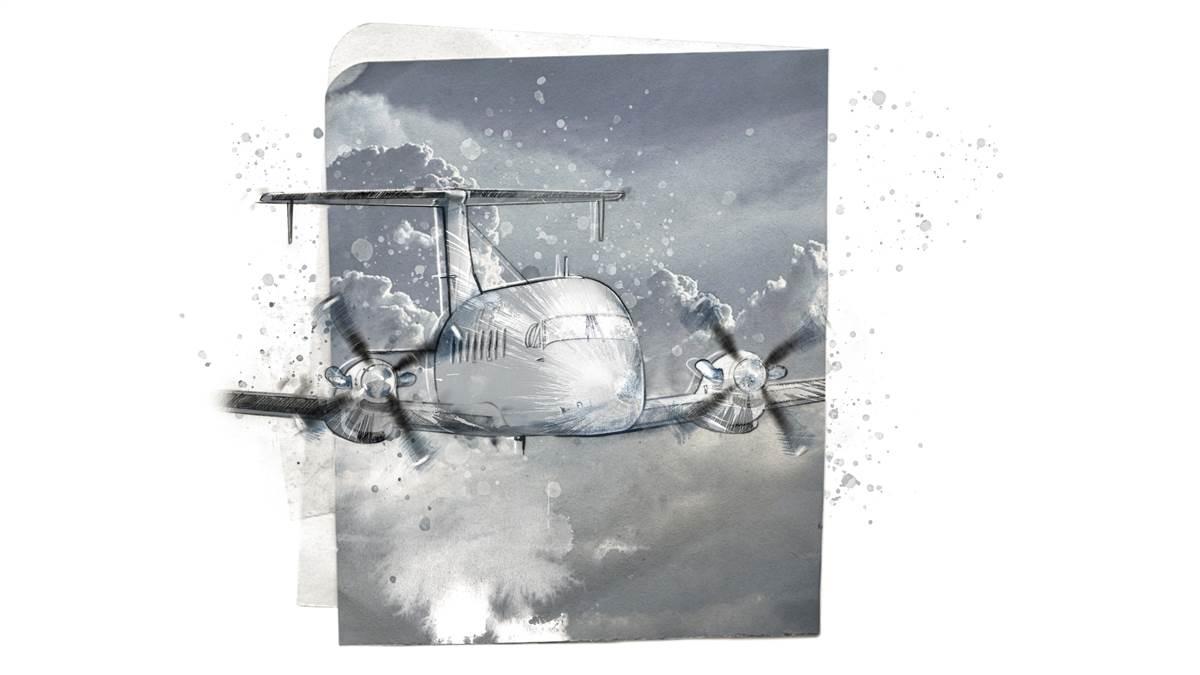
Back in the days when I was young and bold, I was a regional airline captain flying Beechcraft 1900s. Rain, snow, or shine, anytime of day or night, 365 days a year, we were flying the skies over the beautiful and sometimes terrifying, but always enchanting, geography of Alaska. Although I had flown the route many times from Anchorage (ANC) to the Cordova Merle K. “Mudhole” Smith Airport (CKU), one wintertime flight went through the bone-white jaws of death.
It should not come as a surprise that winter flying in Alaska gives a pilot more than a few encounters with airframe icing. IFR flights routinely subject the airplane to freezing temperatures and visible moisture all the way from the ground to the flight levels with no hope of encountering ice-melting temperatures once you leave the warmth of the hangar.
We would often deice the aircraft in Anchorage where the equipment was readily available, but many of the outstations didn’t have the equipment, or if they did, it did not function. So, we learned to deal with it in one way or another. But we were no strangers to ice encounters.
The Beech 1900 is a great performer with capable anti-ice and deice equipment and even when fully loaded, the airplane could be relied upon to get you rapidly through most of the icing layers to the ice-free colder air above in a matter of a couple minutes. Most, but not all the time, and not this time.
In those days, well before GPS, the only approach into “Mudhole” was a nondirectional radio beacon approach requiring dual automatic direction finders that brought you in along the Prince William Sound coast and, when the second ADF needle centered on the inbound course, you’d turn left and track inbound several miles perpendicular to the landing runway.
An imposing Heney Peak, cresting above 2,500 feet, sat menacingly a mere 2.5 miles behind the airport so landing minimums were pretty high and if you were not visual with the airport within about 5 miles, it was a missed approach back out to Prince William Sound. Because of the maritime climate of moist warmer air around Cordova, we almost always got into “Mudhole,” but those same conditions would open Pandora’s Box on this flight out.
We had an on-time 9 a.m. arrival with no appreciable ice on the airframe and what little rime ice we had picked up was easily shed by our equipment before landing. No problems. We loaded up our 19 passengers and picked up our IFR clearance void time and launched. Because of distance and terrain constraints, we would have no radio contact with ATC before reaching our assigned altitude of 14,000 feet.
Immediately as we entered instrument meteorological conditions at about 1,200 feet msl, we started accreting ice. A quick glance at the outside air temperature (OAT) revealed zero degrees Celsius. We were flying through a temperature inversion layer, so the OAT wasn’t dropping as we climbed. It was as if we had penetrated a wall of supercooled liquid drops of freezing rain which coated the windscreen, wings, and airframe.
The anti-ice equipment was already on per our company departure standard operating procedure and still—we were losing the battle to keep the wings and windscreen clear. Power was set for a maximum power climb, right up to the engine limits, which produced a respectable climb performance of 2,500 feet per minute, but that quickly waned. Inside the “milk bottle,” the shocking sound of the propeller blades slinging ice onto the fuselage punctuated the silent stress with ear-splitting bangs. There were no breaks in the clouds, just one continuous column of ice as we struggled onward and upward.
Staring at the vertical speed indicator only seemed to slow it down while the airspeed was deteriorating each second. I was sweating bullets. It was like being in a heavily loaded Cessna 172 on a 90-degree day out of Denver.
At 10,000 feet, showing minus-20 Celsius on the OAT, we were still in the soup but the ice accretion appeared to have slowed. The boots, which had been shedding ice continuously, were in constant operation, but ice had flowed aft onto the wing surfaces so we were carrying a load that could not be shed. We were in an ice cocoon. Power was set and we were at maximum torque and maximum temperature with no more room to move the power levers.
Creeping up to 14,000 feet, the thought occurred to me that if something didn’t change in a minute or two, we’d be descending with no hope of recovery. At that point we were over the rugged, snow-covered Chugach mountains which would swallow us up and we wouldn’t be found until the spring thaw.
Continuing our climb, the windscreen was totally opaque, but we could discern the light changing in the cloud tops indicating that just a few hundred feet more remained and we’d be on top of the ice-ladened clouds.
We broke out into the crystal-clear, blue sky above the killer deck, and even though we were limping along—just barely flying—at least we were in the sunlight and not accreting any more ice. Despite our radio antennas encased in a sheet of ice, we had established scratchy contact with ATC and were being given vectors to the Anchorage ILS Runway 7L with priority handling.
Even though the distance back to ANC was only about 150 nautical miles at this point, it would take us all of about an hour to get on the ILS. All this time we were up against the torque and temperature limits of the airplane, but we were still flying. Once we were established with vectors to final, we did not dare reduce power or set flaps or lower the gear, fearing that even the slightest aerodynamic change might induce a stall from which there would be no recovery.
Thankfully, the weather in Anchorage reported a 500-foot overcast cloud layer and 5-mile visibility with a temperature of minus-10 Celsius. No one was reporting any ice on final. We stayed high for as long as we could to stay out of the soup, so with full power I pointed the nose down slightly to keep the needles centered. When we broke out on short final, we still did not have a clear windscreen but with the runway lights on full we had just enough lateral visibility to stay centered over the asphalt. Over the end of the runway, I called for gear down, got three green, and we touched down almost simultaneously.
Taxiing to our ramp we had been in communication with our dispatch so as we pulled in and shut down, company personnel started to swarm around the airplane which was still blanketed in ice. No one had ever seen so much ice on an airplane. Sometimes it is better to be lucky than good. Remember this: Ice has no respect for pilot proficiency nor aircraft capabilities. There is no such thing as a little ice. 
Joseph C. Baginski has been a certificated pilot since 1966 and is a Wright Brothers Master Pilot Award recipient. He has logged more than 15,000 flight hours and holds ATP, CFI, CFII, MEL, helicopter ATP, and SEL.


