Why aviation needs a 'Top Gun' for mechanics
The system relies on skilled mechanics yet struggles to attract or replace them
The people who fix airplanes are invisible and we're running out of them.

That absence matters more than it sounds. Pilots remain the visible symbol of aviation, but the people who maintain the aircraft are still largely invisible to the public until something goes wrong, when a flight is delayed, or a maintenance issue makes the news. The shortage of airframe and powerplant mechanics has been building for years, described by people in the industry: Older technicians are retiring, younger recruits are not entering the workforce fast enough, and too few people ever consider aircraft maintenance as a viable career path in the first place.
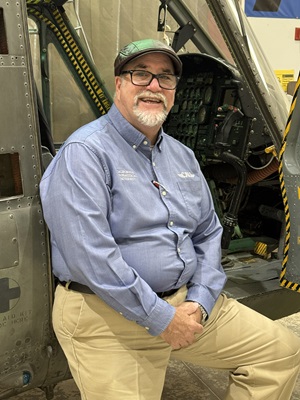
DuRand recalls his entry into aviation back in the U.S. Air Force, where he guarded flight lines and watched Boeing B–52s and KC–135s take off and land through the night. After transitioning to civilian life, he took a shipping and receiving job, but his habit of carefully checking and verifying manifests got him fired for being too slow. "It was one of those scenarios where, unbeknownst to me, I was kind of meticulous about that stuff, and I think that's why aviation worked out well for me." It was during that job that he learned what an A&P was, from a co-worker who was headed off to school, an option he hadn’t previously considered. He was able to use some of his GI Bill benefits to help fund the training. At the time, DuRand had three young children, needed more than minimum wage, and was looking for a stable career rather than just another job.
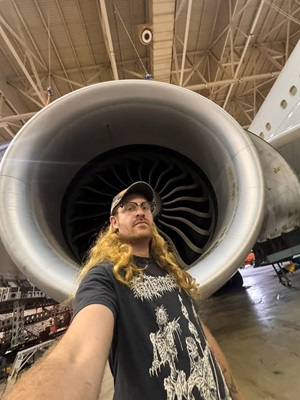
Max Comer, of Airplane Facts with Max, came to aircraft maintenance through a different route, but his reasons were quite similar. At the time, with a one‑year‑old child at home, he needed a career. He had a friend in A&P school and thought aviation maintenance sounded interesting. He wanted a hands‑on job, not a desk job. That was enough to get started. Ten years later, he’s still in the field and working to explain why more people should pay attention to the field.
Both men kept returning to the same point: Mechanics are essential, yet largely unseen. For Comer, that understanding shifted unintentionally after the death of his wife. He began making short videos about aviation maintenance as part of his grieving process. What he did not anticipate was the response. Viewers engaged with the work itself and often shared their own experiences of loss. The videos became a place where the invisible labor of maintenance and grief could be made visible and acknowledged.
Although after 10 years in the industry Comer is still considered the "new guy," his experience points to a broader issue in aviation maintenance: Knowledge is not easily replaced. Experience matters in a way many other industries claim but often do not value. When a technician retires after 30 years and is replaced by someone with a fraction of that time, the gap is not just numerical. It is a loss of accumulated judgement, pattern recognition, and practical understanding that does not live neatly in a manual. Even with more people entering the pipeline, there remains a growing knowledge gap as older mechanics leave faster than that experience can be rebuilt. At the same time, the economy has shifted. What many assume to be a low-paying trade can lead to wages ranging from roughly $28 to over $50 an hour, with some employers offering benefits, education support, and even flight perks. DuRand sees this in his students, who come from a mix of backgrounds, some right out of high school, others transitioning from the oil fields, automotive work, or other trades. An A&P certificate can open doors not just in the airlines but in general aviation, defense contracting, NASA pipelines, amusement parks, industrial systems, and other technical fields.
But the defining feature of the job is not where it can take you. It is the responsibility it demands. Both Comer and Durand hold this principle: If the work is not right the airplane does not go. If a part is wrong, if an O-ring is missing, if there is any doubt, the job is incomplete. They hold firm to that decision despite constant pressure from schedules, operations, and the passengers waiting to leave. DuRand teaches the standard in simple terms: "If you can't put the most important people in your life on that airplane and trust it, then you don't sign it. You get another set of eyes."
The responsibility exists alongside the physical reality of the job, which is often rough, dirty, and unglamorous. Mechanics work with hydraulic fluid that burns, around heavy equipment, at heights, in environments filled with grease and grime—sometimes even troubleshooting toilets. And yet, "there's a satisfaction in it," Comer said, describing the moment you see an airplane you worked on take off and know the job was done right. That sense of purpose is what keeps many in the field, even when the work is demanding. According to the 2026 State of General Aviation Maintenance survey by aircraft maintenance software provider TBX, over 92 percent of maintenance professionals say they're proud of what they do.
The industry often frames the issues as a recruitment problem, but what emerges more is a visibility problem. Aviation is asking people to enter a profession that remains largely unseen, where its importance becomes visible in moments of failure. When nearly half the industry points to staffing and training shortages, it's easy to call it a pipeline problem. But the numbers on the survey suggest something deeper: people aren't rejecting the work; they're never seeing it in the first place.
If more people are going to choose this path, the work must become understood in public culture by highlighting skilled labor performed under real pressure, with real consequences, supported by a community that takes pride in doing things correctly.
DuRand jokes that maintenance doesn’t need an A&P movie but maybe an A&E show, adding that mechanics are funny and hangars are full of characters. The show wouldn’t need to put a wrench into slow motion with heart-pounding music. Although Comer does entertain—sometimes through light tapping of airplane parts on camera—the notion that tension between speed and precision is enough. It would be a place where the truth is told at all costs, and where the mechanic has the final authority to say no. A place where there is meaning in the transfer of knowledge from an old, salty mechanic to a rookie, where skill and pride are deeply tied to safety. Where there is beauty in the systems and in the people who know them intimately.
Related Articles


