More on the backside
The region of reversed command and the law of the roller coaster
I always enjoy letters about my “Flying Smart” articles and “Where’s Your Backside?” (May 2026 AOPA Pilot) elicited several. Two involved notions that deserve more than an individual response. I am summarizing their main points and addressing them here.


Figure 1. Thrust / The lowest curve gives the thrust required to maintain a given airspeed in level flight and is equal to the drag incurred at that airspeed. The speed for minimum required thrust VME is the one that maximizes endurance in a turbojet aircraft.
The maximum climb angle airspeed VX is the one for which excess thrust (available minus required) is greatest. For a propeller-equipped aircraft, available thrust is a decreasing function of velocity and the maximum angle of climb airspeed VXP is found by locating the airspeed for which the slopes of the curves are the same.
In contrast, a jet produces relatively constant thrust across the airspeed spectrum so the slopes of the two curves agree when they are both zero. The maximum climb angle airspeed VXJ is also the speed for which the airplane incurs the least drag. All other factors equal, VXJ is higher than VXP.
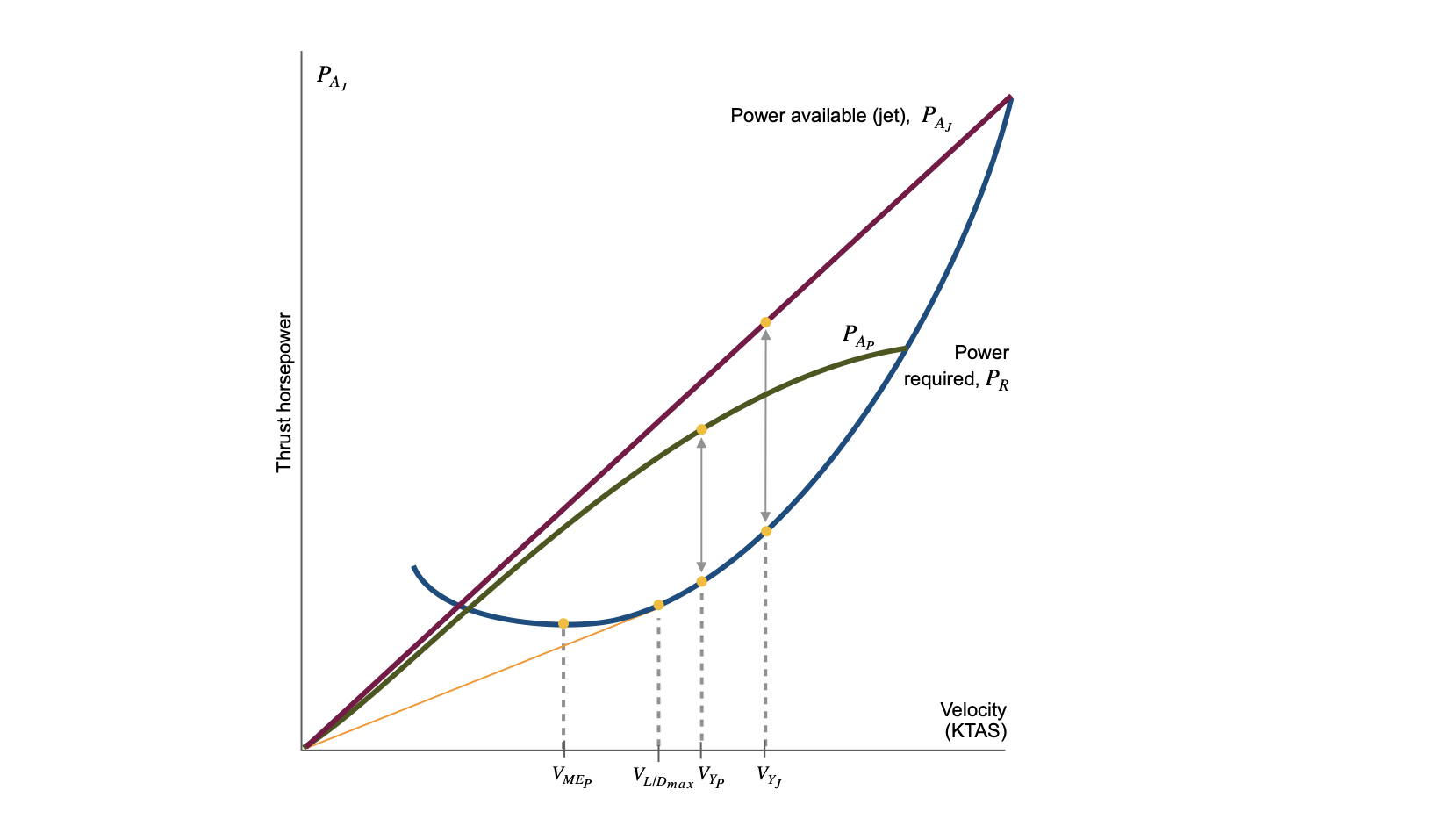
Figure 2. Power / The lowest curve gives the power required to maintain a given airspeed in level flight and the two upper curves show the power available for a propeller-driven airplane PRP = TRP V, and for a jet-equipped aircraft PRJ = TRJ V. The airspeed that minimizes power required is the maximum endurance airspeed VME. In Aerodynamic for Naval Aviators, Hurt specifies VME as the dividing line between airspeed instability (below VME) and airspeed stability (above VME).
Another airspeed that is solely determined by the required curve is the one VR that maximizes range for a flight with calm winds and is also known as VL/Dmax. The airspeed is found by minimizing the power required per unit airspeed, PR/V = TR. Interestingly, for a jet aircraft, this is the same as the best angle of climb airspeed.
The upper curves represent the power available for a jet and propeller-driven aircraft. An aircraft achieves an optimal rate of climb by choosing the airspeed for which excess power (available minus required) is maximized.

Figure 3. Climb rate / These curves show climb rate as a function of airspeed for three power settings: takeoff, cruise, and idle power. Once the throttle has been reduced to idle, the best rate of climb speed becomes the minimum sink airspeed VMS.
When a pilot flies in level cruise flight with airspeed A and wants to correct for an altitude deviation, pulling back on the yoke will cause a climb and pushing forward will make the airplane descend. But at the slower airspeed B, pulling back on the yoke will cause a descent and pushing forward will make the airplane climb so the control effects can be counterintuitive. In this case, the best rate of climb for that power setting determines the threshold between the elevator acting "normally" and "backward."
In “Where’s Your Backside?” I shared that explanations I hear on practical exams about the back side of the power curve, or the region of reversed command, are all over the map. In training, we’re taught that, in this region, pitch should control airspeed and power controls altitude. So, it’s important to know when we’re operating in it. With an informal Google poll, I asked pilots what airspeed formed the dividing line between the front and back sides of the power curve. In the responses, two popular candidate airspeeds emerged. VL/Dmax, the airspeed that maximizes range (in calm winds) in either a power-off or power-on scenario, was the most popular suggestion. Runner-up was the speed that ensures maximum endurance (or time) aloft, VME. H. H. Hurt, in his text Aerodynamics for Naval Aviators, shows that, at airspeeds faster than VME, the airplane will quickly return to a trimmed airspeed upon a disturbance, so the system is stable. Below VME, the aircraft tends to exhibit airspeed instability and reducing airspeed requires an increase in power to sustain flight. This is where the region of reversed command gets its name.
My article posited that, while VL/Dmax is certainly an important airspeed to maximize glide distance upon engine failure, a pilot need not change the way he controls the aircraft below this airspeed. And this is true for propeller-driven aircraft. Reader Bruce Billig astutely offered that “poll responders saying that VL/Dmax is the defining airspeed are not wrong.” While maximum endurance airspeed is found at the lowest point of the power-required curve for propeller-driven aircraft, for jets, that happens at the lowest point of the thrust-required curve. “Those poll responders who voted for VL/Dmax may be flying jets.”
In Aerodynamics for Naval Aviators, Hurt explains that fuel flow for a turbojet-powered airplane is proportional to thrust required, so VME is found at the low point of the thrust required curve in Figure 1. The construction in Figure 2 shows that this is the same value as VL/Dmax. Interestingly, because the thrust available curve in Figure 1 is constant, these special airspeeds happen to coincide with the maximum angle of climb airspeed VX for a jet aircraft.
“Where’s Your Backside?” made a case for considering the dividing line between the front and back of the power curve as best rate of climb airspeed, VY. For any fixed power setting, there is a corresponding vertical speed versus airspeed graph and the highest point on the curve represents the associated maximum rate of climb airspeed (see Figure 3). Flying above this airspeed, say in cruise flight, if the pilot pulls back on the yoke the airplane will ascend. But the same motion flying below the maximum rate of climb airspeed will make the aircraft descend. VY is a compelling candidate for defining the two sides of the power curve. Warren Webb Jr. disagreed in his message: “Well, I’m afraid that’s disproved thousands of times every day when pilots pull back on the yoke to flare, which transitions the line of flight upward from the glideslope, not downward. And that proves the airplane’s reaction to forward or back pressure is the same in either region of command.”
Figure 3 plainly shows that the elevator acts differently on either side of best rate of climb airspeed but pulling back on the yoke correctly in the flare can result in a soft landing on the runway. So, what gives? The answer lies in considering both short- and long-term effects of elevator deflections.
As discussed in “Pitch and Power” (August 2023 AOPA Pilot), an aircraft flies with an amount of mechanical energy that is the sum of kinetic energy (airspeed) and potential energy (altitude). The engine turns fuel into chemical power (energy per unit time) and drag power is the inevitable and constant loss of energy due to drag. The pilot controls chemical power with the throttle and can increase drag power by extending flaps, flattening the prop pitch, or flying uncoordinated. For most phases of flight, of course, he seeks to minimize drag power. The pilot uses the elevator to distribute net power (chemical minus drag) into (or from, in case of a deficit) the airspeed or altitude repository. Wolfgang Langewiesche explains in his classic Stick and Rudder the “law of the roller coaster:” If mechanical energy remains constant, the elevator allows airspeed to be traded for altitude and back again.
In the flare, we can assume that the pilot has reduced the throttle to idle. By pulling back on the yoke, he will take energy from the airspeed repository to offset the increase in drag; done properly the altitude will remain relatively constant. In his excellent online text, See How It Flies, author John Denker explains that this effect is governed by the law of the roller coaster. If the same maneuver were performed at altitude, the aircraft would initially remain level but ultimately descend at a rapid rate. For short-term elevator effects like the flare, look to the law of the roller coaster; long-term effects are explained by the power curve (Figure 3). For long-term effects, pulling back on the yoke below maximum rate of climb airspeed will indeed make the aircraft descend. It remains a worthy contender for defining the sides of the power curve.
One of my joys is exploring and understanding the science of flight and I appreciate all the questions, suggestions, challenges, and ideas that readers share with me. Please keep them coming!
Catherine Cavagnaro teaches aerobatics at UOS and is the Gaston Swindell Bruton Professor of Mathematics at Sewanee: The University of the South.
Related Articles


