Vision test
Visual approaches are more than meets the eye
By Bruce Williams
In routine Part 91 personal flying, the most common type of instrument approach we fly—the visual approach—is rarely practiced during initial or recurrent IFR training.
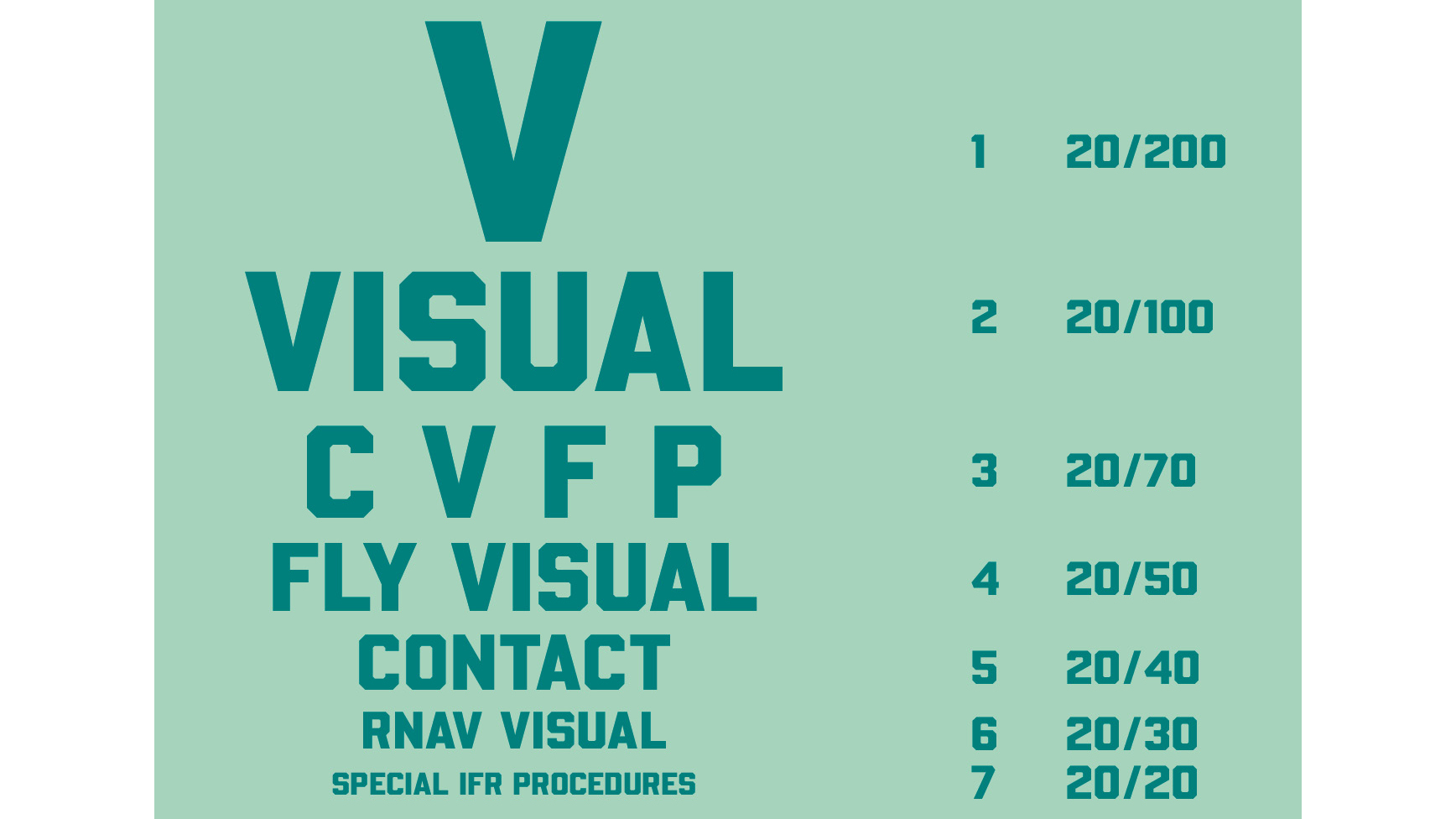
Even when we mingle with clouds, often we land after breaking out in at least basic VFR minimums, having flown much of an approach visually. But that common experience may mean that you’ve overlooked the various types of visual approaches, including apparently standard IFR procedures that, on close inspection, include visual elements.
Let’s start with the familiar, basic visual approach described in Aeronautical Information Manual 5-4-23, available when the reported weather at the airport has a ceiling at or above 1,000 feet and visibility of at least 3 miles. When visual approaches are in use, ATC guides you toward the airport and clears you for a visual approach after you report either the airport or traffic to follow in sight, and if visually following preceding traffic, the pilot accepts responsibility for maintaining separation and wake turbulence. A clearance for a visual approach may include limitations, such as “join final at or above 1,500,” or “turn a two-mile final,” but otherwise the vertical and horizontal paths you fly are up to you. You must remain clear of clouds, but you generally don’t have to meet the cloud clearance requirements of FAR 91.155. If a control tower is operating, ATC clears you for a visual approach to a specific runway; otherwise, the clearance is to the airport. (And you must remember to cancel IFR if you’re landing at a nontowered airport. See “Cancel with Care,” June 2025 AOPA Pilot). Remember also that a visual approach is not an instrument approach procedure and does not count for instrument currency purposes under FAR 61.57(c). It does not include a missed approach segment, and if you can’t land, you must get instructions from the tower who may instruct you to join a standard traffic pattern.
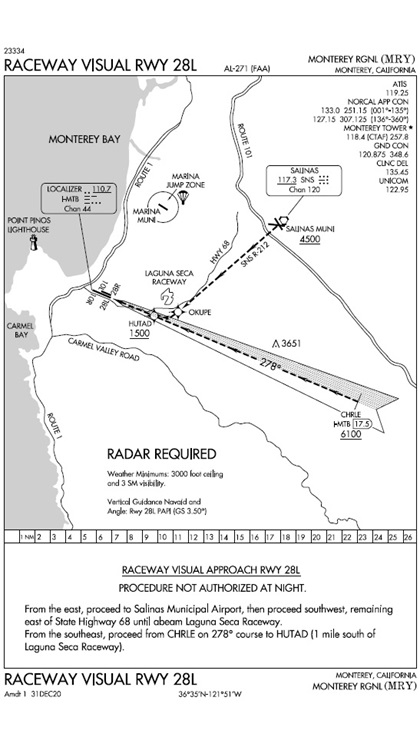
In crowded airspace and areas where noise-abatement is important, you may encounter a charted visual flight procedure (CVFP), explained in AIM 5-4-24. An example is the Raceway Visual Runway 28L at Monterey, California (MRY). A CVFP, published only for an airport with an operating control tower and designed for use primarily by turbojet aircraft, defines specific flight paths and altitudes for you to fly, so you have less freedom to maneuver than when flying a uncharted visual approach, and ATC can better predict how you’ll get to the runway. To enforce consistency, CVFPs, while still visual approaches, are published on charts that look like conventional approach plates, which include specific weather minimums based on minimum vectoring altitudes. CVFP charts show navaids and landmarks that ATC may include in your clearance. In fact, to fly a CVFP, you must report having a charted landmark or preceding aircraft in sight. As when flying a basic visual approach, you’re responsible for avoiding clouds and wake turbulence if visually following traffic.
Garmin, in conjunction with Hughes Aerospace, has started publishing Guided Visual Approaches, a variation on CVFP, to runways in “challenging airport environments, including those with terrain and obstacles nearby.” Examples include the RNAV G Runway 30L at North Las Vegas (VGT) and the RNAV G Runway 29 at Hanscom Field (BED) near Boston. These procedures have the letter “G” in the title, and like CVFP, are designed to make visual approaches more consistent (see “The Dreaded Visual Approach,” May 2025 AOPA Pilot).
These procedures often require the ability to fly curved radius-to-fix legs, a feature now available in most Garmin GTN and later navigators, but they’re not authorization-required approaches. So far, Garmin has published some 31 Guided Visual Approaches. You can add these procedures to your database subscription; read more about them on the Garmin website.
The often-misunderstood contact approach, described in AIM 5-4-25, is another variety of a visual approach. Unlike a basic visual approach, however, you must specifically request a contact approach. ATC can’t even suggest this option. To ask for a contact approach, you must be flying to an airport with a published instrument approach, be clear of clouds, have at least 1 statute mile flight visibility, and “reasonably expect to continue to the destination airport in those conditions.” But you don’t have to see the destination airport, and ATC won’t clear you to follow a preceding aircraft. Because ATC can’t anticipate the path you’ll fly to the runway, don’t expect a controller to approve a contact approach in crowded airspace.
Some pilots try to use a contact approach to get below the clouds and then continue to another airport, often one that doesn’t have an IFR approach. But the AIM notes that a contact approach “[Is] not intended for use by a pilot on an IFR flight clearance to operate to an airport not having a published and functioning IAP. Nor is it intended for an aircraft to conduct an instrument approach to one airport and then, when ‘in the clear,’ discontinue that approach and proceed to another airport.”
AIM paragraph 5-4-5 and the Pilot/Controller Glossary describe yet another variation on the theme of visual approaches—the “fly visual to airport” or “fly visual” segment of an otherwise conventional instrument procedure.
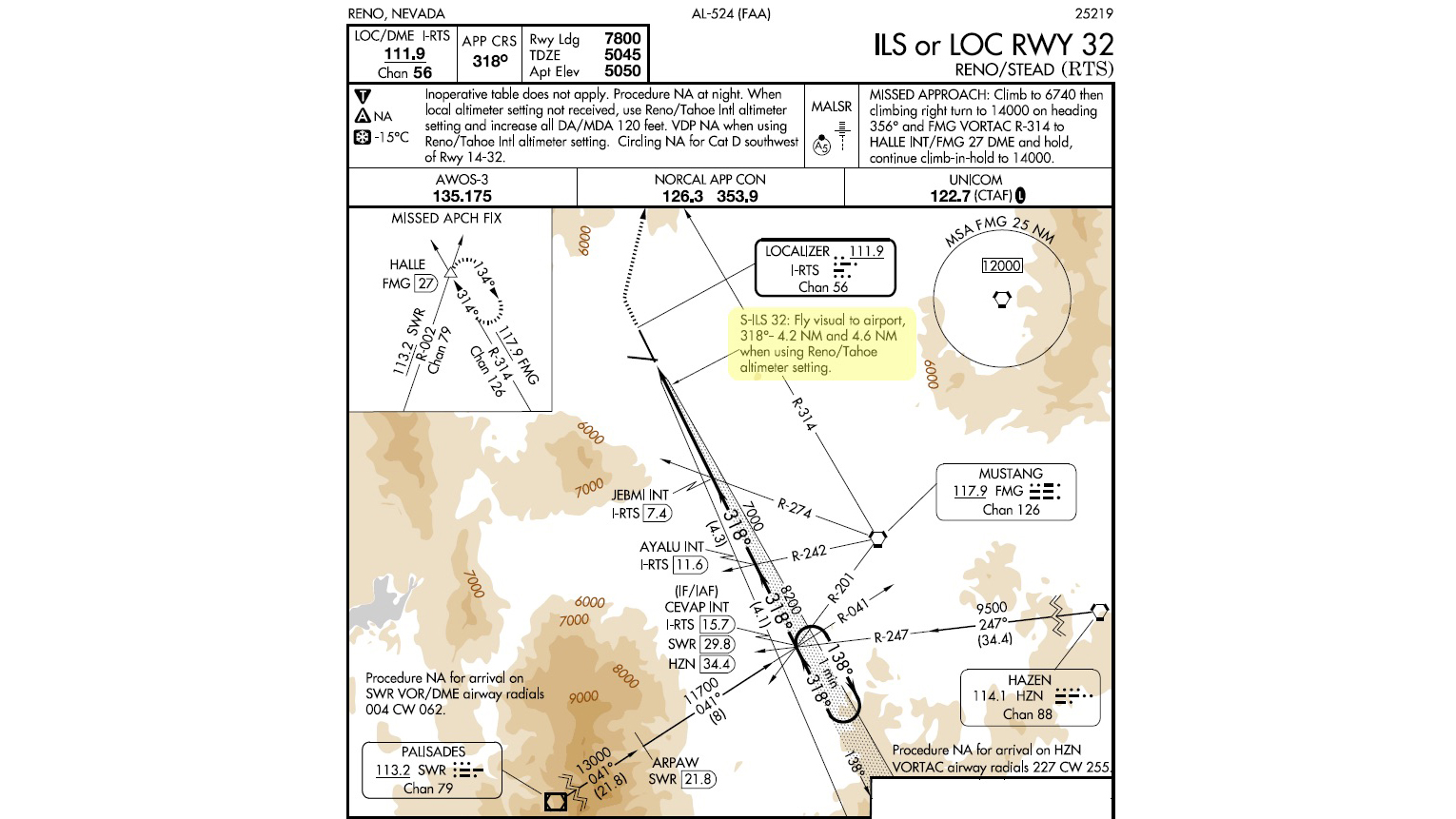
Consider the ILS or LOC Runway 32 at the Reno/Stead Airport (RTS) in Nevada. The visibility requirement is 3 sm, but if you’re on the glideslope, you reach the decision altitude 4.2 nm from the threshold. The “fly visual” provision allows you to continue toward the runway if you have at least the charted 3-sm minimum flight visibility, remain clear of clouds, and maintain visual contact with the ground. As the Pilot/Controller Glossary explains, “The visual segment should be flown with flight instrumentation…and/or pilotage or dead reckoning navigation techniques while maintaining visual conditions.” A dashed arrow shows the visual flight path to follow, “but altitude on the visual flight path is at the discretion of the pilot…[and] it is the responsibility of the pilot to visually acquire and avoid obstacles.” In other words, a fly visual segment is essentially a contact approach tacked on to a normal approach. Note also that “Missed approach obstacle clearance is assured only if the missed approach is commenced at or above the MDA/DA and flown from the published MAP.”
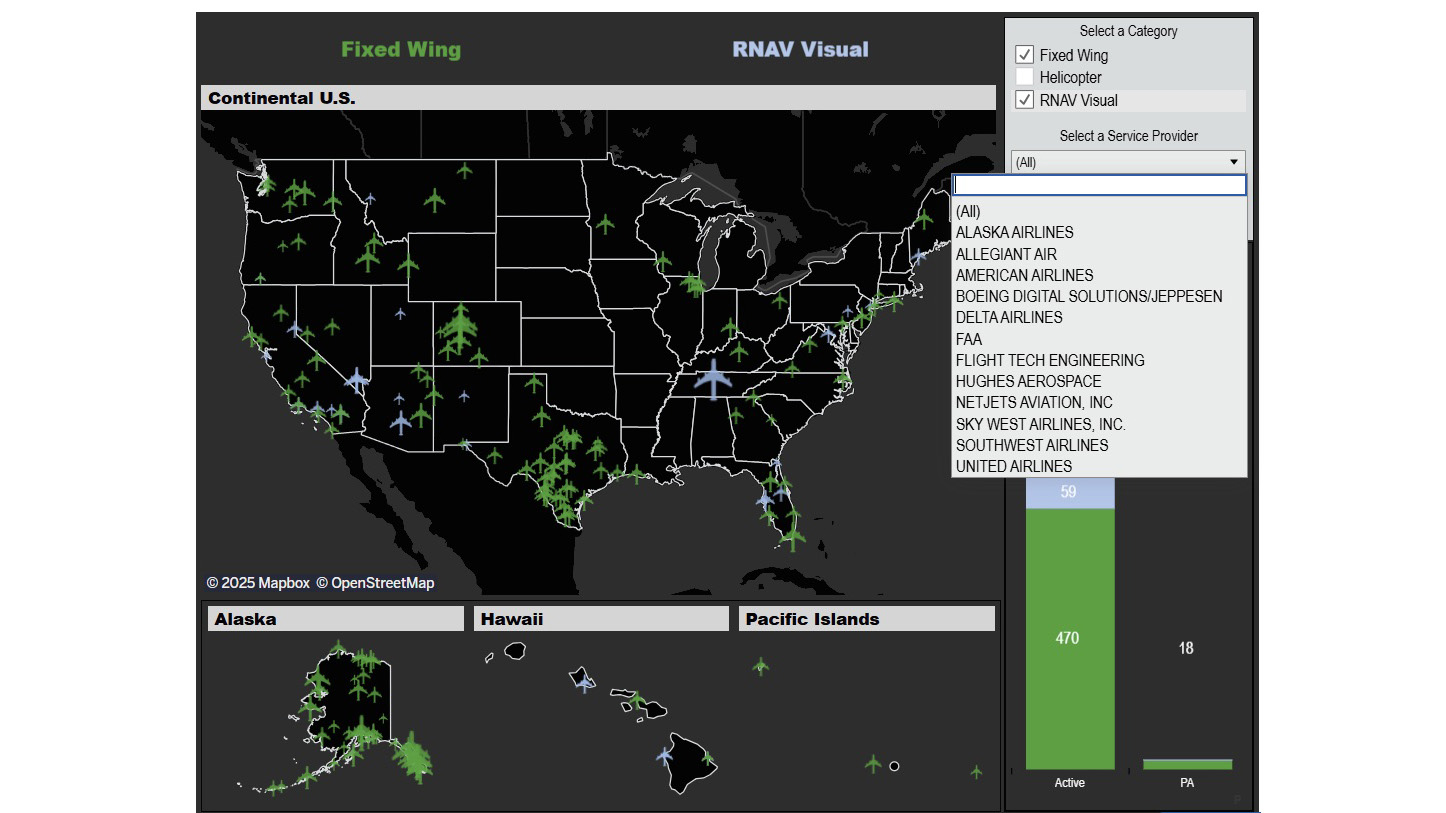
You should also be aware of visual approaches that you’re probably not authorized to fly. For example, you may see an RNAV Visual Flight Procedure (RVFP) in your GPS database. An RVFP is a special visual flight procedure (see AIM 5-4-8) that isn’t published for general use, and the charts for RVFP are issued only to operators authorized to fly them. So even if you can “see” the procedure, don’t try to fly it without approval. 
Bruce Williams is a CFII and specializes in IFR training and instruction in aircraft with advanced avionics. He owns an Extra 300L.
 youtube.com/@BruceAirFlying

