Savvy savings
The impact of reliability-centered maintenance
In past columns, I’ve written at length about why doing less maintenance and doing it strictly on-condition instead of on a fixed timetable improves safety and reliability by reducing the incidence of maintenance-induced failures (see “Quantifying Maintenance Risk,” November 2025 AOPA Pilot).
But what about the impact on maintenance expense? How much cost does this approach to maintenance really save? This is challenging to quantify. It’s easy to keep track of how much money an aircraft owner spends on maintenance—you just look at their maintenance invoices. But figuring out how much money the owner did not spend is harder.
So, early last year, I asked Savvy’s software engineering team to add a new feature to our ticket system that would enable our dozens of veteran A&P/IA account managers to log cost-saving events as they occurred throughout the year. This new facility went online in February 2025, but it took a few months of poking and cajoling to persuade the account managers to actually start using it. Frankly, we’ve still not convinced them all yet.
We instructed them not to bother logging the nickel-and-dime stuff but encouraged them to track events where Savvy’s recommendations demonstrably saved the client at least a few hundred bucks. Over the next six months, the managers logged hundreds of such cost-saving events. The analysis involved about 1,000 clients. Of those clients, about 100 of them saved $2,000 or more.
When I totaled the logged events involving savings of $2,000 or more, the result was an astonishing $750,000. Due to the slow adoption of logging cost savings by the managers, I’d guess that this represents only about half the actual cost savings. And since these events occurred during the six-month period from February through August of 2025, annualized cost savings could easily have been $3 million. As you might imagine, this put a big smile on my face.
During 2026, as this logging of cost savings becomes part of my team’s muscle memory, we should start getting a more complete picture of how much money our Savvy maintenance philosophy is saving. But the preliminary results of the first six months of tracking cost savings offer some interesting insights.

Cost-savings breakdown
These cost savings were accomplished in several different ways (see Figure 1), but nearly half (47 percent) came simply by saying “no” to maintenance that the shop recommended but we considered unnecessary. A lot of these were tasks that were “due” according to the manufacturer’s maintenance schedule but were not demonstrably necessary to make the aircraft safe, reliable, and legal.
Every aircraft maintenance manual contains long lists of maintenance tasks that are “due” every 100 hours, every 12 months, every five years, and so on. My Cessna 310 service manual has more than 250 of these scheduled items. FAA regulations do not require owners to comply with most of these, and we say “no” to the lion’s share of them. We prefer to do these tasks only when demonstrably necessary based on inspection results—in other words, “on-condition.”
Another 26 percent of the savings were attributed to improved diagnostic accuracy. These are typically cases where the shop misdiagnosed a problem and recommended an inappropriate solution that wouldn’t have resolved the issue. Savvy is obsessive about data-driven evidence-based diagnosis. We analyze engine monitor data and borescope images and interpret laboratory oil reports and scanning electron microscope analysis of oil filter contents. We require an accurate diagnosis before authorizing any repair or replacement. There’s too much shotgunning and overkill in general aviation maintenance, and we push back hard to prevent this.
An additional 13 percent of the savings came from sourcing replacement parts from lower-cost suppliers. This includes using PMA parts instead of OEM parts, maximizing discounts, and using serviceable salvage yard parts where appropriate. Yet another 11 percent of the savings came from reduced labor costs, usually achieved by recommending more efficient and less invasive methods.

The art of saying ‘no’
Figure 2 shows the savings achieved by saying “no” to various kinds of “due” maintenance tasks that manufacturers recommend doing on a fixed timetable, but we prefer to perform strictly on-condition. The largest share of such savings—23 percent—came from saying “no” to propeller and prop governor overhauls. Such overhauls are pretty expensive.
A typical recommended TBO for a Hartzell propeller is every 2,400 hours or six years, whichever comes first. Since not many owner-flown airplanes fly more than 400 hours per year, the six years almost always come first. So, why does Hartzell want your propeller to be sent to a prop shop and torn down every six years? It’s because they’re concerned about corrosion and deterioration—particularly inside the hub where your IA can’t see it. Corrosion and deterioration generally run with calendar time, as opposed to wear that generally runs with hours in service.
Is six years an appropriate interval to do this? Well, it might be—for an airplane that is tied down outdoors in Tampa and flown irregularly. But it’s gross overkill for an airplane that’s hangared in Tucson, Denver, or Missoula and flies every week or two. Since most of our clients’ airplanes are at far less risk of corrosion and deterioration than the worst-case airplane tied down outdoors in Tampa, we will typically say “no” when a shop recommends a prop overhaul because it’s been six years since the last one.
Other things we say “no” to that save lots of money include fuel nozzle cleaning (17 percent; this does more harm than good in our experience), engine maintenance based on oil analysis (14 percent; we don’t get excited until we see three consecutive oil reports that are bad), and cylinder work based on poor compression readings (13 percent; we always insist on a re-test after flying the engine for an hour or so).
Saying “no” to unnecessary maintenance not only reduces maintenance costs substantially, but it also makes shops and mechanics more productive—something that is crucial given the current acute mechanic shortage in GA.

Base hits and home runs
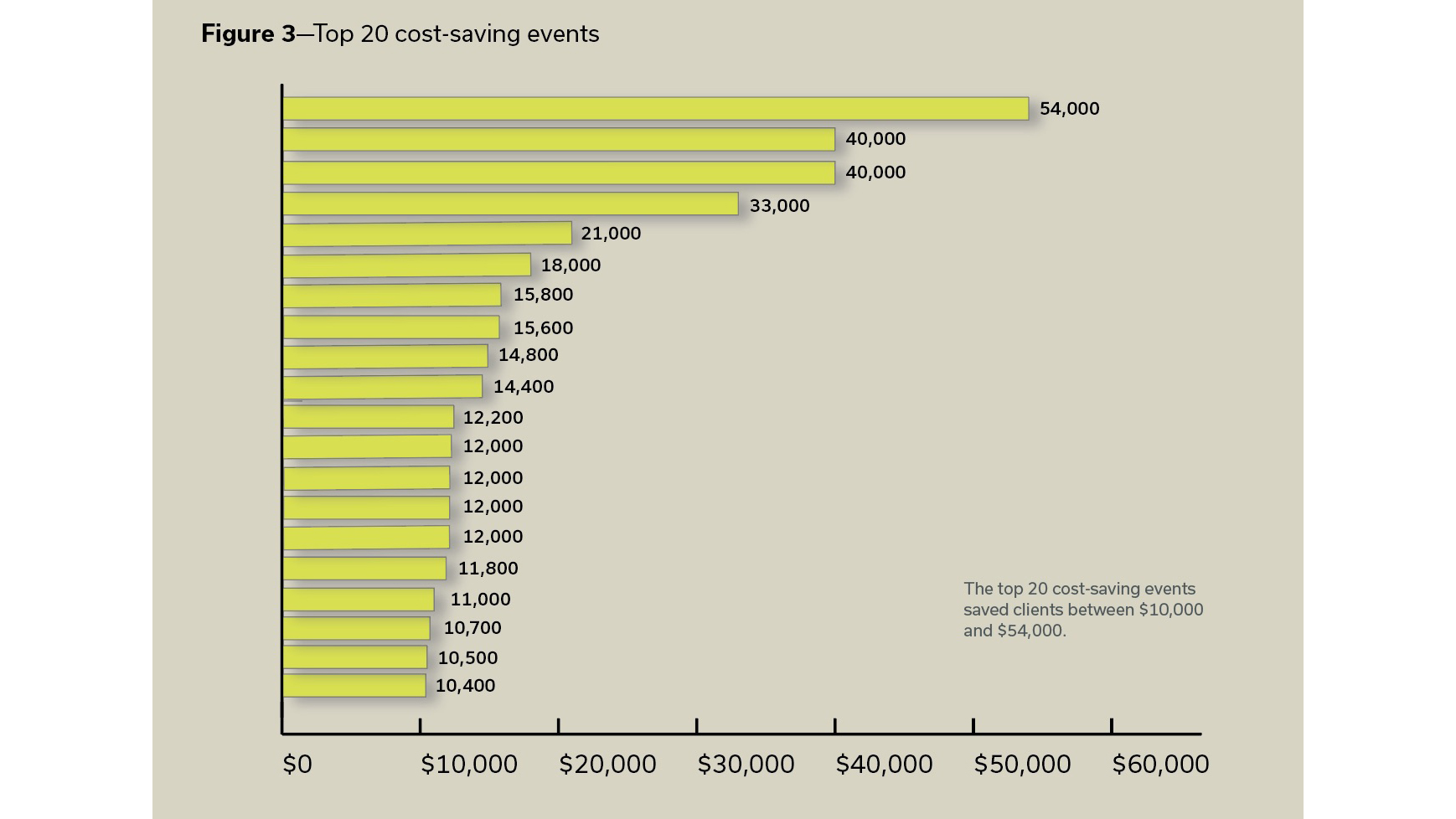
Most of the logged cost-savings events involved savings of less than $10,000, with the most common being in the $2,500 to $5,000 range (see Figure 3). But about 20 percent of the events were home runs that saved the client between $10,000 and more than $50,000. Figure 4 depicts the top 20 such events.
Several of these involved Continental engines where the shop found significant ferrous metal in the oil filter and reported that “the engine was shot” (typically concluding that the camshaft was coming apart) and the engine would need to be replaced or major overhauled. We had the shop remove the lifters—typically at least a few of them were seriously spalled—and inspect the cam through the vacant lifter bores. We determined that the cam lobes were still airworthy per the criteria of Continental SID 05-1B—in one case, we had some lobes polished with crocus cloth—and that the engine only required new lifters, thereby eliminating engine removal and teardown.
We also averted several Lycoming teardowns by insisting that the shop follow the guidance in Lycoming Service Bulletin 480F, which provides a thoughtful and measured approach to dealing with metal in the oil filter. This service bulletin is the best antidote we know of to deal with the typical knee-jerk reaction many A&Ps have when they find appreciable metal in the filter. In fact, it’s such good guidance that we try hard to persuade shops to follow it even for Continental engines, since Continental provides no comparable guidance.
So far as I’m aware, this is the first time anyone has attempted to measure the cost-savings potential of modern reliability-centered maintenance for piston GA. These are very preliminary results, but I find them quite instructive. By the end of 2026, we should have a lot more cost-savings data, and I’ll be sharing the results with the community of GA owners and mechanics. Stay tuned. 
 savvyaviation.com
Mike Busch, Paul New, and Colleen Sterling answer your toughest aviation maintenance questions on our Ask the A&Ps podcast. Submit questions to [email protected]
 aopa.org/ask-the-a-and-ps