'Necessary Turbulence,' necessary flight
Retired Air Force pilot tells stories of resistance
Before retired U.S. Air Force Lt. Col. Eileen Isola could help tell the stories of 108 Air Force Academy women in Necessary Turbulence: Fifty Years, One Unbreakable Sisterhood Forged in the Crucible of the Air Force Academy, she had to write her own comeback story, one that began not in a military aircraft, but in a rented Cessna 172.


"I never wondered what I was going to be when I grew up," Isola said. "I just always knew I was going to be a pilot." Isola's father was a U.S. Marine turned international airline pilot, and by the time she was 5 years old, she was sitting on the front lawn perusing his flight manuals. By age 17, she had secured admission into the Air Force Academy, despite a guidance counselor telling her that girls didn't do that. Isola ignored that advice, earned her congressional nomination, and got accepted. After graduating, she went straight into Air Force pilot training.
After retiring from the Air Force and subsequent work with a Fortune 200 company, Isola was diagnosed with breast cancer. The mastectomy went as well as it could; the reconstruction led to six additional surgeries and left her physically disabled. "When I first came out of a lengthy hospital stay, I couldn't even put on my own socks," she said. "If I went to the mailbox and got the mail, that was my one thing for the day. If I took a shower and washed my hair, that was it. Nothing else was getting done." She had gone from commanding high-performance aircraft to being unable to lift her right arm. She was certain she would never fly again.
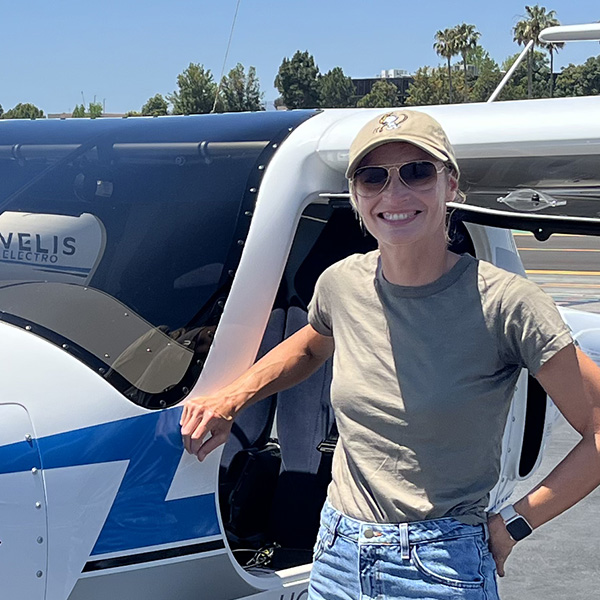
Getting back to being a pilot in command took five years. And it required something Isola had never done before—entering the general aviation world as a student.
GA was an entirely different domain than the military. She didn't know what an FBO was and never dealt with a FAR/AIM. But she figured it all out and brought her Air Force flight records to the Flight Standards District Office and later received her FAA pilot and instructor certificates.
Isola lurked on aviation forums, dove into the AOPA website, completed AOPA's Rusty Pilots course, joined The Ninety-Nines, and connected with the North Texas Aviators Facebook group. She absorbed as much as she could, especially anything that was free since her income was limited to her military pension.
Eventually she walked into a FAR Part 61 flight school, owned by a Vietnam veteran and Air Force Academy graduate. He threw her into a Cessna 310, swapping seats mid-flight to see how she instructed. "He didn't ease me in. He threw me right into the deep end," she said laughing.
With her first class medical restored and her certificates in hand, Isola needed one more thing: recency. She had thousands of hours of military time in turbine aircraft, but the airlines wanted to see current hours in the logbook. Whenever she could, she rented small piston aircraft like a Piper PA-28 Cherokee or Cessna 182 to fly Angel Flight South Central missions: transporting patients, most of them headed to MD Anderson Cancer Center in Houston, across a sprawling territory that stretched from Arkansas to El Paso, Texas and back to Louisiana. "I was droning along in a little 182 in the hot Texas summer, landing at airports I've never been to in a small airplane. Figuring out how GA really works."
Then Hurricane Harvey hit in the summer of 2017, followed closely by Hurricane Irma. Entire communities along the Texas Gulf Coast were inaccessible by road, but GA airplanes could still reach them. Through Operation Airdrop, Isola joined other GA pilots flying relief supplies into flooded towns, landing where sometimes only the runway and taxiway were above water.
Between Angel Flight missions and the hurricane relief efforts, she built the recency she needed. And within it she also built a deep, lasting respect for the GA community she had only just discovered. "I came through this very singular little tunnel as a military pilot," she said. "I didn't know anything about the vastness of the rest of the aviation world. And then all of a sudden, I was immersed in it, the Part 61 schools, the 141 programs, the FBOs, the Angel Flight community, the volunteer pilot networks. All of it. And I came out the other side as a better pilot than I had ever been."
Her advice to any pilot, whether chasing a private or Airline Transport Pilot certificate, is simple: "You have to be all in. Flying isn't just a certificate. It's currency, proficiency, medicals, all of it. It's a way of life. And if you really want it you have to treat it that way."
Isola eventually got hired. She flew a Boeing 767 in the Part 121 world, logging hours across the Atlantic while also quietly sitting in the galley on layovers, on a Bluetooth keyboard connected to an iPad, co-writing a book.
Necessary Turbulence: Fifty Years, One Unbreakable Sisterhood Forged in the Crucible of the Air Force Academy chronicles the experiences of 108 women connected to the Air Force Academy across its first 50 years of admitting women. Isola led the nine-person writing team, spread across 10 time zones from Germany to the U.S. West Coast, over three years of work conducted almost entirely over Zoom and Google Drive.
The raw material they worked from was staggering: 560,380 words of 108 written submissions and oral interviews. What emerged wasn't an anthology of individual stories, but formed into a single collective narrative, told in a "we" voice that speaks for all women who entered the Air Force Academy—even present day.
"It's the story of women finding their way through systems and places that were never designed for them. Without precedent. Without a template. And typically, with little to no margin for error. That's a universal story for women everywhere," Isola said.
Contributors range from the first women to enter in 1976 to a class of 2026 graduate. It includes corporate CEOs and four-star generals, first-generation Americans and women who were the first in their family to earn a college degree, and who chose the Air Force Academy as the place to do it.
There is one story that follows an early Delta Air Lines hire who, despite flying Boeing KC-135 Stratotanker and holding an ATP certificate, was required to complete a strength and reach test before her simulator profile, because Delta needed to know if a woman could physically operate the aircraft. She had already flown combat missions, but the test went ahead regardless. "There are plenty of other flying stories in there from our other women pilots. And they matter, because they're part of the larger story of how these women changed our country, and made our military far more combat capable," Isola noted.
Isola is now finishing her own memoir, a project she set aside when Necessary Turbulence took over. The 108 women, the nine teammates, the three years of holding their stories with care, all of it changed her. "I live with intention. I find a way to yes, and when the universe is telling you this isn't the direction you're meant to go, you let go, you turn and suddenly all the yeses start happening," Isola reflected with a pause. "That's when you know you were always meant to go this way."
Necessary Turbulence: Fifty Years, One Unbreakable Sisterhood Forged in the Crucible of the Air Force Academy is available for purchase at necessaryturbulence.com.
Related Articles


