Silver Wiiings: The Flying Bulls DC-6 returns to the US
Every year at EAA AirVenture Oshkosh in Wisconsin, there’s an aircraft that captures the hearts of the crowd. The show hasn’t even started, but one of this year’s stars will certainly be the Flying Bulls' Douglas DC–6.

This stunning 1958 aircraft, built in Santa Monica, California, has been lovingly restored and before its journey to AirVenture is making a short North American tour. First stop—Westchester County Airport in White Plains, New York, just a short hop away from New York City.
Of the crossing, Amdal says, “It's really cool in hindsight, but you know when you’re in it it’s quite intense.”
“As you know, these were flying guns,” he continues. “And, you know, redundancy is not a priority at the time. But it's an amazing journey. But everyone that's flown across the Atlantic in a smaller aircraft knows that there is a certain amount of mental stress around it in case…” he trails off, the implication of emergency-related anxiety during ocean crossings clear.
“But it helps if it's overcast because then you can't see the water. The engines don’t know,” he says with a smile.
The P–38 is resting in a hangar, but the DC–6 is ready to go. We’re some of the lucky few who get a ride on the very first passenger flight in the United States, and the day, from start to finish, is overwhelmingly memorable.
After LARPing as the cast of Succession on a Blade helicopter transfer from Manhattan to Westchester, video producer Michelle Walker and I, along with a handful of other invitees, touch down on the ramp at Million Air White Plains. And there it is, in all its polished, vintage glory, tall and proud and beautiful, with those classic Douglas lines and familiar shape, but larger than life with four Pratt & Whitney engines and Red Bull branding. The ramp appeal is astounding. Beyond the airport fence, someone has hopped out of their car to take a photo from a distance.
This DC–6 has lived a full and varied life already, first as part of the Yugoslavian airline Jat Airways fleet, and then transporting former President of the Socialist Federal Republic of Yugoslavia Josip Tito for official travel before moving to Zambia as a luxury aircraft for the nation’s head of state. But then it was abandoned and “nearly forgotten.”
Chris Schutte, who built an airline in Namibia, rediscovered the aircraft and began a restoration. In March 2020, the Flying Bulls’ chief pilot, Sigi Angerer, saw it for sale in an African aviation magazine, bought it, and with a ferry permit and many stops, brought it to Salzburg, where the second restoration began.
Three years later (which really isn’t that long for a full restoration of such a large and complex vintage aircraft), the DC–6 was airworthy once more, and fitted with a new interior and upgraded technology.
“It's largely stock in the cockpit, but we have a backup of two GTN 750s and also modern radios for 833 channel separation. Max takeoff over 103,000 pounds,” says Amdal. “So yeah, it's a big lady and but she was meant to travel and that’s what she’s doing now.”
And now the DC–6 is back in the United States for the first time in 68 years, and ready to do what it was born to do—fly.


Walker and I head from the ramp to the FBO, where refrigerators full of Red Bull, tables, and bars invite visitors to drink their fill of the lightly carbonated, serve-chilled energy drink. Display cases host a variety of athlete helmets. A wingsuit on a dummy waits next to a Red Bull Formula 1 car that somehow is sitting in the FBO’s atrium. It’s smaller than they look on television.
After check-in we get boarding passes (which we do actually need as proof that we signed Red Bull’s waiver) for the very first North American passenger flight and attend a safety briefing from captain Julian Firth. Pilot Lukas Költringer will be the co-pilot, with Martin Lösch as flight engineer. The three-person crew is essential for this “very manual airplane,” says Amdal.
Most of the folks who will be on board are non-frequent fliers, and the team briefs the sights and sounds (and smells) of the Pratt & Whitney 2800 CB-3 2,000-horsepower engines start and runup before we follow the two flight attendants outside and head up the airstairs to board.
The cabin is spacious and plush, with a half-moon couch aft covered in fabric filched from the 1970s, clusters of two and four blue leather seats throughout, plus a bar and a couch across from each other left of the door toward the front of the airplane. The deep blue carpet throughout feels thick enough to sleep on. A coat closet and lavatory separate the forward cluster of seats from the majority of the cabin, where a sun and bulls logo is embossed on a desk, above which the vintage sextant rests. The best seats in the house are, of course, on the flight deck.
After a brief from flight attendants Annette Mösl and Julia Steinache (it is a vintage airliner after all) and a look at the safety cards for our Douglas DC–6, it is time to start the engines, and each is smooth, steady, and mostly smoke free. The flight attendants pass out Flying Bulls-branded fans as we taxi. There are vents on board, but the airflow can’t quite keep up with the oppressive New York heat and humidity.
On takeoff, the engines roar loud enough to silence conversation and concentrate all focus on the magic of flight. How amazing, to fly in aviation’s Golden Age. The time machine is smooth, our departure from the earth discernable with visual confirmation only, not feel. After our initial climb the engines power back and conversation is once again possible.
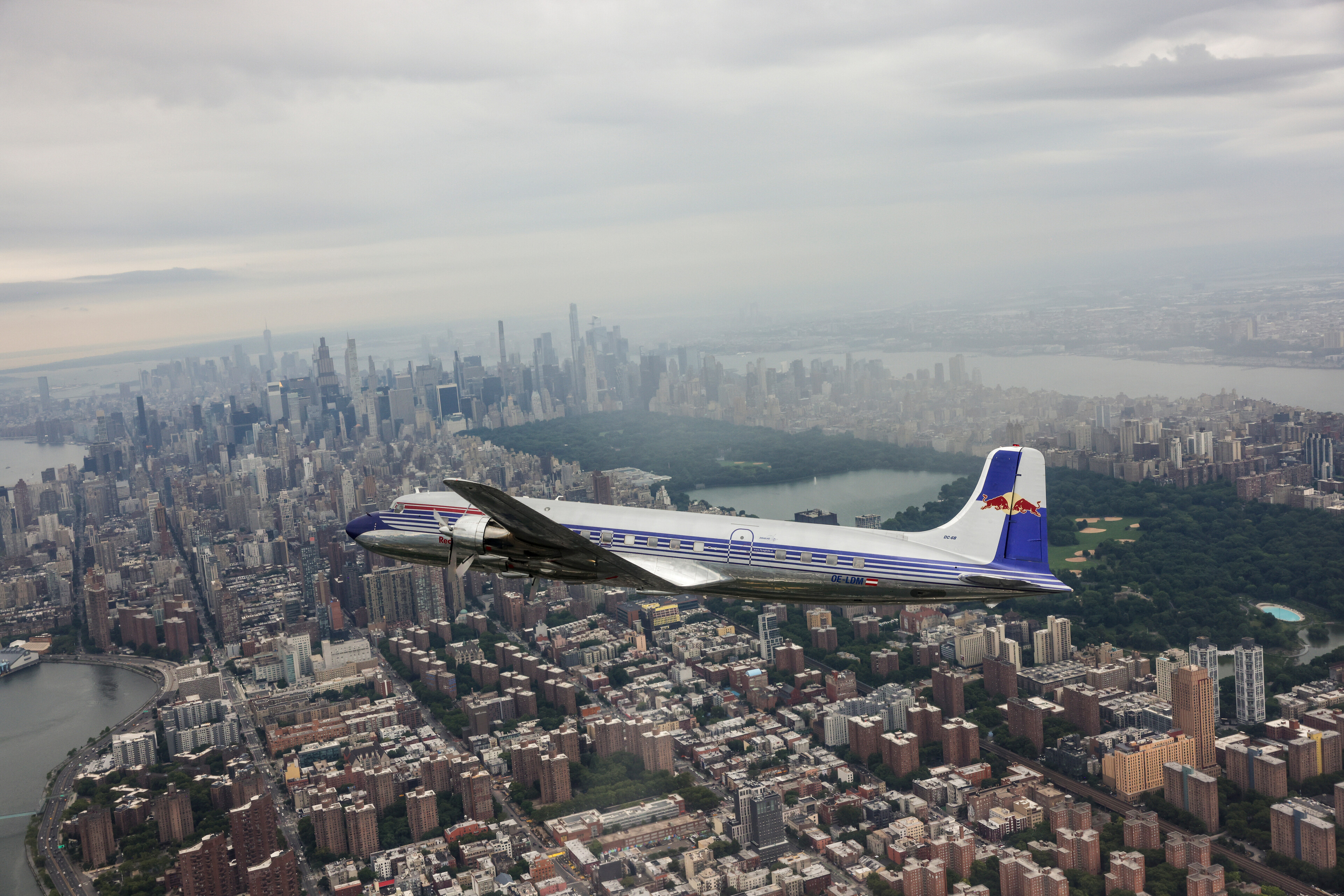
We head south toward the Hudson River Exclusion, and the New York skyline blooms and grows off our port side. With the air fairly smooth and the seat belt sign off (yes, literally), we’re free and indeed encouraged to move about the cabin. The city shines outside the windows and we fly by iconic buildings in an icon of our own. Naturally, today’s in-flight beverage service consists of Red Bull, and Walker and I each snag a can before we fly over the Statue of Liberty.
We one-eighty to the north and fly back up the river, and over the cabin speaker the pilot notes that in just a moment, we’ll be passing the Freedom Tower, the top of which will be above us. Rockefeller Center and the Empire State Building glisten in the sunlight, and Central Park’s deep green cuts the urban jungle sandwich. Standing behind Amdal on the flight deck, it is clear to me that the Flying Bulls are just as happy to be here as we are, pointing out landmarks and (safely and responsibly) snapping photos from the flight deck themselves. You know it’s good when the pilots are taking photos, too.


White Plains is unfortunately only a short flight away now, but the tower makes a request for a flyby, and the team is delighted to provide. I’m thrilled we get a few more minutes in the air. But all good things must end, and we touch down and head back to the ramp, where everyone—rampers, transient pilots, charter passengers walking to private jets—has a phone out, eyes our way, before engine shutdown and disembarkation.
To fly in an airplane like that is exceedingly rare, and Walker and I wait until we’re the last ones on board and the flight attendants are looking at us expectantly before disembarking. The DC–6’s look-back factor is off the charts, and it’s impossible to walk into the FBO without turning around for one more photo.
The DC–6’s busy July has just begun, and Amdal and the team can’t wait to share the real thing with the aviation family at AirVenture, and hopefully inspire some folks along the way.
“That's the coolest thing we do, inspire young people [at] airshows. And we beg to differ from the social media to actual physical things because I think that's going to last in the end beyond anything.”
Witnessing the culmination of years of effort, time, and money is moving, and to know how far the Flying Bulls have come to share it with a North American audience only enhances the experience. They have succeeded in bringing the past to the present, and in spectacular fashion.
The Flying Bulls’ DC–6 is expected to land at Oshkosh on July 19. The Flying Bulls’ P–38 Lightning will also be at the show.

Related Articles


