More fun per gallon
The SE–1 defies modern convention
Bracing Rocky Mountain air spills over the open-cockpit Spirit SE–1’s windshield as I fly northwest at 100 miles per hour. The towering rock walls of the Black Ridge Canyons Wilderness glow in the low morning sun about five miles ahead as I take in this mesmerizing moment: The low-pitched rumble of an inverted V-2 engine turning 3,000 rpm, the wraparound view over the narrow instrument panel, a slightly reclined seat—and the sublime control harmony of this beautifully balanced metal aircraft.
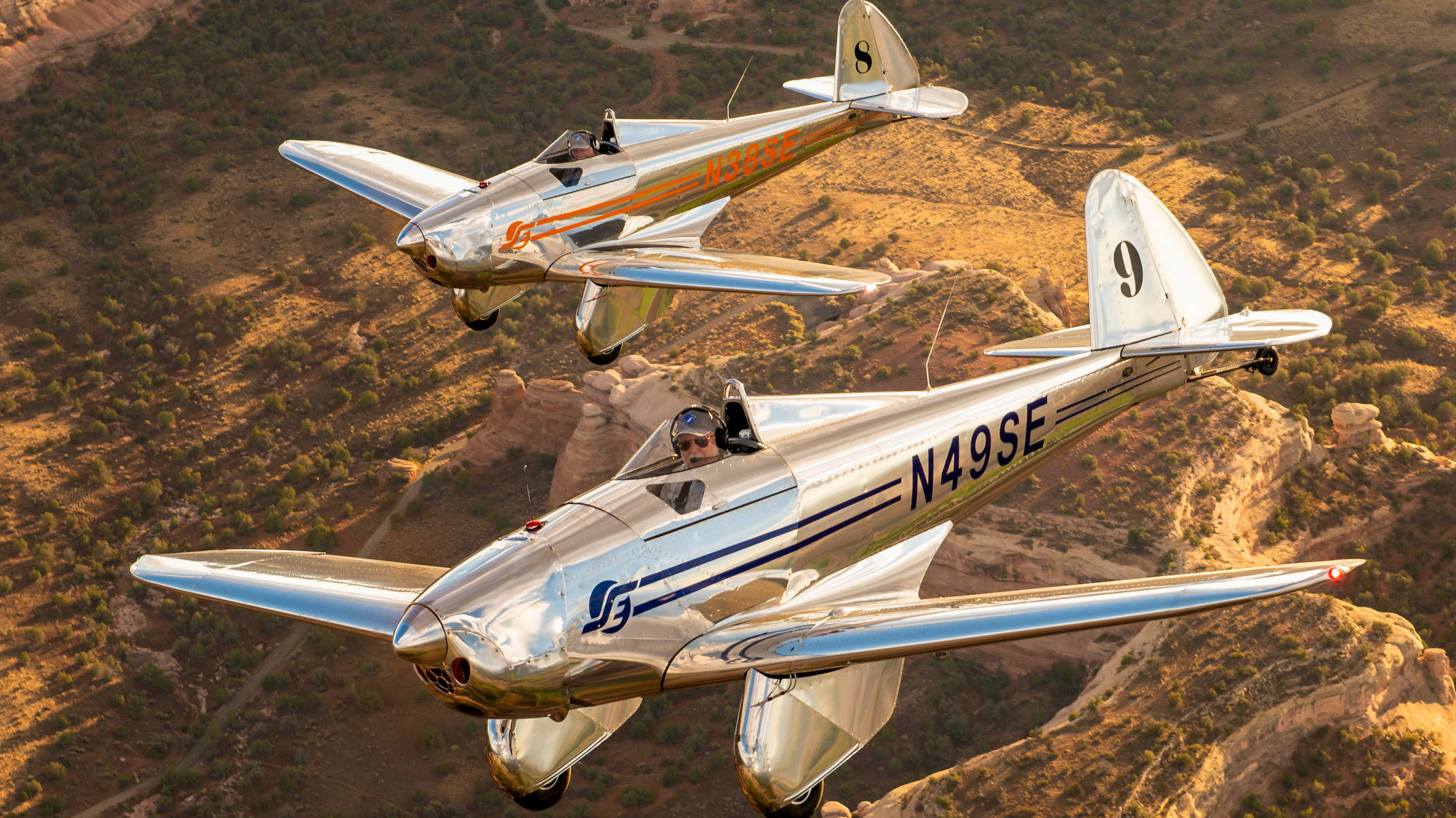
There’s no slop in the full-span ailerons as I roll into a series of steep turns, and golden sunlight flashes across the bare aluminum wings. I nudge the throttle forward to keep a constant airspeed in these 2-G turns, but it doesn’t take much. The aerodynamically clean little airplane keeps its energy.
Next, a series of lazy 8s shows off the airplane’s obedient temperament through its full speed range—and there’s surprisingly little change in control force. I’m not even tempted to move the tiny elevator trim wheel on the right cockpit wall even as the airplane slows to 55 mph and accelerates to 110. I pitch up and reduce power for a power-off stall. The SE–1 buffets lightly at 50 mph, and a gentle, symmetrical stall break follows at 46.
Grand Junction Regional Airport (GJT) was my starting point for this morning’s introductory SE–1 flight, and I call the tower and ask for a series of stop-and-go landings. The gigantic 9,300-foot-long Runway 11 seems like a laughably long place to operate this Lilliputian sport airplane, but I dutifully report my position and am quickly cleared for the option.
The prelanding checklist is short (carburetor heat on, mixture set for takeoff), and I’m set for my first try at returning this SE–1 to the ground.
I make a straight-in approach to Runway 11, intercept the visual glideslope at one mile, reduce engine power, and—since there are no flaps—slip mildly to increase the rate of descent while holding 60 mph. Visibility over the narrow nose is very good for a tailwheel airplane, and a pair of side windows improves peripheral vision in the landing attitude. In ground effect, I take out the sideslip, reduce engine power to near idle while working the stick aft, and let the main landing gear touch down on the grooved concrete surface.

Once the main wheels touch in a tail-low attitude, I pull the throttle lever to idle and bring the stick full aft to pin the steerable, solid rubber tailwheel to the pavement. The rudder remains highly effective as the airplane decelerates, and I consciously resist any urge to overcontrol during rollout.
With more than one mile of runway remaining, I add full engine power for takeoff. Acceleration is relatively slow as a result of the airport’s nearly 5,000-foot elevation and roughly 6,000-foot density altitude. Holding a tail-low attitude allows the SE–1 to lift off on its own at 48 mph indicated after a 400-foot takeoff roll. I let the airplane accelerate in ground effect and then start a shallow climb at 70 that nets a 500 foot-per-minute ascent.
I start a 180-degree turn to downwind at the departure end of the runway and accelerate to 90 mph for more landing practice. Fuel flow at this low power setting is comically low at just 1.5 gallons per hour. In terms of fun-per-gallon, this SE–1 stands alone.


Telling the world
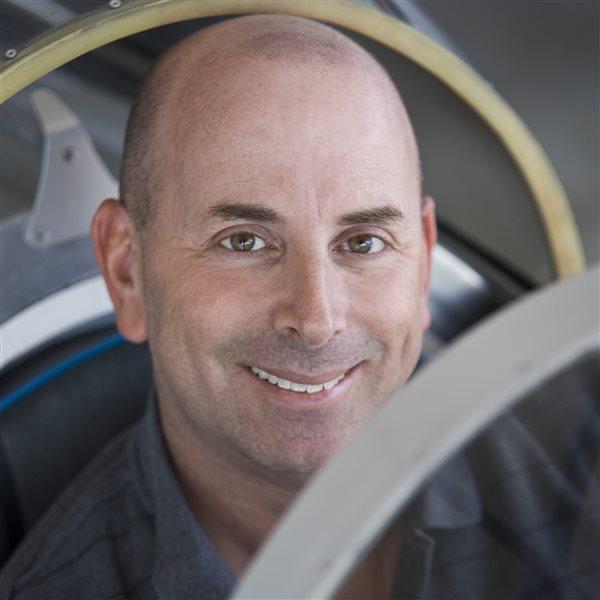
 Spirit Engineering founder and owner Steve Wood doesn’t look like a renegade. He’s personable and friendly with an easy laugh and looks the part of a Coloradan cowboy with a full-size Dodge Ram truck, faded jeans, and boots. He’s also a 2013 winner of AOPA’s Laurence P. Sharples Perpetual Award for his volunteer work. The only hint that Wood is an aeronautical engineer is the fact that he’s carrying five pens in the pocket of his Western shirt.
But Wood’s approach to designing the SE–1 defies modern convention.
It’s made of aluminum—not composite material—and held together with traditional bucked rivets instead of the pull kind. Its inverted-V, two-cylinder, four-stroke, air-cooled, 42-horsepower engine was designed and built in-house. It’s a low-cost airplane made in the United States—not overseas, where labor is less expensive. It’s a single-seat, tailwheel airplane that’s meant to be built in volume.
Wood spent more than a decade designing, testing, and manufacturing SE–1s before announcing at EAA AirVenture 2025 that they even existed. Usually, designers trumpet their intentions with great fanfare and solicit investors before a prototype ever flies. Wood set up a 60,000-square-foot production facility in Grand Junction and started manufacturing airplanes before issuing a single press release.
To date, Spirit Engineering has sold more than 80 SE–1s and delivered 30.
“I don’t believe in hype,” Wood says. “I need to know what my team and I can do before telling the
world about it.”
Art deco looks
SPEC SHEET
Spirit SE–1
Base price: $69,500
Price as tested: $76,150
Powerplant / Spirit V2
Recommended TBO / Undetermined
Horsepower / 42
Propeller / Wood fixed-pitch
Length / 17 ft 6 in
Wingspan / 24 ft 7 in
Wing area / 80.4 sq ft
Wing loading / 9.2 lb/sq ft
Power loading / 17.6 lb/hp
Seats / 1
Empty weight / 420 lb
Max gross weight / 740 lb
Useful load / 320 lb
Max takeoff weight / 740 lb
Fuel capacity, std / 8 gal
Baggage capacity / 20 lb
Max demonstrated crosswind / 13 kt
Max pilot weight / 260 lb
Performance
Runway takeoff distance, ground roll / 500 ft
Runway takeoff distance over 50-ft obstacle / 880 ft
Rate of climb, sea level / 750 fpm
Max speed at sea level / 112 mph
Service ceiling / 17,500 ft
Runway landing distance over 50-ft obstacle / 1,230 ft
Runway landing distance, ground roll / 700 ft
Limiting and recommended airspeeds
VX (best angle of climb) / 64 mph
VY (best rate of climb) / 72 mph
VA (design maneuvering) / 96 mph
VNE (never exceed speed) / 140 mph
VS1 (stall) / 45 mph
 spiriteng.com
All specifications are based on manufacturer’s calculations. All performance figures are based on standard day, standard atmosphere, sea level, gross weight conditions unless otherwise noted. Find more specifications in AOPA’s Aircraft Guide.
 aopa.org/aircraftguide
Wood has been flying since he was a teen and has owned airplanes such as a Luscombe 8A, Taylorcraft, Cessna 180, and Beech 18. He got his first job in the aviation industry at Cessna in the late 1970s, where he worked as an engineer on the T303 Crusader, a high-performance piston twin. He was also involved in the early days of the Cessna 208 Caravan single-engine turboprop, but was furloughed with thousands of others in the early 1980s.
Wood moved to western Colorado and worked as a pilot and aviation consultant on a wide variety of aircraft projects. But those eventually took a backseat to specialty manufacturing for the Department of Defense. After decades of highly specialized defense work, Wood left that industry and founded Spirit Engineering. The company’s purpose was to design and manufacture a light sport airplane that addressed an individual owner’s four biggest economic obstacles: acquisition, operation, storage, and maintenance costs.
The SE–1 has a retail price of $69,500. It consumes about two gallons of unleaded auto gas (or 100LL avgas) per flight hour. Folding wings take less than five minutes for one person to stow or prepare for flight are meant to radically reduce hangar costs. A relatively simple airframe with fixed landing gear, a fixed-pitch propeller, and no flaps is designed for low maintenance expenses.
Wood’s intangible yet critical design challenge was aesthetics. The airplane had to appeal to pilots on a visceral level—and that’s where gleaming metal, complex curves, traditional rivets, an open cockpit, and a tailwheel come into play.
“It would have been simpler to make square corners,” Wood said. “The SE–1 reflects our sense of what connects with people. No one complains about the art deco look or the way the air-cooled engine sounds.”
The first thing that stands out in my introduction to the SE–1 is its minuscule size. The airplane weighs just 440 pounds empty, or half as much as a Cessna 152 trainer. The SE–1’s fuel capacity is eight gallons. Total. Yet that’s enough for about four hours of flight.
The next obvious SE–1 feature is its vintage appearance—yet it’s not clear which historical airplanes provided the inspiration. The rakish sweep of the single-piece windshield is reminiscent of a Ryan STA. The elliptical wings conjure a Swift. The metal landing gear fairings and headrest scream Boeing P–26 “Peashooter.”
Full-span metal ailerons cover the wing trailing edges. A non-swiveling tailwheel is steerable via taut springs attached to the rudder. There are two elevator trim tabs: One is ground adjustable, and the other connects to a manual trim wheel.
The wooden Sensenich prop has about 40 inches of pitch. The engine is carbureted.
Step onto the left wing, turn the canopy latch, lift the cover, and brace yourself on the rollover structure as you step inside. Slide down into the seat and cinch down the four-point seatbelt harness.
The fabric seat frame adjusts up and down, and the rudder pedals move fore and aft. The throttle and mixture levers are on the left side of the cockpit. The floor-mounted control stick is in the middle, and the starter and most electrical switches are on the far right.
It’s a 52-degree Fahrenheit morning, and I push an electric primer switch to pump fuel into one of the engine’s two cylinders. Then I turn on the ignition switches (one per cylinder) and push the start button. The engine fires immediately and settles into a 1,200-rpm rumble.
The windshield does a great job keeping the pilot out of the slipstream, but I’ve got to keep my head inside to prevent my ballcap from blowing away. Perhaps a canvas helmet would have been a better option.
The SE–1 has a predictably tiny turning radius, and the steering linkage is quite sensitive. I do some figure eights and circles in the non-movement area, then call the tower for a taxi clearance. Winds are light and variable, and I don’t mind the long taxi to Runway 11 because it allows the oil temperature to warm up along the way.
By the time I get to the runup area, my feet have adjusted to the tailwheel sensitivity. Runup is standard for an air-cooled engine, and I adjust the mixture to obtain a full-power, static rpm of about 2,700. There’s nothing left to do but fly.
The experience of flying an SE–1 is exhilarating. The magical sounds and sensations of an open cockpit, exceptionally responsive, exquisitely harmonized controls, and an ergonomically designed cockpit make me feel comfortable quickly. I’ve arranged for Wood to be available via radio in case I have in-flight questions. But the airplane is so self-explanatory I have none. I fly the SE–1 twice that morning, and my confidence rises with each takeoff and landing.
I’ve owned and flown a variety of single-seat airplanes, so the act of flying a new-to-me airplane without accompaniment is familiar. Many pilots are intimidated by the thought of flying a single-seat airplane for the first time, yet the same preparation that goes into making any familiarization flight successful also works in single-seat airplanes.
There’s no two-seat training version of the SE–1, and no computer simulator. Wood says tailwheel proficiency in other aircraft is enough.
“If someone can show me three good landings in a row in a Luscombe,” he said, “they can fly an SE–1.”


Pure enjoyment
The SE–1 takes a bold, unique, and original approach to addressing aviation’s cost barriers. The airplane is inexpensive to operate—yet it’s also soul-stirring and invigorating.
It’s easy to imagine flying clubs buying multiple SE–1s so that pilots can fly together. Some of the first batches of airplanes are headed overseas, and places like Europe and New Zealand, where distances are relatively close, turf runways are plentiful, and avgas is expensive or nonexistent, seem like especially fertile ground for SE–1s.
Wood is tight-lipped about future modifications, but he says many potential customers are asking about full cockpit enclosures and tricycle landing gear.
“Those are excellent questions,” he said. “But right now we’re as busy as we can be delivering airplanes that are already on order—so there’s not a lot of incentive to explore modifications.”


The only thing I didn’t like about the SE–1 was its cable-actuated heel brakes. They’re awkward to apply, and I only found them useful for keeping the airplane stopped during engine runup. Wood’s team is testing a D-ring attached to the hand parking brake, and he regards it as a potential game changer.
As for paint, Wood only sells bare metal airplanes with vinyl graphics.
“Paint would add 30 pounds to an SE–1,” he said, “and I prefer to steer clear of it entirely.”
Wood says he is gearing up to produce SE–1s in high volume.
“We’d like to deliver a couple hundred a year, and I think that’s realistic,” he said. “The world needs a low-cost airplane. And in addition to being inexpensive to operate, this one handles just the way my team and I hoped it would. Several SE–1 owners have multiple airplanes—and this is the one they choose to fly for fun, no matter what else they’ve got in their hangar.
“The experience of flying it is just pure enjoyment.”