The ‘Impossible Airplane’
Another RV–10? Not quite
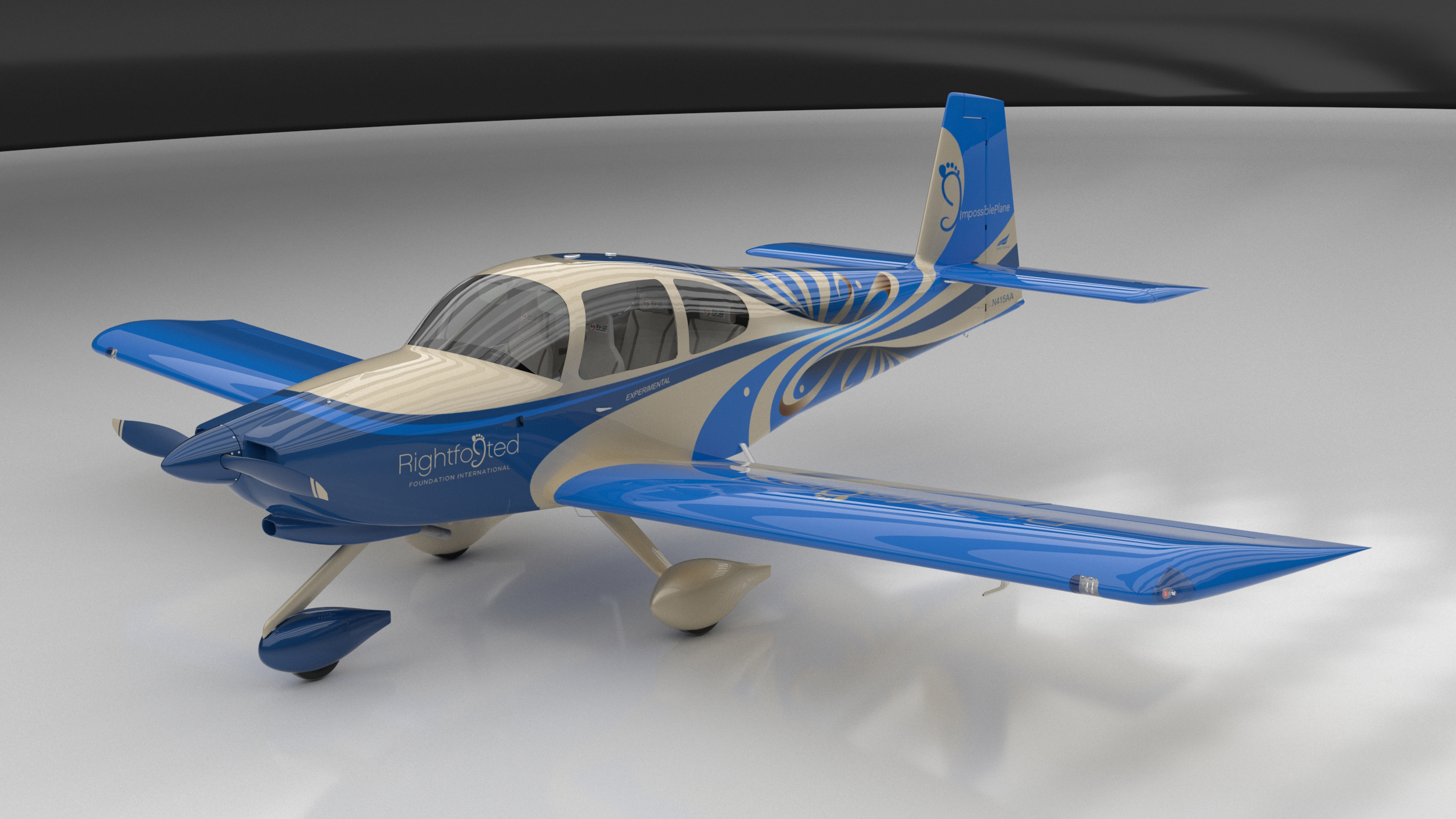
Led by founder Jessica Cox, the world’s first certificated armless pilot, the project centers around her effort to fly a custom-built airplane designed specifically for her. So, when people first hear of the Rightfooted Foundation’s “Impossible Airplane,” they expect something radical with the controls, something unfamiliar with the panel, a new vision, something unmistakably different from every other airplane they have ever seen. But this aircraft looks ordinary.
“That’s the point,” says Patrick Chamberlain, inclusive engineering director and Cox’s husband. “A lot of people will look at it and say, ‘That’s just a normal airplane.’ And that’s exactly what we’re aiming for.”
The Van’s Aircraft RV–10 is built around a guiding philosophy of universal design—an approach to accessibility that emphasizes designs that can be used by as many people as possible.
“Automatic doors are the classic example,” Chamberlain says. “Nobody thinks twice about them. They work for nearly everyone.” From the beginning of the project, the engineering team focused on how to identify existing systems that could work if the team looked at them differently.
Early design conversations included some bold ideas, like reinventing controls for pitch, roll, and yaw from scratch. Yet it turns out that standard parts began solving problems more effectively than custom designs.
One of those discoveries came during avionics testing. A standard Aerosport 310 panel, paired with Advanced Flight Systems avionics, has a built-in lip on the panel.
“Her foot naturally rested there,” Chamberlain says. “She automatically had a brace point.” Even better, most of the knobs and buttons were arranged along the side edges giving Cox stability and precise control. “We realized that we didn’t have to reinvent the wheel on that one,” he says. “This panel was already a step in the right direction toward universal design.”
That same attention to detail appears throughout the airplane. Early on the team noticed that when Cox reaches for the panel with her right foot and then relaxes, her foot naturally drops back down. A protruding switch would be easy to bump accidentally, so the team selected an extremely low-profile flap switch. “And people are going to look at that and say that’s normal,” Chamberlain explains. “But it isn’t. The combination of the 310 panel along with an extremely low-profile flap switch gave us a solution to a problem.”


Yes, you can
Jessica Cox grew up navigating environments that were not built with her in mind. “I always wondered, you know, is there anyone else out there? Is there anyone who knows what it feels like? I always was yearning for that because I think that human beings yearn for a sense of belonging, and then I turned on the TV, and it was a full-blown news story about this woman who lost her arms at the age of 3. And she did everything with her feet. She had a beautiful home. She was driving a car, and my jaw dropped, and I was stunned, and I was like, I need to meet her. That person for me that changed my world—shook my world.” That moment transformed everything and informed her purpose. “I want to replicate that for as many children as we can—kids who’ve been told their entire life, ‘No, you can’t.’”
—Janine Canillas
Some changes are more obvious. Cox insisted on a throttle quadrant instead of Vernier controls since it’s what she knows from years of flying an Ercoupe. “The panel wasn’t designed for it,” Chamberlain says. “We had to do a lot of fabrication to make it fit.”
At first glance the fuel selector seems to be stock Van’s Aircraft. But it was designed by interdisciplinary engineering students at the University of Arizona. Chamberlain asked them if they could find a way to automate switching between left and right tanks to reduce the workload, while keeping Cox’s ability to override the system and shut off fuel in an emergency.
“The stock selector requires lifting and rotating a mechanism,” he says. “That’s hard to do with a foot.” The students came up with a design that’s now between proof-of-concept and prototype.
Other innovations almost go unnoticed. The landing lights, for example, no longer require a separate wig-wag switch. When certain flight parameters are met, the system activates automatically. “Once you see it,” Chamberlain says, “the question becomes uncomfortable: Why wasn’t it always this way?”
Instead of a traditional control stick, pitch and roll are controlled by a foot-operated device that looks like a slipper, designed by Mach One Solutions. Cox’s left foot rests inside it, and pitch comes from subtle forward and aft movement, while rolling comes from sliding left and right. Her right foot controls the rudder and avionics, and while both rudder pedals are installed, the right rudder is configured to push and pull. A yaw damper has also been added, thanks to a donation from Advanced Flight Systems.
“People assume you couldn’t fly precisely, especially in crosswinds,” he says. “That assumption ignores Jessica’s reality.” She has spent a lifetime developing fine motor control in her feet and has been flying for nearly two decades. “If more people approached aviation with curiosity instead of assumptions, we’d be much further ahead.”
The controls were tested in a simulator RV–10 that Pima Community College’s A&P program helped restore and outfitted with sensor systems donated by Sim Your Plane. “Jessica can fly the airplane virtually, give feedback, and help us refine things before they ever touch the real aircraft,” Chamberlain says. Eventually, that simulator will travel to events like EAA AirVenture and Sun ’n Fun, allowing the public to experience flying using her control scheme.
This airplane is not finished, and it may never be. As Cox progresses from simulator to flight testing, solo, cross-country, and beyond, the airplane will evolve with her.
“In that sense,” Chamberlain says, “the airplane grows as Jessica grows.” 
 rightfooted.org
Related Articles


