Make it meaningful
Coming up with a plan when the engine lets you down
Before Cassie took Runway 18 at the Winchester Municipal Airport (KBGF) for departure, she listed her anticipated actions during the departure should the engine fail.
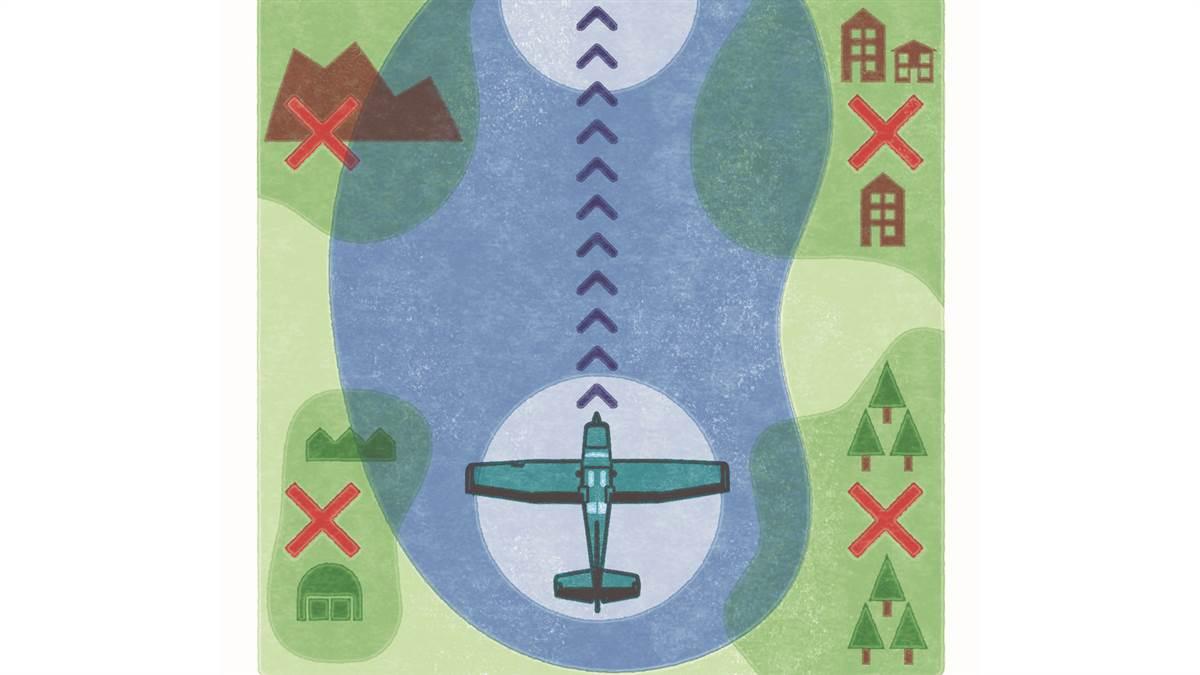
“With sufficient runway remaining, I’ll bring the airplane to a stop. Without that, we’ll land straight ahead. Once we reach 1,000 feet in the air, we’ll turn around and land back on the runway in the opposite direction.”
Once I saw the 36 numbers pass below us on the climb, I retarded the throttle enough for the change in engine sound to be noticeable. Cassie looked alarmed as I blurted, “What’s the plan?” She immediately looked over her left shoulder at the edge of the airport complex, motioned a turn to the left and voiced a plan to return to the field. At only 250 ft agl, turning around deviated starkly from her pre-takeoff briefing and the results were guaranteed to be disastrous. And there were decent fields right ahead of us that would have allowed us to walk away from the airplane. A notice of disapproval isn’t fun for anyone but if the retraining prevents that response in a real scenario, it’s potentially lifesaving.
Cassie could have used a thoughtful, and more readily useful, pre-takeoff briefing for handling engine anomalies.
Engines sometime fail us by not producing as much power as they did when they were rolling off the assembly line. Over the years, wear and tear might result in longer takeoff rolls and slower climbs, yet the pilot’s operating handbook performance charts represent that new airplane. The calculated distances and rates become optimistic and, perhaps, nowhere near what a mature airplane requires. Paired with challenging atmospheric conditions, the runway and surrounding environment may not support a safe departure.
A pre-departure briefing should cover an engine operating with lacking performance through all phases of the departure. Identify the last acceptable spot along the runway for the aircraft to become airborne and begin a safe climb but with enough remaining runway to stop if things don’t look right. It may be a particular centerline stripe, a taxiway intersection, or simply a distinctive tree off to the side. Commit to retarding the throttle and exercising a Plan B if you reach the landmark while still on the ground.
Engine anomalies in the air require more planning that is tailored to the departure airport and surrounding environment. A “land straight ahead before reaching 1,000 feet agl and turn back to the airport above that” proves overly simplistic and is rarely an optimal plan. Include a review of the local geography when developing a plan for anomalies that occur after rotation. For an unfamiliar airport, use the aerial (or satellite) view to identify areas that can serve as emergency landing sites.
For example, I make most of my departures from Runway 25 at Sewanee Franklin County Airport (UOS) in Tennessee. With tall trees at the end of the runway, there is a brief window of time for which splitting the gap between two of them and hoping for the best is the only course of action. Once the airplane climbs about 300 feet agl, there are athletic fields and a golf course to the west and north that could provide reasonable landing spots. We’re not looking for pretty, just survivable. Upon reaching 800 feet agl on a typical day, the edge of the plateau is in reach; beyond that, the terrain drops 1,000 feet to the valley below, with relatively few trees and wide-open fields. My Sewanee departure briefing, then, never includes turning back to land on Runway 7.
Any plan for engine failure after departure could benefit by taking a cue from ForeFlight’s Glide Advisor. The tool outlines a circle on the selected chart. (Because of low altitude, winds, or varying terrain, it might look more like an amorphous blob.) The idea is that, upon engine failure, the circle defines the area accessible in an engine-out glide. It’s based on the lift-to-drag ratio that can be modified by the user who thinks the book numbers might be overly optimistic.
I recently used my iPad screen capture tool to make a video of the ring during a departure from Sewanee. The Glide Advisor ring begins to appear only when the aircraft is about 200 feet in the air and is a small wedge directly ahead of the airplane. With increased altitude, the region widens to include more area to the sides. Only after reaching several hundred feet of altitude does the area sweep to the back to enclose the airplane symbol. Even then, most of the region lies in front of the airplane. Most interestingly, on any of the departures from Sewanee (or any other airports I recorded), the ring never contained the departure airport. The message is that, at first, landing straight ahead is the only viable option but, as altitude increases, looking right or left of course can make sense. And it’s a great reminder to think hard before accepting the risk involved with a turn back to land on the opposite runway after engine failure.
Finally, be sure to translate any key altitudes to mean sea level figures so that they are easily identified on the altimeter. Had Cassie done so, perhaps seeing 1,250 feet msl as well below her turn-back altitude of 2,000 feet msl would have prompted a different response. Citing a plan that isn’t easily implemented becomes merely lip service.
While turning around and landing at the field can be an option, and has had a successful ending in some cases, it has earned the nickname “impossible turn” for those situations where the maneuver ended in fatalities. Sometimes it works and sometimes it doesn’t. The success of the maneuver is highly dependent on winds, aircraft, pilot proficiency, and surrounding obstacles and terrain. Even when its success seems promising, there are often other less risky options that should be studied.
Consider constructing a meaningful pre-takeoff briefing, tailored to the airport environment and with key altitudes identified on the altimeter. Make it easy to use so that an engine anomaly can result in a happy outcome.
Related Articles


