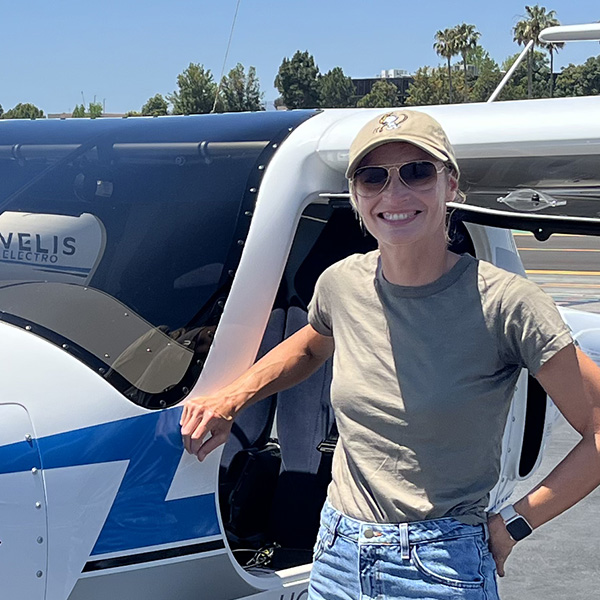
'Why fly'
Caroline Paul on bravery and the courage to go farther
Caroline Paul has been a lot of things before becoming a bestselling author. She has worked as a journalist, was among the first women to serve as a San Francisco firefighter, and has been a pilot for more than four decades.

The thread running through all of it is a spirit of adventure, along with a fascination with flight and what it can teach us about ourselves. Her new book, Why Fly: Seeking Awe, Healing, and Our True Selves in the Sky, is her attempt to explain the why.
At that time, Paul thought her career might be in documentary filmmaking or journalism, a way to combine adventure with storytelling. In 1987, while working as the morning news anchor at a San Francisco radio station, she chased a story about sexism and racism inside the San Francisco Fire Department. She took the entrance test with no real intention of becoming a firefighter. But she kept passing each stage of the hiring process.
Paul initially deferred when the department offered her the job. Then the Loma Prieta earthquake struck the Bay Area, and she watched firefighters respond. The experience challenged some assumptions about the department and the people who worked there. She eventually joined the department, becoming one of its first female firefighters and spending 14 years on the job before retiring after a fall in a fire led to multiple knee surgeries.
The fire department taught Paul as much about herself as it did about the work. She admired the bravery, service, and loyalty she saw among her male colleagues, but also noticed something about the way men and women were taught to approach difficult things. "I really admire how men lead with bravery, and they're taught to do this," she said. "And we, on the other hand, are very much taught to lead with fear." What she prefers to lead with is bravery.
Paul's first book grew out of her time in the fire department, and she has since published eight books total, including Tough Broad. Not every manuscript has made it to the shelf. Paul said she has written proposals that were rejected outright, and she credited her identical twin sister, an actress who dealt with constant rejection in her own career, for teaching her how to handle the emotional weight of that kind of setback. "Rejection was embedded and is embedded in that career," Paul said, "and she really taught me the emotional resilience of that kind of thing."
Though grounded in her own experiences, Paul's books typically combine personal narrative with reporting, research, and observations about how people navigate challenges and uncertainty. "They're not really memoir," she said. "I'm a device that I use in a lot of my books to bring people through." The experiences may be her own, but the focus is often on larger themes of courage, exploration, and self-discovery.
Paul sees bravery and confidence as overlapping rather than separate traits. Confidence can help someone step outside their comfort zone, and through those experiences they may build even more confidence. She points to research on children who ended up in the emergency room after taking physical risks. Girls were more often warned not to repeat their behavior, while boys were less likely to be given the same message. Over time, Paul said, girls may learn to pull back instead of testing what they can do. "I'm not against fear," Paul said. "I'm just pro-bravery."
Risk, in Paul's view, exists somewhere near that edge. "Risk is basically that small space beyond your skill," she said. Stay too close to what you know, and you don't grow. Go too far, and it becomes reckless. Paul admits she is still figuring out where that line is. Over time, adrenaline mattered less to her than awe, an idea she first explored while researching her previous book, Tough Broad. At first, she wondered whether her diminishing appetite for adrenaline meant she was simply growing bored. Eventually, she realized, "What you're looking for is awe."
That carried into Why Fly, which Paul describes as perhaps her most personal book. It tracks the end of her marriage alongside her growing obsession with flying a gyrocopter. "I became obsessed with flying a gyro," she said. "Mostly it had to do with the things I couldn't control on the ground." Flying offered something immediate and tangible. "You can control this thing," she said. "You can make it leap into the air. That feels good."

Flying also taught Paul how to let go. In an open cockpit, she could feel the wind as well as the vibrations and movement of the aircraft while remaining focused on the immediate demands of flight. As she got better, she began to notice how the expansive view made her feel small. "You just feel this sense of how tiny and insignificant I was, but not in a bad way," she said. Up there, the problems waiting for her on the ground didn't seem quite as big.
The book also draws a connection between communication in the cockpit and communication in a relationship. As Paul worked to become more comfortable talking with air traffic control, she was also going through couples counseling, where she was asked to listen to her partner without interruption and then repeat back what she had heard. In the airplane, listening and accurate readbacks demanded similar attention. "I want to be a good student in the air," she said, "but on the ground, I was like, 'No, that's not the way it happened.'" The comparison showed her how easily emotion and assumptions interfere with listening.
Paul originally wrote Why Fly with nonpilots in mind because she wasn't convinced she had much to tell experienced aviators. She estimates she has accumulated roughly 1,200 to 1,500 hours since learning to fly in her 20s, much of it in experimental aircraft. Flying has shaped her understanding of awe, the experience of encountering something so vast or mysterious that it interrupts the familiar patterns through which we see the world. The simple fact that humans—"two-legged, non-feathered, heavier than air," as she put it—decided they wanted to fly still strikes her as remarkable.
After decades of adventure, Paul says she is less interested in milestones than she once was. She is not working on another book, something she says is unusual for her. Her biggest goal now is simpler: "to be more present in the things I do."
Why Fly: Seeking Awe, Healing, and Our True Selves in the Sky is available from Bloomsbury Publishing.