Tricked-out Caravan
A graceful all-surface adventure machine
“When I envision a perfect place to fly seaplanes, this is the view that comes to mind,” says Steve Guetter, a veteran seaplane flight instructor and general manager at Advanced Flight Training and Leasing in Minnesota, a Wipaire subsidiary that provides Caravan flight training. “I always look forward to flying here.”
But there are reasons to be wary. A steady, 10-knot south wind dictates taking off toward high terrain. The fully fueled Caravan weighs about 8,600 pounds—just 150 pounds less than its maximum gross weight. There’s a swarm of boat traffic, flocks of seabirds, and the density altitude on this sunny morning is about 3,000 feet.
We’re taxiing downwind toward the main body of Moosehead Lake to increase the distance between the Caravan and the hills to the south. A Caravan on amphibious floats typically needs about 2,000 feet to get off the water, and since water distances are notoriously tricky to estimate, I gladly take the extra distance.


Guetter (pronounced “Getter”) reminds me that this Caravan is special, however. Its short body, Hartzell prop, and big 867-horsepower engine (675 horsepower is standard) help it easily outperform other Caravans. According to Wipaire’s specifications, this one will need just 1,242 feet to get airborne. N80RD was the test bed for a variety of Caravan supplemental type certificates, including the Hartzell Yukon prop, so its performance claims have been thoroughly vetted.
“We like to debate which of this airplane’s many modifications make it such an awesome performer,” he says. “But the bottom line is it’s an awesome performer.”
Guetter sets flaps to 20 degrees for takeoff, shifts the condition lever to flight idle, and pulls the water rudders up as I turn the Caravan’s long snout into the prevailing wind.
I steady my right hand on the center-mounted pedestal, hold the power lever like a pencil, and steadily push it forward as the propeller growls, and rpm rises to its maximum 1,900. Then I shift my gaze to the torque meter and keep nudging the power lever ahead until the needle in the analog gauge reaches the 2,300-foot-pound red line. Full up-elevator applied at the beginning of the takeoff run raises the Caravan’s nose almost immediately, and the airplane muscles itself on the step in about six seconds. Moderate to heavy right rudder pressure is required to counteract the airplane’s significant left-turning tendencies, and light forward pressure on the yoke keeps the Caravan from porpoising as it accelerates along the choppy surface.
The Caravan passes through 50 knots after a 12-second water run, and left aileron lifts the right float out of the lake. That reduction in hydrodynamic friction causes the Caravan to surge forward, and the chattering stops as the airplane flies in ground/water effect.
With the evergreen-covered hills ahead looming large in the Caravan’s wraparound windshield, I start a shallow climb and glance at the airspeed indicator. The airplane is accelerating through 90 knots in a 10-degree nose-up attitude, and Guetter raises the flaps to 10 degrees. That causes the airplane to reach 100 knots almost instantly.
“You can either keep climbing and go over the hills or turn before you reach them,” he says. “This airplane gains so much energy so quickly that it gives you all kinds of options.”
Ugly duckling
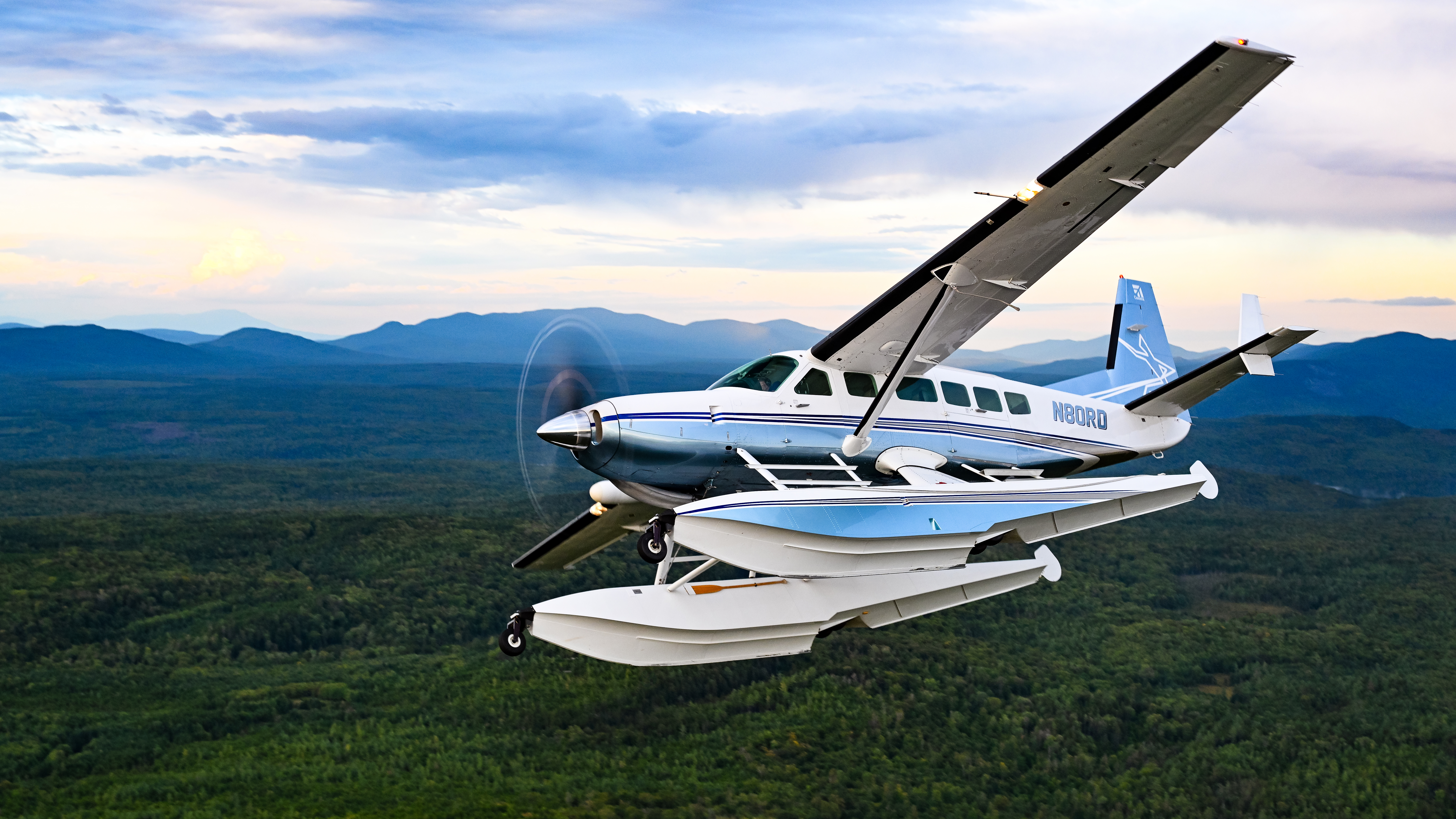
The Caravan’s transformation from inglorious night freighter to graceful all-surface adventure machine is one of the most unlikely shape shifts in general aviation.
FedEx was the launch customer to the blandly named “Cargomaster” and purchased hundreds of them when Cessna first certified the boxy turboprops in 1984. The overnight delivery firm was looking for a simple, reliable, single-engine airplane that could carry two freight cans at a time between regional sorting hubs and small-market cities.
 The Caravan’s slab-sided, unpressurized fuselage exactly matches freight can dimensions, a cargo door allows loading and unloading via forklift, the landing gear is fixed, and the wheels are open for simplicity, and a Pratt & Whitney Canada PT6A engine increases dispatch reliability. Gross weight is kept below 12,500 pounds so pilots don’t need type ratings.
The original Caravan didn’t win any beauty contests, but FedEx—and then a surprisingly long list of short-haul commuter airlines, humanitarian relief agencies, skydiving firms, cargo carriers, and foreign militaries—bought Caravans and modified them for their own wide-ranging purposes.
Individual and corporate owners jumped in the Caravan game early, and Wipaire designed, built, and certified its first amphibious floats for them in 1985. Float-equipped Caravans started appearing at far-flung places such as Alaskan fishing lodges and Bahamian resorts soon after.
A Caravan’s appearance and demeanor change dramatically with floats. Instead of a short, squat, boxy freighter, it becomes a towering presence that exudes elegance.
The performance penalty for adding floats is significant, however, as are the costs. A new set of 8750 amphibs sell for more than $800,000, a new Hartzell four-blade prop is $85,000, the Blackhawk engine upgrade is more than $600,000, and the Garmin G600 panel adds another $100,000. The finished airplane is about 20 knots slower on floats than wheels, and its ceiling drops to 20,000 feet from 25,000.
But the places an amphibious Caravan can go are nearly limitless.
From Alaska’s Inner Passage to the Caribbean or Patagonia, a float Caravan gets you there reliably, stylishly, and with room for up to 10 friends and gear.


Shopping cart
A wind-protected arm of Moosehead Lake provides an ideal location for water landings, and Guetter coaches me through the process.
This airplane has both a Wipaire laser gear warning as well as the more traditional landing gear advisory system, which contains a landing gear handle, four blue LED lights to indicate the wheels are up for a water landing, four green ones to show they’re down, and aural callouts. Mechanical landing gear position indicators are mounted on the floats, and convex mirrors on the struts confirm their positions. The laser system senses whether the airplane is flying over water or land and reminds the pilot to “check gear” if it senses a mismatch.
Guetter says to aim for 90 knots on final approach, raise the nose to a pitch attitude of seven degrees in ground effect, then bring the power lever all the way back to idle, beta, or reverse after touchdown, and pull the yoke full aft as the airplane settles. Then slide the condition lever to the ground idle position, lower the water rudders, and reset the flaps.
“On final approach, keep the nose pointed down and use the prop disc to hold 90 knots,” he says.
Getting the pitch attitude just right in the flare is essential.
“If the pitch attitude is too high, you’ll induce a massive amount of drag, airspeed will decay rapidly, and the airplane will drop,” he says. “If you come in too flat, you risk touching down on the front part of the floats and they’ll grab.”
A series of power-lever adjustments on final moves the prop smoothly in and out of flat pitch—and the Hartzell governor’s instant response allows for precise airspeed control. I gradually raise the nose in the flare, and the floats skitter along the wave tops before the deep-V hulls settle into the water.
The graceful flier becomes a yacht in about 500 feet. Guetter demonstrates the prop pitch locks as we shut down on the water. Restarting the engine with the prop in flat pitch avoids the surge in power that takes place when the blades move out of the feather position.
Once the engine is restarted, we try our hand at a series of spot landings. Eventually, an approaching thunderstorm cell—along with my tiring left arm and right leg—convince us to bring the airplane back to the Greenville Municipal Airport (3B1).
Runway landings are pretty much identical to the water variety except for the landing gear position. The landing gear takes about 15 seconds to move to the full down-and-locked position and Guetter targets the same seven-degree nose-up attitude at touchdown. Once on the runway, full up-elevator keeps as much weight as possible on the robust double-truck rear wheels of this oversized shopping cart.
“The main adjustment new Caravan pilots have to make is getting used to the height above the ground,” Guetter said. “The wheels tend to touch down a few seconds before they expect them to.” Modifications—even extensive ones—seldom change the essential character of an airplane. But the combination of the 867-horsepower Blackhawk engine STC, four-blade Harzell prop, and Wipaire 8750 floats make this Caravan a utility vehicle that handles like a sports car.
Pilots tend to equate more horsepower with tricky flying characteristics—but this hotrod Caravan proves the opposite can be true. The big engine makes taking off from land or water easier and quicker. In the real world, that superior performance provides greater safety margins that can keep pilots out of trouble. Also, the addition of floats typically makes airplanes less stable in yaw—yet two extra vertical stabilizers allow float Caravans to track arrow straight. In the air, this is even more stable than a wheeled Caravan.
Synthetic vision is a game-changer for seaplane and bush flying—and the Garmin G600 TXi primary flight display in N80RD vastly improves situational awareness. Syn-vis and terrain warnings are nice to have for routine IFR and VFR flying, but they’re vital when flying on and off the water in remote or mountainous regions.
The Hartzell Yukon prop is jet-smooth in flight, provides more low-speed thrust for quicker takeoffs and climbs, and delivers cruise speeds on par with three-blade props. Guetter says N80RD typically cruises about 170 knots at 9,000 feet on long trips, although greater speed and range is available at higher altitudes up to the mid-teens. Also, the big engine gains efficiency by climbing quicker, getting to cruise altitude sooner, and flying at higher altitudes and true airspeeds.
The Blackhawk engine conversion was originally marketed for skydiving airplanes and others with a need to haul heavy loads to high altitudes quickly. But N80RD shows that it also can make one of the world’s most versatile and capable single-engine seaplanes even better.