Checkride Ready
See how you measure up to FAA standards with these questions from the AOPA Pilot Information Center.
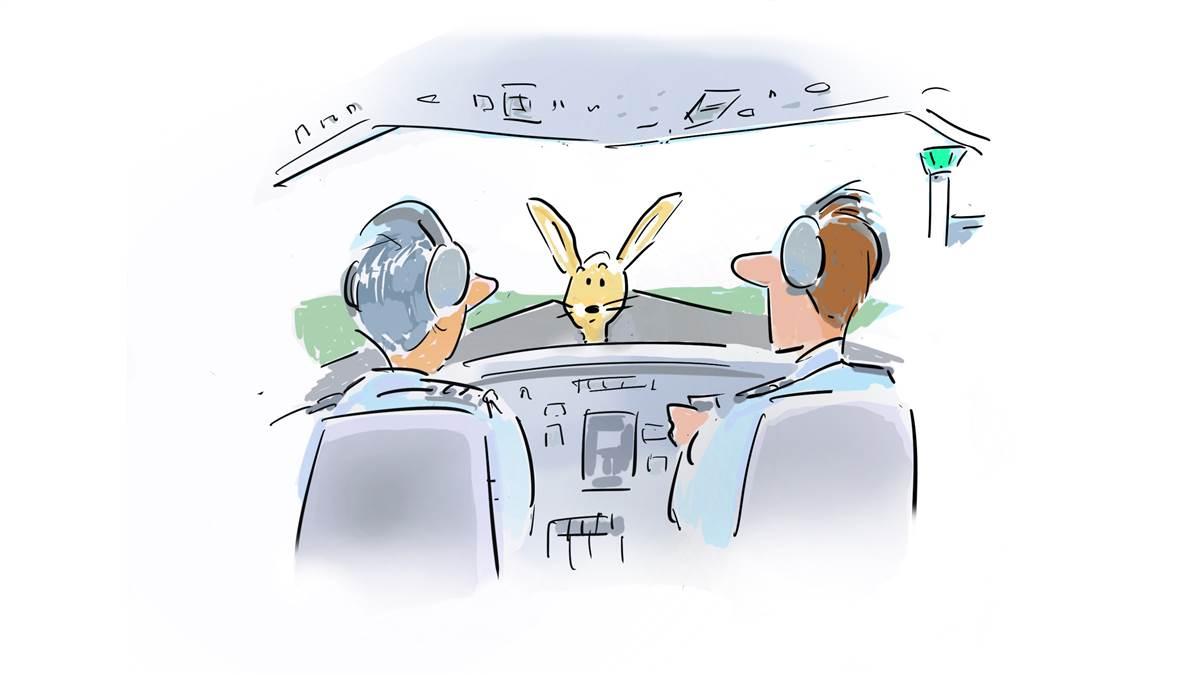
Illustration courtesy of John Holm
- Name the four fundamentals involved in maneuvering an aircraft:
- pitch, power, bank, and trim.
- thrust, lift, drag, and weight.
- straight and level, turns, climbs, and descents.
- What does the red line on an airspeed indicator represent?
- Maneuvering speed, or VA
- Never exceed speed, or VNE
- Never operate over speed, or VNO
- An airplane has a glide ratio of 8-to-1, or 8:1. This means that, under no-wind conditions, in a power-off approach
- the airplane will lose 1 foot of altitude for every 8 feet traveled horizontally.
- the airplane will lose 8 feet of altitude for every 1 foot traveled horizontally.
- the airplane will travel 3 miles horizontally from a typical traffic pattern altitude down to the runway.
- What represents the most common communications sequence from the parking area to climbout from a Class B airport?
- Clearance delivery, ATIS, ground control, tower, departure control
- ATIS, clearance delivery, ground control, tower, departure control
- ATIS, ground control, clearance delivery, departure control, tower
- What is the duration of a certificate of aircraft registration?
- Seven years
- Three years
- 12 months
- A pilot is flying an unpressurized airplane at 11,000 feet msl. He opens a thermos bottle that had been filled at sea level with hot coffee and is immediately blasted with injurious steam. What is the primary reason for this often-unanticipated hazard?
- A pilot is on short final approach to a runway with standard runway markings. He notes eight white stripes that look like hash marks painted on the runway threshold. From this he knows that the runway is
- 75 feet wide.
- 100 feet wide.
- 150 feet wide.
- 200 feet wide.
- For instrument-rated pilots: True or false? A truly proficient pilot can follow the glideslope to touchdown.
- True or false? A propeller-driven airplane’s rate of climb depends on the excess thrust available. (Excess thrust is the thrust available beyond that required to maintain altitude at a given airspeed.)
- Most pilots are aware of the possibility of bird strikes, but pilots also strike animals during takeoff and landing. What is the most commonly struck land-dwelling animal?
Answers
- The correct answer is C. Usually from the very first flight lesson, pilots are taught these four basic flight maneuvers upon which all flight is based. Airplane Flying Handbook, Chapter 3
- The correct answer is B. The red radial line represents the aircraft never exceed speed, or VNE. This is the speed to not exceed under any condition or circumstance. FAR 1.2
- The correct answer is A. A glide ratio of 8:1 means that an airplane will travel eight feet horizontally (forward) for every foot of altitude it loses. For a glide started from a typical pattern altitude of 1,000 feet AGL, the airplane will travel 8,000 feet horizontally, or about 1.5 miles. AFH, Chapter 3
- The correct answer is B. Tune in and obtain the current ATIS broadcast; contact clearance delivery for your route, altitude, departure instruction, and squawk code (RADS); obtain taxi clearance from ground control; obtain takeoff clearance from tower; and contact departure control when instructed by the tower. Aeronautical Information Manual, Chapter 4, Section 2
- The correct answer is A. A certificate of aircraft registration (FAA form 8050-3) expires seven years after the last day of the month in which it is issued. The expiration date is noted on the document. The previous three-year duration that was implemented in October of 2010 was extended in January of 2023. FAR 47.40
- At 11,000 feet, the boiling point of water (and coffee) drops to only 193 degrees F. If the coffee is hotter than this, which is likely if the thermos was filled at sea level, opening the thermos causes some of the coffee to instantly boil and release an explosion of steam.
- The correct answer is B. A table of runway threshold stripes versus runway width can be found in Chapter 2 Section 3 of the AIM.
- False. A UHF glide slope levels off at approximately 25 feet above the ground (abeam the transmitter site) and then begins to climb after the site is passed. Autoland systems use the radio altimeter to flare and land.
- False. Excess thrust determines angle of climb. Excess power determines an airplane’s rate of climb.
- White-tailed deer. Between 1990 and 2023, there were 1,301 reported white-tailed deer strikes.
Related Articles