Diabolical downwash
A ‘moving man-made microburst’ takes down a Cessna Skylane
In early October 2017, the islands of the Caribbean were recovering from twin natural disasters that had occurred in quick succession. In September, Hurricanes Irma and Maria wrecked critical infrastructure, and led to widespread power outages and water service interruptions across the archipelago. Heavy rains that saturated the earth caused landslides, and damaging winds destroyed electrical grids.
Aviation was also disrupted by the hurricanes. For example, the air traffic control tower on St. Thomas in the U.S. Virgin Islands was badly damaged, requiring a temporary replacement to be brought from the U.S. mainland. Across the region, essential aviation safety technology was still out of service weeks later.

On the morning of Monday, October 2, 2017, a lightly loaded 1961 Cessna 182D Skylane with the registration N9021X departed St. Thomas-Cyril E. King Airport (TIST) in Charlotte Amalie, bound for neighboring Puerto Rico. The flight was a milk run of sorts—a 1,057-hour private pilot and his less-experienced private pilot friend were going to pick up some parts for another airplane. Their destination was San Juan’s secondary airport, Fernando Luis Ribas Dominicci Airport (TJIG). Also known as Isla Grande Airport, the Class Delta field primarily caters to general aviation traffic inbound to Puerto Rico’s capital.
It was a beautiful VFR day in the Caribbean, with lots of sunshine and scattered clouds at 3,000 feet agl, and light winds out of the southeast. The temperature was 87 degrees Fahrenheit, with high humidity. The 65-nautical-mile journey almost due west was routine and slated to take about 45 minutes.
As it approached San Juan, the Skylane flew the westbound Tango transition through San Juan/Luis Munoz Marin International Airport’s (TJSJ) Class C airspace and joined a left base for TJIG’s Runway 9.
The pilot-rated passenger in the right seat later told investigators that there was a moderate amount of traffic approaching the airport that morning, mainly relief missions bringing aid to the hurricane-battered island.
He said he heard the controller tell a Cessna 172 pilot to go around and cleared a Cessna Citation jet to land. A flight of two Sikorsky UH–60 Black Hawk helicopters were then cleared to land behind the Citation. A few minutes before 11 a.m., N9021X was told to follow the two Black Hawks.
As the Skylane turned onto final, its occupants felt some turbulence, and assumed it came from the helicopters, which were descending toward the runway ahead of them. Air traffic control instructed the Skylane pilot to fly S-turns on approach, to create some spacing between the light aircraft and the heavy helicopters.
“Upon completing two S-turns we were back on final and immediately saw that the Black Hawks slowed down and based on our speed would have still been in a hover taxi over the runway when we would cross the threshold,” the right-seat passenger told investigators. The pilot then “radioed for clarification to make sure if we were still cleared to land and tower replied, ‘yes, you’re cleared to land.’ We looked at each other and said, ‘OK.’”
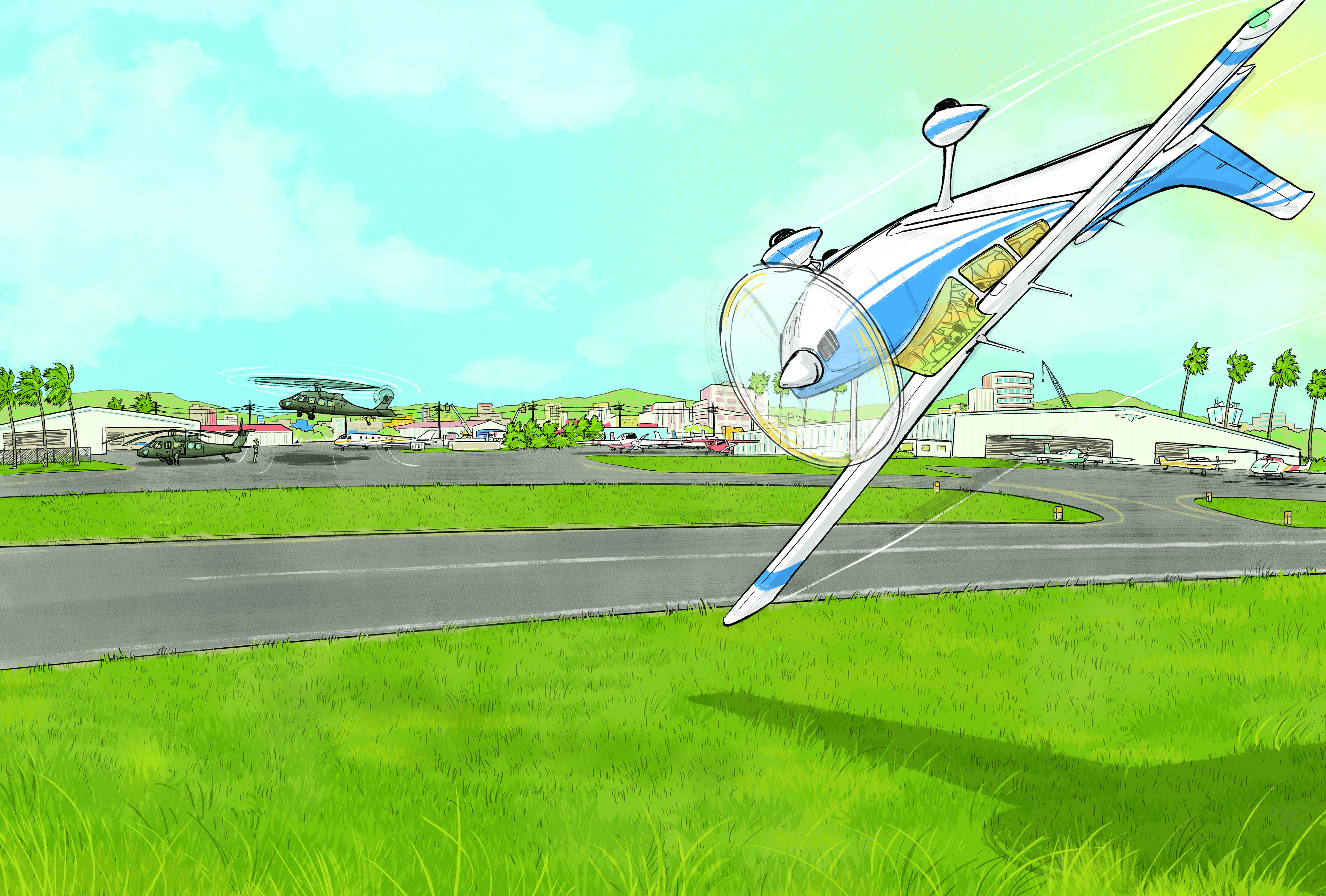
That’s when the full force of the helicopters’ downwash and spiraling vortices hit the aircraft.
N9201X’s occupants felt a “heavy downdraft” and feared they would make a hard landing. Just as it was touching down on the runway, about 500 feet before the B3 intersection, the Skylane flew into another “burst,” which was too much for the small aircraft’s control authority. N9201X banked hard to the left.
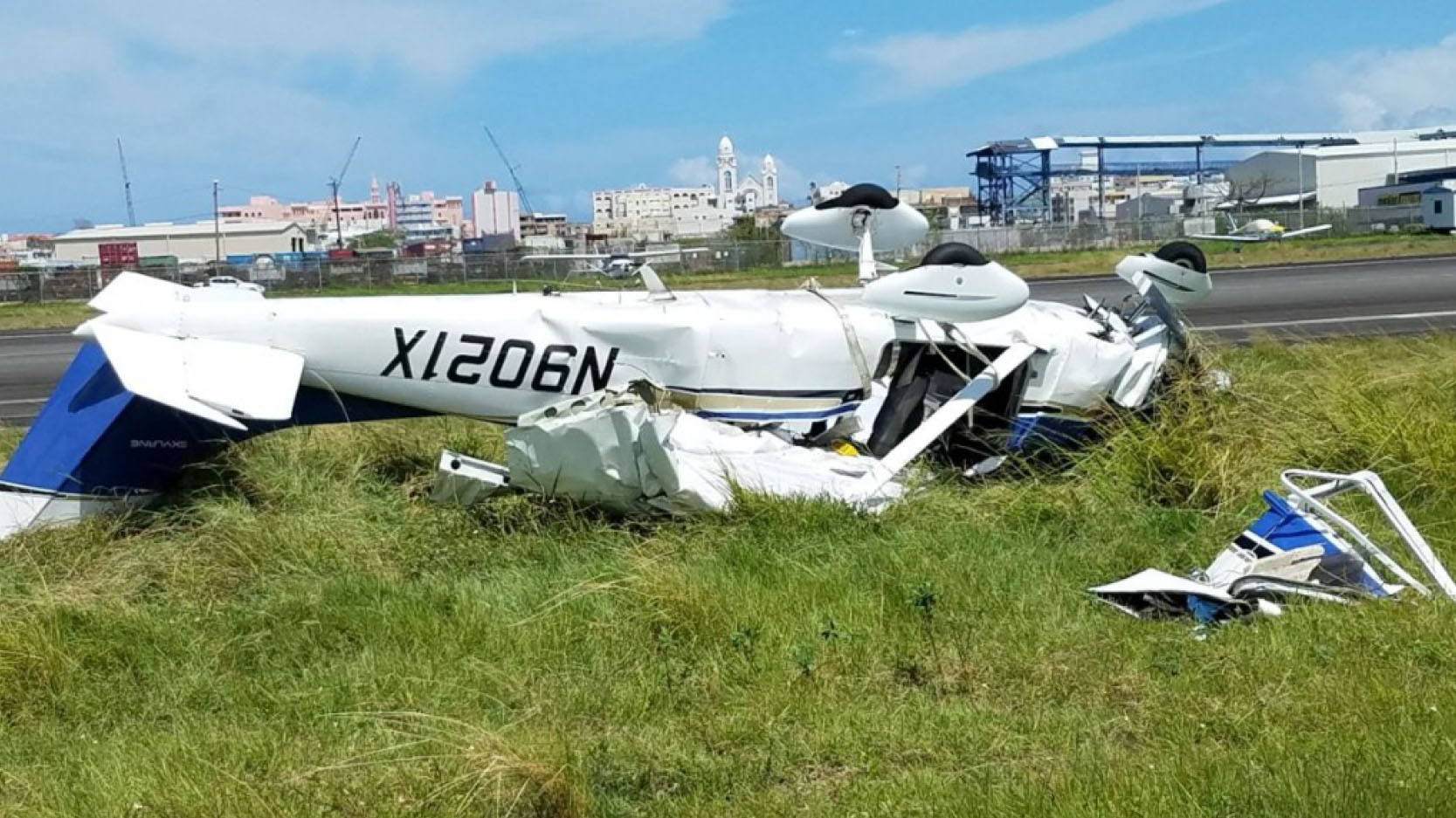
By this time, the pilots realized what was happening and scrambled to go around. As the pilot in command added power, another draft hit the aircraft and forced it to pitch up vertically, until it reached an altitude of about 50 to 100 feet above the ground. It then rolled inverted and impacted the ground on the grass median between the runway and the taxiway. Both occupants of the Cessna Skylane suffered life-threatening injuries. The pilot in command died in the hospital the next day, while the pilot in the right seat needed months to recover.
Analysis
In its final report, the National Transportation Safety Board determined that the accident was caused by wake turbulence and a lack of adequate separation from the landing helicopters, leading to a loss of control.
The hurricane had damaged equipment at the airport, so communication between the tower and the aircraft was not recorded and saved, which made the investigation more challenging. Because of the aftermath of the natural disaster, the San Juan FAA Flight Standards District Office was closed at the time, and no detailed examination of the wreckage was performed.
The surviving pilot told authorities later there was nothing mechanically wrong with the aircraft. It had had a smooth flight over from St. Thomas, and all appeared to be normal until the aircraft entered the air mass that the helicopters had just vacated.
The Skylane flew into another “burst,” which was too much for the small aircraft’s control authority.
A few days before this accident, at the same airport in Puerto Rico, a Pilatus PC–12 arriving on a relief mission flew into a Black Hawk’s wake and was severely tossed just a few feet above the ground. In that incident, the pilots managed to rescue the situation, regain control of the aircraft, and go around.
Another similar accident happened on December 5, 2014, in Fort Collins, Colorado, but the student pilot on board, flying his second solo in a Cirrus SR20, was not so lucky. The departing Black Hawk’s downwash caused the aircraft to cartwheel and crash, seriously injuring the pilot and substantially damaging the aircraft. Both of these events were captured on video.
Helicopter downwash and its effect on light aircraft is often underestimated. The U.S. Helicopter Safety Team (USHST), a group of government and industry stakeholders tasked with improving the safety of civil helicopter operations, advises that pilots “should think of a helicopter in a hover as a moving man-made microburst.”
According to the FAA’s advisory circular on aircraft wake turbulence published in 2014 (AC 90-23G), “pilots should avoid helicopter vortices since helicopter forward flight airspeeds are often very low, which generates a strong wake turbulence.” If a pilot accepts a clearance to visually follow an aircraft, “the pilot also accepts responsibility for both separation and wake turbulence avoidance.”
Furthermore, Chapter 7 of the Aeronautical Information Manual (AIM) gives some vital warnings about helicopter wake turbulence and rotor vortices.
“When rotor downwash hits the surface, the resulting outwash vortices have behavioral characteristics similar to wing tip vortices produced by fixed wing aircraft. However, the vortex circulation is outward, upward, around, and away from the main rotor(s) in all directions…. Pilots of small aircraft should use caution when operating behind or crossing behind landing and departing helicopters.”
In February 1996, the FAA Technical Center released a flight test report (DOT/FAA/CT-94/117) on the hazards of rotorcraft wake vortices in forward flight. The aviation regulator deliberately flew light aircraft into the wakes of various-sized helicopters to test the result.
One of the conclusions was that “medium weight helicopters…can leave active, potentially hazardous vortices for up to 90 seconds” and more than two miles away.
Interestingly, the tests showed that “helicopter vortices did not descend in the same predictable manner as for fixed-wing aircraft. Some vortices descended; some remained level; and some initially descended, leveled off, and ascended above the altitude of the generating helicopter.”
So, helicopter vortices do not move outward and descend like a heavy commercial jetliner; they radiate in all directions.
And if that wasn’t enough, the test concluded that the vortex core separation appears to increase in descending flight and to decrease in climbing flight. That means the aircraft following the landing Black Hawk pair was in grave danger from the get-go. USHST says that generally, other aircraft should stay “at least three rotor disk diameters” away from a hovering helicopter. If it is in forward flight, a minimum of three nautical miles and two minutes of separation is recommended for the rotor vortices to dissipate.
The lesson here for fixed-wing pilots is that the dangers of helicopter downwash may be invisible, but they cannot be taken lightly. It’s imperative that pilots learn how to identify these hazards, and how to avoid them.
A basic rule of thumb remains: The larger the helicopter, the greater the distance others should keep away from it.
Final thoughts
We learn in flight training that there are ways for light aircraft pilots to mitigate the effects of wake turbulence close to the ground as they land: Fly slightly above the glidepath of a larger aircraft, land beyond its touchdown point, and further adjust, as necessary.
These two pilots, with about 1,200 flight hours between them, were experienced island aviators who knew the region’s geographic and climatic conditions well. They’d flown to San Juan before and were familiar with the procedures, the airspace, and the airport itself. They were also surely aware that helicopter downwash from heavy Black Hawk helicopters was a danger for their aircraft.
The airport was busy because of the relief flights arriving continuously, and all the two pilots wanted was to drop in, pick up something, and head back to St. Thomas. The perceived “quick and easy, in and out” routine nature of this flight to San Juan, coupled with their familiarity with the area, could have led to complacency.
The pilots did what they were told by ATC, including flying separation maneuvers on final approach to increase the spacing between themselves and the Black Hawks. But with the light quartering wind coming from 30 degrees to the right, and the helicopters also leaving the runway to the right, the intense vortices apparently did not dissipate soon enough for the small aircraft to be able to land safely behind them.
With a visual reference on the helicopters, the pilots likely didn’t expect the downwash from so far away to be so violent. Yet, it is always the pilot in command’s responsibility to ensure the approach and touchdown point will be safe for the aircraft they are flying.
In hindsight, the pilot in command should have been better prepared to abandon the landing and execute a go-around, especially after the realization that the helicopters were so slow in exiting the runway.
Landing is just a go-around until it is not. In this case, that would have been the wiser decision.
Related Articles


