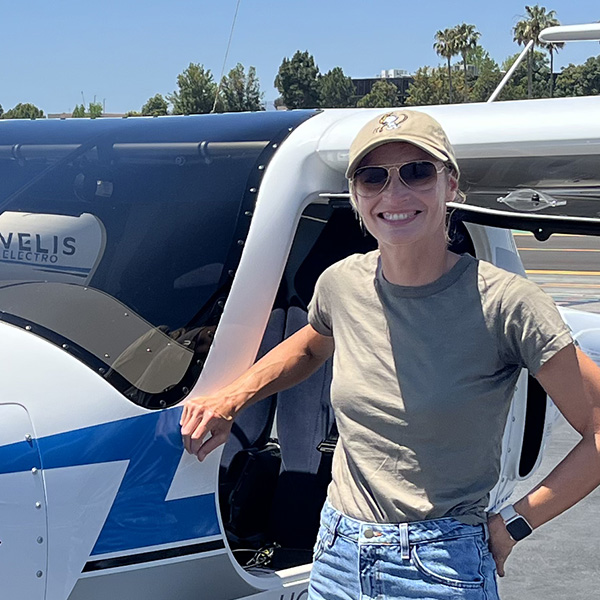
Jessica Cox has a new mission
Redesigning who gets to belong
Jessica Cox is building the Impossible Airplane and designing a future for others. She's challenging an industry shaped by limits—and doing it all with her feet.

Cox isn't designing an airplane to demonstrate she can fly without arms; she established that years ago. This project addresses a different problem: how aviation systems are designed—and who they are designed for.
Cox grew up navigating environments that were not built with her in mind. Long before she entered aviation, she encountered systems that excluded people with disabilities. For decades, barriers to entry have limited who can pursue training or even access.
Like many others, Cox was told what she could not do. That narrative shifted when she encountered someone like herself. "I always wondered, you know, is there anyone else out there? Is there anyone who knows what it feels like? I always was yearning for that because I think that human beings yearn for a sense of belonging and then I turned on the TV, and it was a full-blown news story about this woman who lost her arms at the age of three. And she did everything with her feet. She had a beautiful home. She was driving a car and my jaw dropped and I was stunned, and I was like, I need to meet her. That person for me that changed my world—shook my world."
That moment transformed everything and informed her purpose. Cox is clear about her mission: "I want to replicate that for as many children as we can—kids who've been told their entire life, 'No, you can't.'"
That's who the Impossible Airplane is for. Her focus is not on symbolic achievement but moving from accommodation after the fact to inclusion that begins at the design stage.
Cox's husband, Patrick Chamberlain, has stood beside her across many years of advocacy and achievement. For both of them, the emphasis is not on aircraft performance or metrics but on creating opportunity. They have seen how visibility changes conversations among families, educators, and young people who had not previously seen aviation as an option. "Jessica showing up in an airplane in their hometown—can't say that any clearer." Chamberlain noted.
Cox previously flew a modified Ercoupe configured for foot-only control. The aircraft was groundbreaking, but limited—short flights, a cramped environment, and limited range constricted how far she could take her mission.
Through her, nonprofit Rightfooted Foundation International, Cox set a new objective—to build the first aircraft designed from the outset for foot-only control. The result is the Impossible Airplane, a custom Van's Aircraft RV–10 selected for its payload, speed, and wide flight deck. With a cruising speed near 200mph and instrument flight rules capability, Cox's operational range jumps from tens of miles to almost anywhere in North America.
Her team worked with engineering students from the University of Arizona and the Oregon Institute of Technology to develop fail-safe systems: automatic doors that open even if power is lost, fuel selectors redesigned for foot control, and custom braking systems. Every decision and modification is intentional. "This isn't about novelty," Cox says. "It's about responsibility."
The Impossible Airplane is moving from construction to flight preparation. The first flight is scheduled for June, with a public debut in Wisconsin at EAA AirVenture Oshkosh in July.
The project coincides with broader regulatory shifts. As the FAA's Modernization of Special Airworthiness Certification framework expands sport pilot privileges, the Impossible Airplane illustrates how access can be introduced through design rather than exception. Cox has become the person she once needed to see—now visible in aviation not as a symbol, but as evidence of participation. "We are all possible," Cox says. "Which is why it's called the Impossible Airplane."