National Soaring Museum
A required pilgrimage for sailplane pilots
It all began in July 1930, when Jack O’Meara flew a one-hour, 38-minute sortie in a Baker-McMillen Cadet II—the longest recorded motorless flight at the time—off a ridge south of the city. Elmira was crowned “the soaring capital of America” and the location of the first 13 national championships between 1930 and 1946 (see “Schweizer, Elevated,” December 2025 AOPA Pilot).
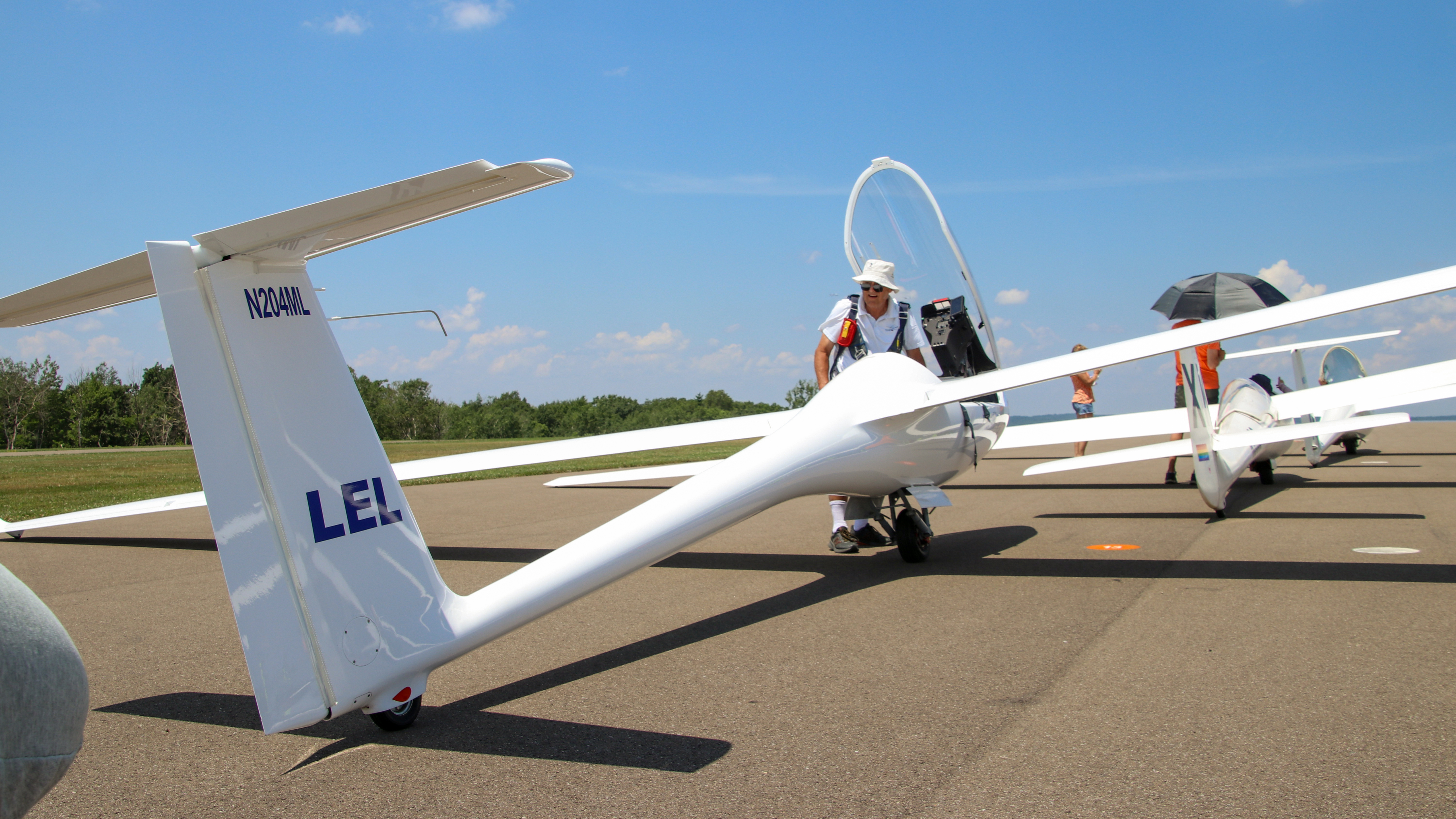
Atop this hill, the National Soaring Museum (NSM), founded in 1969, houses one of the most extensive collections of gliders, parts, and memorabilia anywhere in the world. It’s one of just two museums in America completely dedicated to motorless aviation. And out front is a 1,800-foot-long runway where visitors can step into a glider and soar.
“Our mission is to preserve the history of motorless flight and present it for future generations,” says Adam Smith, NSM’s executive director.
Visitors entering the spacious and airy building immediately come nose to nose with a Bowlus 1-S-2100 Senior Albatross, the wooden airframe that won the 1934, 1935, and 1936 competitions. It is one of just two in existence. The other is at the Smithsonian Institution’s Steven F. Udvar-Hazy Center in Chantilly, Virginia.
“We are extremely lucky to have that ship, it’s completely unique and it’s aesthetically beautiful,” Smith says.
In addition to more than 75 gliders and parts from all eras of soaring, a central display on the museum’s main floor outlines the technological advancements from soaring’s early innovators to the present day. A circular gallery of 129 model aircraft, beginning with the wood-and-fabric Montgomery #1, which in 1883 conducted the first manned, controlled flight of a heavier-than-air machine in history, through to the fiberglass Schempp-Hirth Discus–2, which won the 1999 and 2001 World Gliding Championships.
The museum also has a replica of the Wright 1911 glider, built by sailplane pioneer Ernest Schweizer, to commemorate the seventy-fifth anniversary of Orville Wright’s record-breaking nine-minute, 45-second sailplane flight on October 24, 1911, in Kill Devil Hills, North Carolina.
An entire gallery is dedicated to Elmira’s own Schweizer Aircraft Corporation. The Schweizers’ original SGP 1–1 was destroyed in a fire, but a replica was built in 1989 to celebrate the company’s fiftieth birthday. It too hangs from the rafters of the museum.
“The Albatross is my favorite exhibit, but my favorite part of the museum is the restoration shop,” says Smith, a student glider pilot. “It is prime real estate for glider pilots who are looking to fix up their ship in the wintertime. I have learned a lot about gliding and soaring just from the pilots who are tinkering away on their ship in the offseason.”
The National Soaring Museum welcomes about 4,000 visitors each year and also conducts outreach to young people.
“We go into schools with lesson plans to talk about aerodynamics and principles of flight. If kids are interested in actually flying, they can become junior members of the flying club and learn to fly here for a very low cost,” Smith said.
“Harris Hill is a very special spot for soaring pilots. It’s an important place for the history of the sport, but it’s also a bucket list item for pilots.” 
 soaringmuseum.org
Related Articles


