Choreographed chaos
Decoding the Aresti System
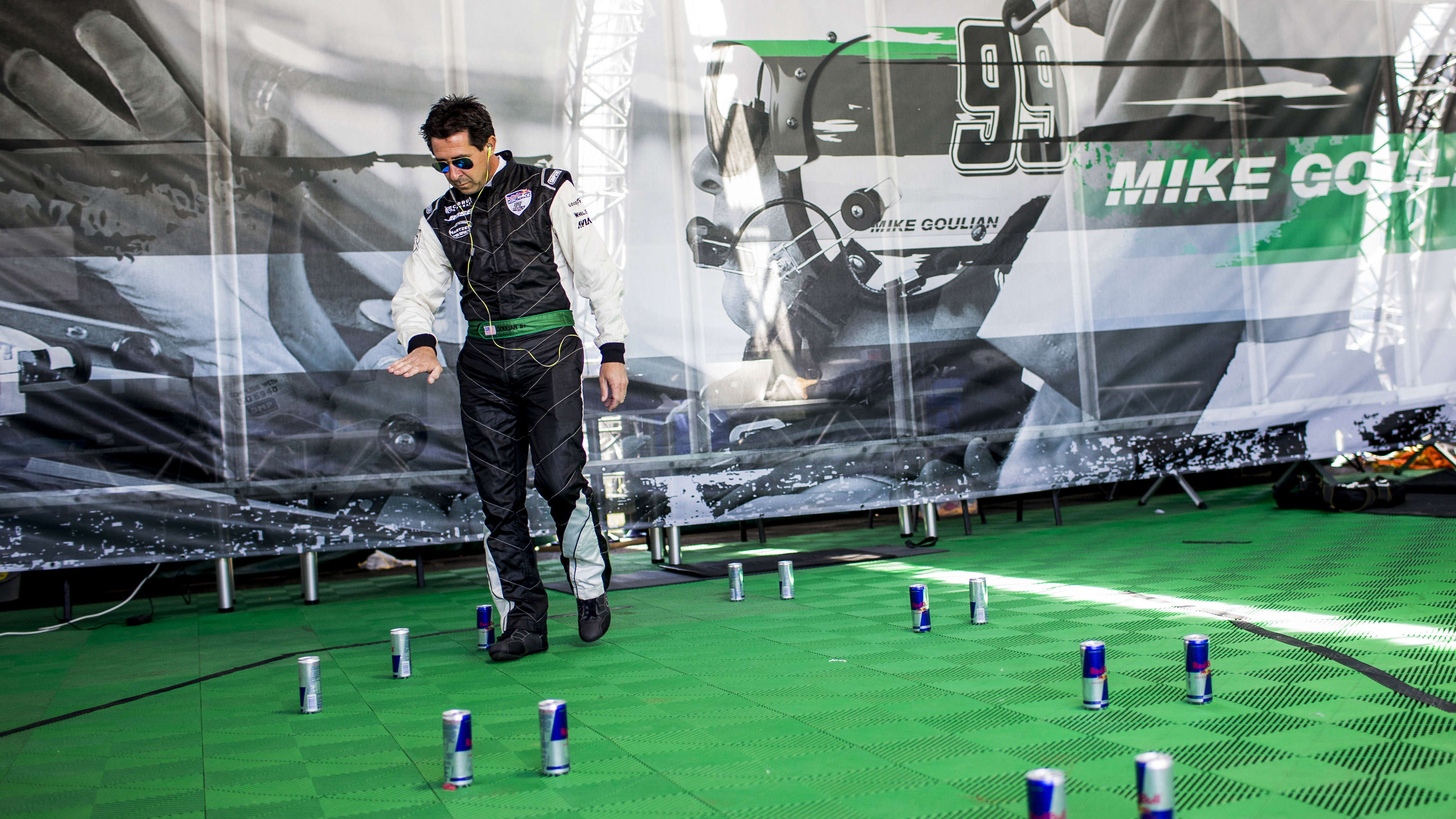
To the layman, this bizarre ritual might resemble an impromptu interpretive dance or perhaps a concerning lapse in sanity from someone about to strap themselves into a cockpit. But there’s no cause for alarm: That pilot does not believe she is a mime, and it’s relatively safe to assume her judgment is still tethered to reality (although a case could be made for aerobatic pilots in general). She’s simply embracing the niche world of aerobatics. More specifically, she’s rehearsing the complex combination of maneuvers she’s about to perform, maneuvers expressed in a language few outside the aerobatic world can understand—the Aresti Aerocryptographic System.
A new language
The Sistema Aerocryptographica Aresti was written in 1961 by Spanish pilot José Luis Aresti Aguirre and has since evolved to become the global standard for aerobatic pilots and judges and the foundation of competitive aerobatics. Described as the “language of aerobatics,” the system is used by the Fédération Aéronautique Internationale (FAI), whose rules are recognized by the EAA’s International Aerobatic Club (IAC). The catalog standardizes scoring and criteria on an international level, allowing pilots from different countries to compete under a single, unified system.
Shoulders of giants
Some notation systems existed before the advent of the Aresti catalog, but none were as advanced. For decades, many of these systems were compilations of informal methods, sometimes little more than an instructor’s personal shorthand, fragmented across pilots, organizations, and countries, leaving ample room for subjectivity and inconsistent scoring.
French aviator François d’Huc Dressler developed an early system in the 1950s, but according to the IAC, development was cut short after Dressler’s death in 1957, before his system was fully realized. Dressler’s work was adopted on a wider scale than had ever been seen before, but it lacked the structure and international support that would be achieved by Aresti’s effort.
In the mid-1930s, Aresti traded his dream of becoming a doctor for a pilot’s seat during the Spanish Civil War. He began flying airshows in 1939 at age 20 and later served as a flight instructor during World War II, providing aerobatic training to military pilots. After developing an aerobatic flight manual for the Spanish Air Force, he became a test pilot for the Air Ministry Test Center in Madrid and became well known in the European airshow circuit. After Dressler’s death, Aresti built upon that foundation and eventually cataloged 3,000 entries that would be used in the World Aerobatic Championships of 1964. The system would grow to comprise more than 15,000 figures. That’s a lot of dance moves.
Aerobatic Syntax
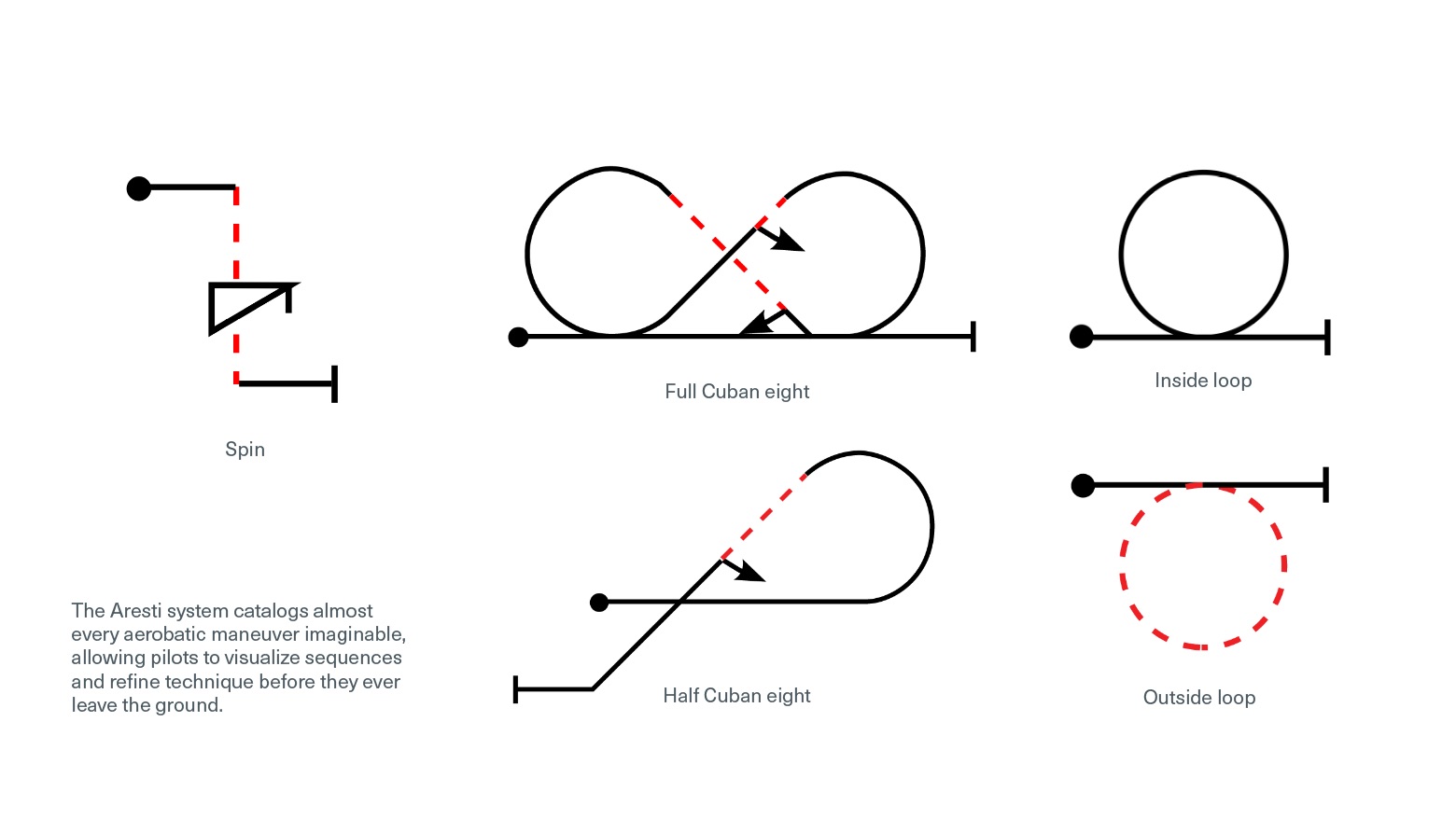
The wild, cryptic symbols you see affixed to aerobatic pilots’ instrument panels are some of the figures that appear in Aresti’s symbolic notation system. All figures begin with a solid black circle (indicating the starting point) and end with a short vertical bar (indicating the ending point). Normal flight is depicted with a solid black line and inverted flight with a dashed line, sometimes colored red. All figures are built on these two symbols, and difficulty increases as the combinations become more complex. For example, an inside snap roll is represented as an empty triangle sitting atop the figure for normal flight, while an outside snap roll is shown as a filled triangle (which may be red depending on the illustration). These pieces come together like building blocks in increasingly more intricate ways as the pilot takes on more challenging sequences.
Each figure is assigned a difficulty coefficient, or “K-factor,” which reflects its complexity and is used for scoring. The higher the K-factor, the more difficult the figure. When figures are combined, their K-factors are summed. Judges score each figure on a scale from 0 to 10 based on execution, and that score is then multiplied by the K-factor to determine the total points for that figure, barring penalties.
Poetry in motion
To many onlookers, aerobatic flight will look like aerial chaos, and that is not too far from the truth. In its rawest form, aerobatic flight is nothing short of chaotic: a body hurling itself through space in unusual attitudes, at wildly excessive speeds. But every control input and resulting maneuver has a corresponding name, shape, and value. The Aresti system is a tool that allows pilots to tame that chaos into beautiful, almost poetic movements. It transforms energy and violent motion into structured choreography and demands a continual refinement of precision, pushing competitors to become better pilots.
Sure, those pilots might look a little crazy while they dance around their airplane like they’re conjuring a spell, but rest assured, there’s a method to the perceived madness, one rooted in decades of innovation and structure, and it connects pilots, judges, and aviation enthusiasts from around the world despite differing languages and geographic dispositions. I say, let them dance. 
[email protected]
 arestisystem.com
Related Articles


