You know it when you see it
Defining a stabilized approach

Some claimed that a power-off landing can’t possibly be stable. Others disagreed but identified configuration changes like extending flaps or changing the propeller pitch on short final would be the destabilizing culprit. I was struck by how worrying about such issues can run counter to safety and strictly adhering to the FAA’s definition misses the point. I’d argue that the definition is a bad one anyway.
In the mid-twentieth century, the FAA attempted to characterize the ingredients of a good approach by defining, and advocating for, a stabilized approach. The Airplane Flying Handbook (FAA-H-8083-3C) describes a stabilized approach as “one in which the pilot establishes and maintains a constant-angle glide path towards a predetermined point on the landing runway” and goes on to say that it “depends on maintaining a constant final descent airspeed and configuration.” That all sounds positive, but parsing that definition carefully shows how little sense it makes.
A stunning omission from this definition is guidance on what that constant airspeed should be. Spinning an airplane straight down and crashing onto the 1,000-foot markers features a constant (90-degree) angle and airspeed (reading zero) to a predetermined point on the runway and will surely end in disaster. But this preposterously bad plan satisfies the stabilized approach criteria.
Less facetiously, nailing 100 knots on short final in a Cessna 172 and following the PAPI guidance to the runway also satisfies the FAA stabilized approach definition. But with all that extra speed, the pilot will either float a long way down the runway or, if he pulls back on the yoke more quickly, the aircraft will balloon upward. Chances are, he’ll try to remedy that result with a sequence of yoke inputs that only exacerbates the situation—the classic pilot-induced oscillation, one of the most common landing accident types. These examples show that the definition is overly inclusive.
Consider another pilot who, say, after ATC requests to keep her speed up on final, chooses a faster-than-normal approach speed following the PAPI light guidance to maintain a constant descent angle of about 3 degrees. She smoothly and continuously retards the throttle and pulls back on the yoke so that she hits the key position, just short of the runway threshold, with an airspeed that guarantees control authority throughout the flare with no tendency to balloon upward or float unnecessarily far down the runway. Although this is a perfectly acceptable technique (see “Collected on the Approach,” January 2023 AOPA Pilot) that sets the stage for a fine landing, it fails to satisfy the FAA’s definition of a stabilized approach. It seems the FAA definition also excludes perfectly fine approaches.
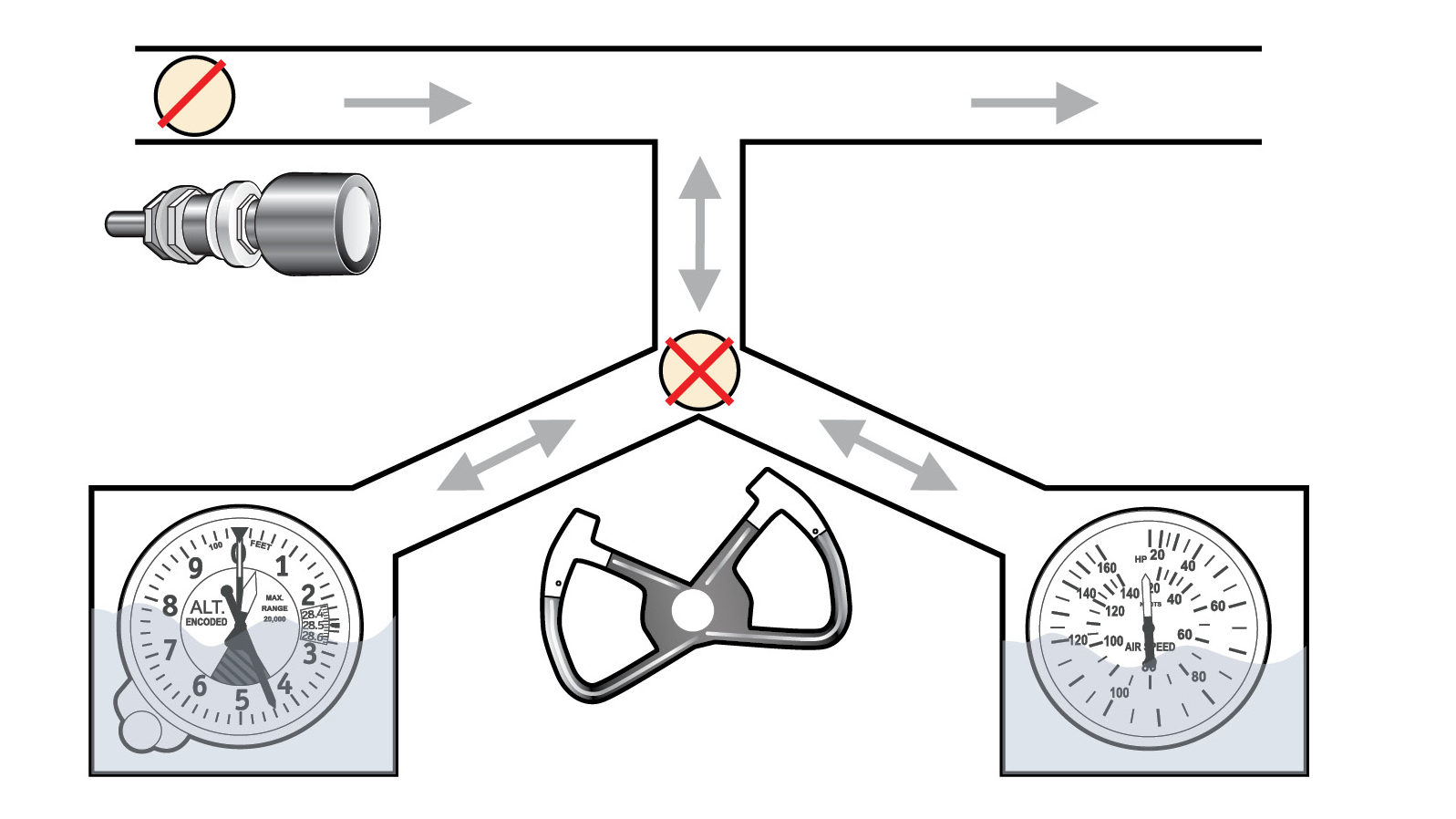
Any discussion of an ideal approach should start with an understanding of energy management. An aircraft that moves through the air has mechanical energy that is the sum of potential energy (height above the ground) and kinetic energy (airspeed), as represented by the buckets in Figure 1. Following the law of the roller coaster, as described by Wolfgang Langewiesche in his classic text Stick and Rudder, a pilot can use the yoke control to trade altitude for airspeed and the other way around.
Drag power is the inevitable tax that the aircraft must pay to fly and represents energy lost in the form of heated air that trails the airplane. The pilot can steepen that cost by, for example, extending flaps, slipping the airplane, or putting the propeller control into a low-pitch configuration. Retracting the flaps, maintaining coordinated flight, or selecting a high propeller pitch will reduce the toll.
To sustain flight, then, a pilot must continually tap into a source of external power (energy per unit time). The engine uses fuel to create chemical power, or the pilot may simply fly inside a column of rising air, called a thermal, for increased power. Downdrafts, of course, have the opposite effect. If the external power exceeds drag power, the pilot uses the yoke control to distribute that added mechanical energy into either the airspeed or altitude bucket. In case of a deficit, the yoke controls the way energy will be removed from each repository.
Throughout the approach and landing, viewing the aircraft as an energy system can be helpful in flying an ideal approach. On the final approach segment, the elevator can be used to precisely maintain a carefully chosen airspeed that guarantees sufficient energy to begin the flare but low enough to prevent unnecessary float. The pilot manages net external power using a combination of throttle inputs, flaps, propeller control, coordinated flight, or a slip to allow the aircraft to descend along a reasonable path to the runway. I strive for a steeper approach than the PAPIs provide because, if chemical power lets me down, I will still be able to get to the runway by managing drag power.
I’ve heard many pilots, some even designated examiners, say that an engine-out approach can’t be stabilized and that news would surprise the glider community. The Glider Flying Handbook offers the stabilized concept, like that in the Airplane Flying Handbook, and advises pilots to approach with half-open spoilers. In doing so, the pilot can either add or subtract that input to correct for being high or low on the approach, respectively. Glider and powered-aircraft pilots alike have a way to manage external power in flight.
In a perfect world, a pilot would fly the final approach segment and landing by making only throttle reductions. But changing air movement as the aircraft descends through various altitudes can make that procedure unrealistic. If the headwind component increases, the pilot will need to add throttle and, if she finds herself too high, she can reduce throttle or add drag by extending flaps or performing a slip. Some pilots believe that any late configuration changes automatically render an approach destabilized and therefore bad. While I am not advocating throttle jockeying or wild, last-second changes to aircraft configuration, precluding late adjustments is unrealistic at best.
The airman certification standards don’t list the power-off one-eighty among the emergency maneuvers, but it’s one of the most useful skills to hone. Flying one well involves doing whatever is necessary to be able to put an airplane down, with exactly the right amount of energy, to land in a confined area. Flying this (or any) approach well involves continually assessing the energy state of the aircraft. Knowing how to make late adjustments for a successful landing may prove useful during an engine-out emergency.
In 1964, United States Supreme Court Justice Potter Stewart famously described pornography as difficult to define but said, “I know it when I see it.” A stabilized approach similarly eludes a concise and accurate definition. Although I dissed the FAA’s definition, I’ll not propose another one because it too would fall short.
An ideal approach begins with choosing a responsible approach speed and flying it with precision. The pilot continually assesses the aircraft’s energy state, then manages external power to guide the airplane with smooth power and control inputs so the aircraft descends along the desired vertical path to the runway. Throughout the approach, a safe landing is never in doubt.
As a pilot, instructor, and examiner, I know it when I see it.