Powered by ButterBurgers
Transitioning from props to fans

His franchise company owned some Culver’s restaurants in the Kansas City, Missouri, area, but was expanding to Wichita. If you’re not familiar, Culver’s is famous for its ButterBurgers, Wisconsin cheese curds, and frozen custard. Once you try any of those, you will understand why it’s such a fast-growing company. (Note: There are two in Oshkosh. Take a night off from Ardy & Ed’s Drive-In this year at EAA AirVenture and give Culver’s a try.)
“Our Culver’s group was growing, and we were making good money,” he said. A new Kansas City location was not opening on time and missing the depreciation from that new asset, “I needed a tax write-off,” Mitchell explained. A friend recommended he buy an airplane.
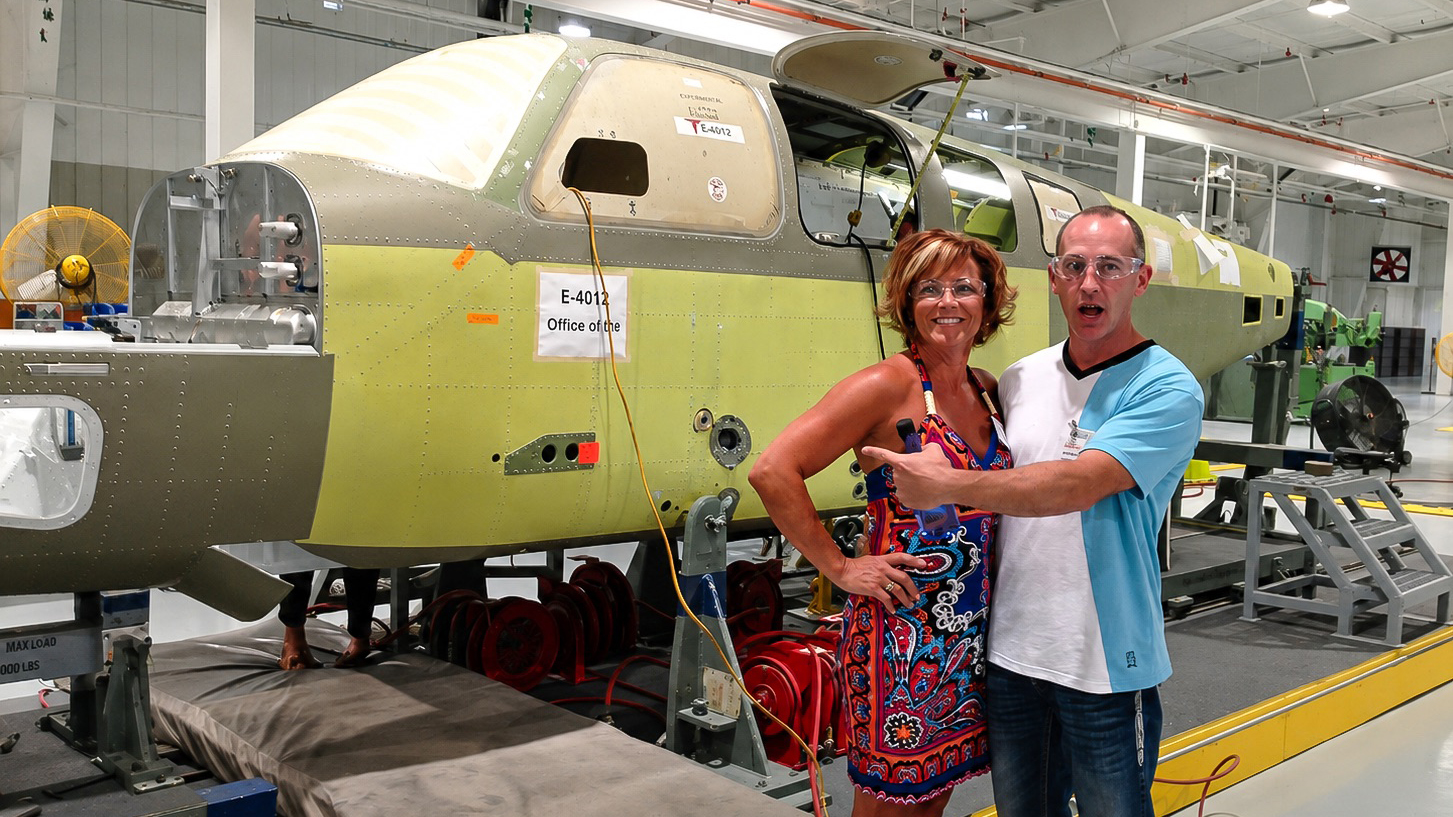
Willing to give it a go, Mitchell took his first flight lesson on September 3, 2013, with well-known CFI and aircraft broker Michelle Stauffer. The ever-savvy saleswoman put Mitchell in the left seat of a new Cessna 206 for his second lesson, and they flew to Independence, Kansas, to tour Cessna’s piston airplane factory. The experience set the hook for Mitchell to buy a new airplane. When he asked what else he might consider, Stauffer produced a nearly new Beechcraft Bonanza A36 for another lesson, and they flew it to Wichita to tour the Beechcraft factory. Along the production line, they took a photo alongside the last Bonanza that would be produced that year. “So that was our first plane,” Mitchell explained. He took possession of the airplane on a Friday in November, just two months after his first lesson. He got his private certificate the following Monday in the Diamond DA40 he had been flying. “So, we owned this brand-new Bonanza and I couldn’t fly it,” he said. But the high-performance and complex signoffs followed quickly. As did an instrument rating. “It took me 50 weeks to go from first lesson to purchasing a plane and getting an instrument rating.”
Shortly thereafter, Stauffer sold her company, Kansas Aviation, to Tim White. Kansas Aviation later merged with jetAVIVA, where White is now vice chairman. As the new owner of Kansas Aviation, White followed up with previous customers and produced a series of potential airplane upgrade ideas for Mitchell, including a Mirage, Piper’s turbocharged, pressurized single-engine piston model. Mitchell saw the benefit of pressurization and flying in the lower flight levels and quickly bought the airplane. Four years later, he was ready for the next move. He contacted White about a jet. Among the goals was nonstop from Kansas City to his home in Arizona.
The DA40, A36, and Mirage all had Garmin G1000 panels. Mitchell reasoned that having to learn how to fly a jet and a new avionics suite would be a lot, so he focused on light jets with a Garmin panel. He ultimately bought an Embraer Phenom 100. White put a package together that included the airplane, insurance, and access to a qualified instructor.
But his careful planning hit a snag: He had anticipated getting his multiengine rating in the Phenom. But the insurance company had other ideas. Guess who won that argument?
With just 30 days before taking delivery of his Phenom, Mitchell began multiengine training in a nearby flight school’s Piper Seminole. The training went well with a young CFI who has since become a good friend. However, a small slip up on the check caused him to fail. “It’s the only checkride I’ve ever failed,” Mitchell lamented. But a quick retest on that one single-engine maneuver a few days later got him the multiengine rating.
Mitchell took possession of the Phenom during a snowy winter in Kansas City. He and the instructor flew to Florida for the training, completing 60 flight hours required by the insurance company and getting a type rating in just 12 days. “That’s probably the craziest thing I’ve ever done. I was either studying or doing ground school or flying. It was literally all day from waking to sleeping for 12 days.”
Among the challenges for him was staying ahead of the faster airplane. “If I’m coming from Phoenix to Kansas City and I’m over Wichita, I’m probably 15 minutes from the ground [in the Phenom]. In the Mirage, I was 30 or 40 minutes [from landing].”
“It does happen quicker, but it’s easier,” he said. With FADEC and only a couple of levers to manipulate, the Phenom is easier to manage. “You’re not fiddling with three levers, trying to get everything dialed in and watching temps and doing all those things. It’s simpler.”
Mitchell advises those looking to transition to a jet to “be prepared to work really hard; study as hard as you can.”
He takes recurring training seriously, changing instructors every couple of years in order to get a well-rounded experience and a new perspective.
With grandchildren growing up and future family vacations in mind, he’s already looking at the next larger airplane, probably a Phenom 300 or a Cessna Citation CJ4. But Mitchell isn’t stopping there, he’s inspiring the next generation. His son, a principal in the franchise company, is now a private pilot. Together they own a 1979 Mooney. “Someday, I’m sure, he will be flying a jet.”
Reflecting on the process, Mitchell remembers a flight instructor telling him just before he bought the Bonanza, “Your life is about to change.”
“And he was right,” said Mitchell. “Having a plane changed everything. What life is like now, having that ability to get so far so fast, we thought it’d be cool. It’s way, way cooler. When I wake up on a day I’m going to fly, I have a little more pep in my step than on a normal day. And when I take the runway, I’m excited. It doesn’t get old pushing those two throttles forward and feeling the power of running down the runway and taking off. The smoothness that you have compared to a piston. You’re blasting through low-level turbulence so quickly that it’s just a different ball game.
“We feel grateful and blessed every day to live the life that we live. But having a jet is beyond what we expected.”

Related Articles


