Flight planning basics
Be smarter than your EFB
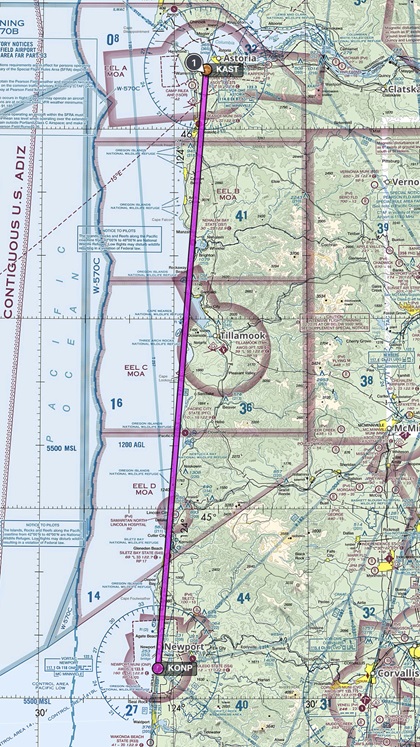 Electronic flight bags (EFBs) are great tools that take the mundane calculations out of determining headings, airspeeds, and other flight planning numbers. But relying on the EFB exclusively can make those skills atrophy or hinder their development. During the exam, I always ask the candidate to pull out the Pilot’s Operating Handbook (POH) to verify a couple of the EFB calculations. That request is sometimes followed by the candidate rustling back and forth through the POH pages and ultimately giving up. Poor understanding of flight planning principles is a common reason for a notice of disapproval, even on flight instructor initial exams.
To illustrate the process, let’s plan a flight along the Oregon coast from Astoria Regional Airport (AST) to Newport Municipal Airport (ONP). Drawing a course on the sectional chart and using a plotter to measure the angle against a line of longitude gives a true course of 185 degrees. Indeed, it’s clear that because the course crosses from the east side of a longitude line to the west side, the flight will progress in a westerly direction with respect to true north. It might be tempting to select a VFR altitude of, say, 4,500 feet, but we need to account for the variation first to find the magnetic course. In this case, the nearest isogonic line, labeled 15 degrees E, means that our magnetic course is 185 – 15 = 170 degrees. FAR 91.159 specifies that for such a magnetic course between 0 and 179 degrees, the altitude should be an odd thousand plus 500 feet, so 3,500, 5,500, and 7,500 feet are examples of appropriate choices. Most nav log forms don’t include a column for magnetic course, so candidates almost invariably make an altitude selection using true course or a heading (true, magnetic, or compass), and all of these are mistakes. The highest maximum elevation figure along the route is 4,400 feet msl, so 5,500 feet msl or 7,500 feet msl makes sense, depending on whether the pilot would like a better view of the ground or have the increased options that extra altitude affords.
So far, we know how the airplane will travel over the ground. But given winds, the aircraft’s nose might be pointed in another direction. On this day, the winds at 7,500 feet were from 290 degrees at 20 knots. Plugging this information, along with a true course of 185 degrees and an airspeed of 115 KTAS, into the E6B, we find the true heading is 195 degrees. Because we navigate with respect to magnetic north, we add the variation of minus-15 degrees to arrive at a magnetic heading of 180 degrees. Finally, the aircraft compass deviation card shows a zero error for southerly headings, so the compass heading for the cruise portion of the flight is 180 degrees.
Like most others, I don’t get out a paper navigation log when I plan a cross-country flight. Using my dependable EFB to make quick work of those calculations allows me to devote more time to investigating weather and considering routes that offer greater ground clearance, easier access to fuel stops, and alternate destinations should I need to change the plan. But pilots should be able to perform all the computations that an EFB provides to be better consumers of the information it provides. Otherwise, an EFB is merely another black box, and pilots may miss critical errors that are often user-initiated.
And the ACS still requires an understanding of these and myriad other calculations, so demonstrating them is fair game on FAA practical exams.
Related Articles


