Tailwheel traditions
The next generation of stick-skilled pilots
Outwardly, Santa Paula Airport (SZP) is not a place that radiates youthful energy. Across the freeway from a town straight out of an old-time Western movie, the hangars are a reminder of a different time, with metal roofs slowly yet steadily rusting away in the foothills of California’s southern mountains. Walking onto the ramp, you might expect a tumbleweed to blow right by you.

But when one of the hangar doors begrudgingly creaks open, a different image unfolds. In these hangars, you’ll find a community of young tailwheel and aerobatic pilots. They all belong to a generation that’s typically accused of being “children of the magenta line”—pilots overly reliant on the magenta-colored GPS course line on digital flight displays. Every single one of these young aviators, however, is not only proficient in classic or new tailwheel, six-pack airplanes, but they love it.
“We don’t have night ops, we don’t have instrument approaches, it’s a very small, short runway, and there’s a big community here,” said Emmersen Berg, a local commercial pilot and CFI in her early 20s, who also flies a Cessna 140 through a local club. Flying tailwheel has not only become a passion for Berg but also a valuable learning tool.
“In a [Cessna] 172, you hear your instructor saying right rudder, in one of these [tailwheels], you actually have to use the right rudder,” said Berg with a chuckle. “It’s easily transferrable to other aircraft. You master it here, when you go step into a 172 or anything like that, you have a better feel and sense of how to control the airplane.”
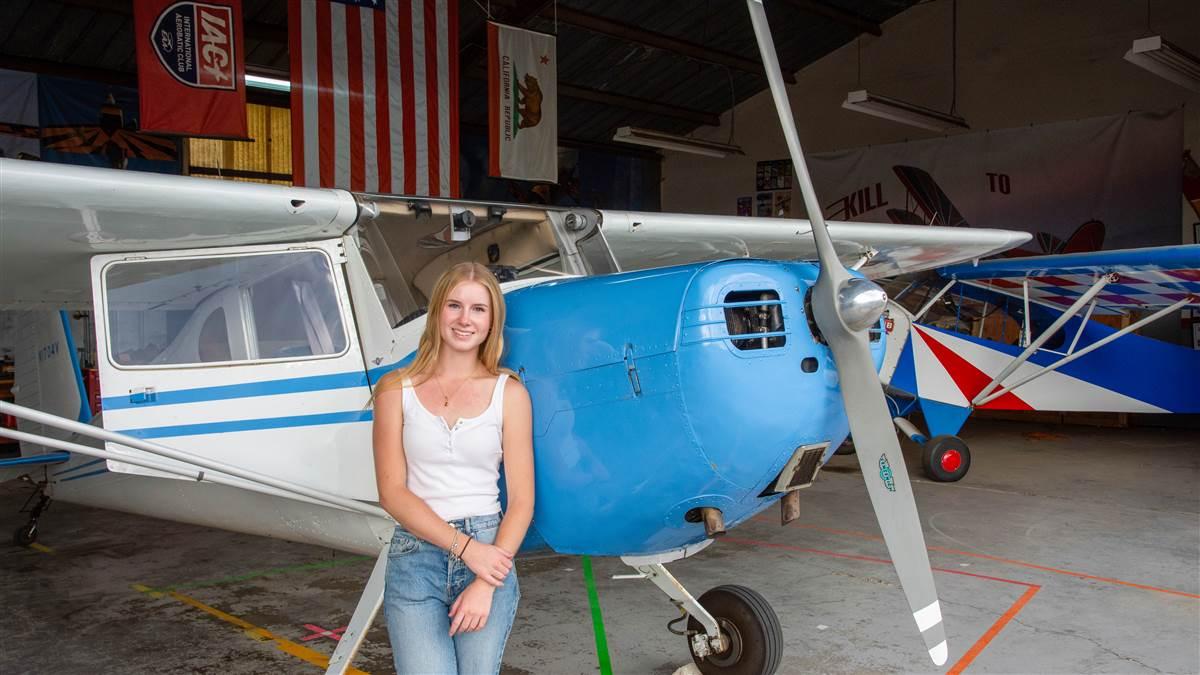

Emmersen "Emmi" Berg
Commercial pilot and CFI
Berg’s passion for tailwheel flying might make her an outlier elsewhere, but not at Santa Paula. Spending a few hours at the airport, you’re as likely to see tailwheel and aerobatic aircraft as you are likely to see tricycle gear. You’ve probably heard people scoff at young, (relatively) low-hour pilots getting anywhere near a tailwheel aircraft. But for some of these young pilots, it’s a family tradition.
“I was born into and raised in an aviation family, so I was in the backseat of this [Cessna 180] from newborn to now,” said Alessandra Rizzo, an instrument flight instructor and California native who moved to Santa Paula to flight instruct.
It would take until the COVID-19 pandemic for Rizzo to get the family flying bug, right around when she was 18. She went to college, where she graduated with a degree in biochemistry, while continuing to accrue her ratings, earning a CFII by the time she graduated. From there, the choice was simple: “I didn’t want to go to med school, flying’s more fun,” Rizzo recalled. “Hey, I have this CFI, CFII, I’m employable!”
I was in the backseat of this [Cessna 180] from newborn to now.
—Alessandra Rizzo
Now instructing at the local flight school, Rizzo started her tailwheel journey in an American Champion Citabria—one of the many you’ll find in Santa Paula. After five hours in the Citabria, Rizzo moved up to the family 180. “At first, it was like driving my dad’s truck after learning how to drive; ‘This is too much airplane!’ But now, it’s like the gentle giant.”
Rizzo and Berg are building a growing community of younger pilots going against the grain of what is expected of Gen Z pilots, all while uplifting each other. Another one of those pilots is Chloe Le Lievre. Le Lievre is also a tailwheel pilot, but with a twist; you’ll find her in a Pitts Special.
“Aerobatics is the ultimate test for a pilot,” said Le Lievre. “It’s made it almost hard for me to be friends with people who aren’t into it because, as any of my friends will tell you, it’s all I can talk about.”
Although aerobatic flying is a different kind of challenge altogether compared to your average Cessna 140 or 180, when it’s time to land, it has all the same stick and rudder challenges that come with a taildragger, and the limited forward visibility over the nose.
Why is tailwheel flying harder?
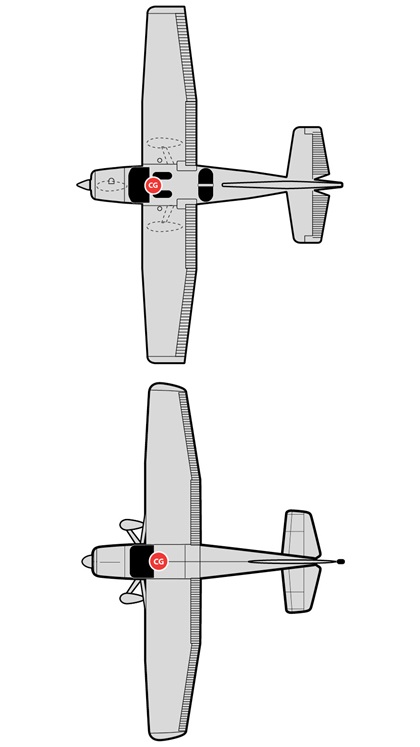 Tailwheel aircraft have a center
of gravity (CG) behind the main
gear, unlike a tricycle gear aircraft,
where the CG is in front of the
mains. This will cause taildraggers
to want to swing their tail around
during taxi and landing, which,
when not adequately accounted
for, causes the dreaded ground loop. This makes keeping the aircraft tracking straightespecially important.
Ground handling is also different
because of the reduced
visibility over the nose.
Flying tailwheel is a great tool
to have in your toolbox, and
many pilots leave tailwheel
training feeling much more
proficient with their stick
and rudder skills, which
transfers nicely to all kinds of flying.

Alessandra Rizzo
Instrument flight instructor
Shaping the next generation
What unites all the young pilots at Santa Paula, tailwheel, aerobatic, or otherwise, is how much they care not only about their subset of the aviation community but the community as a whole. Tons of individuals out there dream of flying. Some get right after it, others struggle. Some of it is financial, but a lot of it, the Santa Paula pilots say, is needing a helping hand (or more), a mentor, to help them break through those initial barriers. Every single one of these young pilots at Santa Paula is chomping at the bit for the opportunity to mentor the next generation of aviators.
“For anyone I meet, pilots, people aspiring in business aviation, I can get them any contact I can to help them any way that I can,” Le Lievre said. Aside from aerobatic flying, Le Lievre works in business aviation, where she is building a career and encourages other young women to consider it if they find it interesting. She also plans to join her friends by pursuing her CFI, which she sees as just another way to give back to the community.
Despite recent growth, women still make up only 10 to 15 percent of active GA pilots (estimates vary based on how you count). Assuming that 15 to 20 percent of those pilots held tailwheel endorsements, the population of female tailwheel pilots is very small, let alone in the age range of Berg, Rizzo, and Le Lievre.
“Being a woman and being able to support other girls that I’ve met along the way, I have a really good group of girls, we fly together, and I help them study and vice versa,” said Berg. “Trying to support other girls and give them the same opportunities that I’ve had.” But every little bit of support a young pilot can get can really help take their dream into a success story.
“I’ve had a really positive experience in aviation, and I’ve received a lot of encouragement from both my father’s generation of older people but also my own community of women in aviation,” Rizzo said.
And when it comes to shaping the next generation of aviators, Berg and Rizzo are keen to pass on the tradition of the tailwheel.
“I think it’s a really big privilege and something I don’t want to take for granted. And I just hope that I can bring those skills to other people so they can join it as well. Encouraging others to exceed the minimum standard is something that has been introduced to me since the beginning of my aviation training,” said Berg. “And so that kind of looks like not just getting your tailwheel endorsement, but I have my complex, high-performance, high-altitude. It’s all about safety, really.”
“I learned right after my primary. A lot of times, students are very gung-ho about tailwheel, which is awesome. I’m so stoked to teach some tailwheel because I love [it], but also—unless they start on tailwheel—sometimes I feel like it confuses them before they start learning to land,” said Rizzo. “But when my students are like, ‘I want to do tailwheel,’ I’ll take them on a flight. And if you really want to do it, we’ll do it.”


Chloe Le Lievre
Tailwheel pilot
From tailwheel onward
These young Santa Paula pilots have their goals set high. Le Lievre plans to continue working in business aviation while working on her aerobatics with hopes to make the advanced national team, or even the unlimited national team. “I would love to teach aerobatics,” said Le Lievre. “Get a couple PPLs under my belt as well, but I would love to teach the aerobatic side of aviation.”
While she continues to instruct, Berg has her sights set on professional flying.
Aerobatics is the ultimate test for a pilot.
—Chloe Le Lievre
“I really want to fly turboprops, like a King Air, or for a charter company. I had an opportunity to fly in a Pilatus PC–12 once with a friend of mine. I absolutely loved that,” she said. “And I think that’s kind of where hopefully my journey leads me. I started aviation not really having, like, a goal. You know, I didn’t really want to go to the airlines. I just kind of started because I fell in love with it.”
Rizzo, too, has her sights on higher ratings, but is enjoying where she is now.
“I decided to start instructing as a gap year from college, and now I’m like, maybe I should go for a career in flying,” she said. “But I definitely want to get my ATP in something. I want to get my multi ATP in the next year and a half. So how we’re going to get there...we don’t know yet!”
Wherever they end up, you’ll know that they have each other’s backs and will be mentoring other people into the cockpit on the way.
Related Articles


