From passion to purpose
Mosquito control helps pilot build experience for wildfire goals
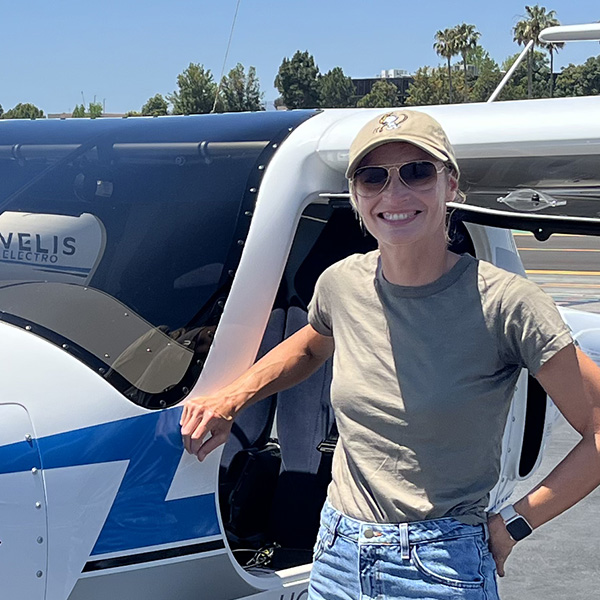
When Mia McKnight talks about how she found her path in aviation, she laughs—because she can't resist the pun. "My passion and love for aviation just took off," she said. But like most compelling flying stories, it didn't happen overnight.

During the long stretch of COVID-19 lockdowns, McKnight was living in rural Northern California, where wildfire season was no longer a season—it became a constant. In 2020 and 2021, she watched as aircraft battled flames overhead.
Like most pilots, McKnight ran into aviation's biggest obstacle: cost. "Going from student pilot to [multiengine flight instructor] can be around seventy thousand dollars. That alone can stop people." She may have stalled there, but that's where the community stepped in.
McKnight applied and received a $10,000 scholarship from the Auburn Aviation Association, which she put toward her private pilot certificate and instrument rating. Later, she earned grants from Ellsworth Hovey Getchell Foundation to support her commercial, certificated flight instructor, and MEI ratings. "It makes the absolute world of difference," McKnight said. "Not only financially but through mentorship, support, and community."
Today, McKnight gives back as a mentor, a scholarship review board member, and now assistant scholarship coordinator for the Auburn Aviation Association.
After becoming a flight instructor at Mac 5 Aviation at Auburn Municipal Airport in California, McKnight followed a path that many pilots know well—teaching and conducting stage checks. Looking to build more hours, McKnight recalled a conversation with another pilot who mentioned a job flying nighttime mosquito abatement missions. Most people would hesitate, but to McKnight, "It sounded fun. Different. A way to get real experience," she said. She applied—and got the job.
Mosquito abatement missions typically take place at dusk or just after sunset, when mosquitoes are most active and winds are calm.
A typical shift begins with dispatch. "We review terrain and obstacles, file notams if needed, load aircraft, program navigation, take off around sunset, spray blocks, return, clean aircraft, and complete the paperwork," McKnight explained. When operations are near controlled airspace, crews coordinate with air traffic control. Once airborne, pilots fly precise patterns over defined areas. "It's similar to crop dusting—but for mosquitoes." Each operation lasts three to four hours, consisting of local flights within California, where applicators are state-licensed.
Last season, McKnight logged about 200 hours spraying mosquitoes over Northern California. That proved more valuable than just numbers in a logbook. "It's crew resource management. Flying with licensed pilots is different than instructing. Several people who previously worked in the position I work at currently work for contracted aerial firefighting companies. Because low-level application time is, it's literally exactly what you're doing as a tanker pilot or a scooper."
In December, McKnight earned her single-engine seaplane rating—a move directly tied to her long-term goal of aerial firefighting. Her first water landing was unforgettable. She described seaplane flying like learning a new language. Next on her list—multiengine seaplane.
Every career move McKnight makes is strategic. She's now exploring FAR Part 135 operations to build turbine time, instrument flight rules experience, and crew resource management. She's also realistic about the competition. "You have to think, you're up against a lot of former airline pilots, former military pilots, professional bush pilots from Alaska or more rural areas," she said. Still, she doesn't see that as a reason to slow down.
Her advice to pilots just beginning to build time is simple: Be curious and make connections. "There are so many people at your home airport that you don't even know have these connections. And the only way you will know is by talking to them," she said. McKnight also points new pilots toward flight instructing and volunteer organizations such as EAA's Young Eagles or the Civil Air Patrol as ways to build experience while staying engaged in the community.