Where’s your backside?
Locating the region of reversed command
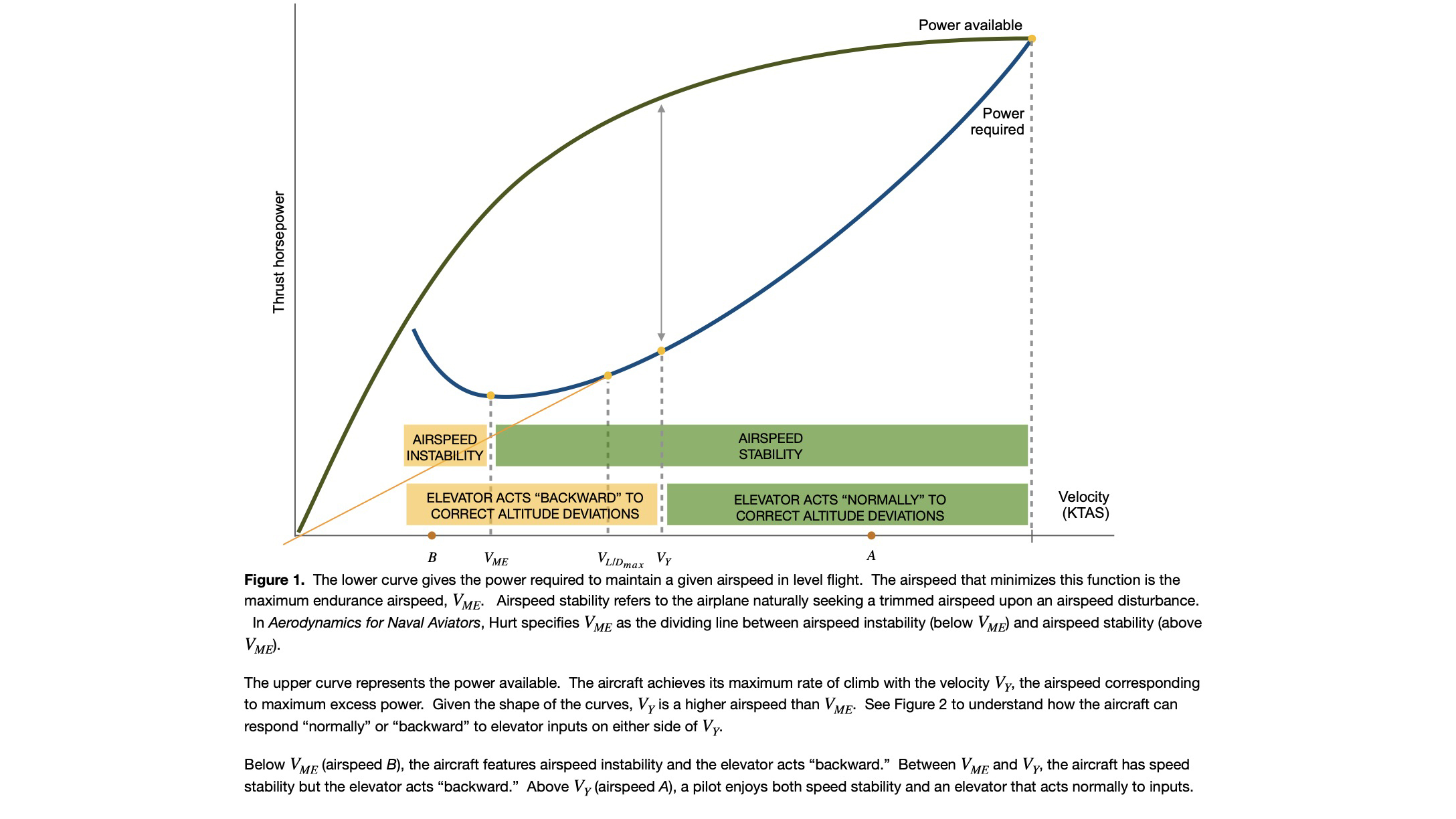
The most common airspeed cited as the defining airspeed was V(L/D)max. This airspeed offers the minimum power required per knot of airspeed, so it maximizes glide distance in an engine-out scenario with calm winds. It’s equal to VMR, the airspeed that will leave the maximum amount of fuel in the tank at the end of a trip (again, with calm winds) as discussed in “Cruise Flight” (January 2026 AOPA Pilot). Figure 1 shows how V(L/D)max can be found on the graph of the power required curve. In my own Beechcraft Bonanza E33C, V(L/D)max is 105 knots, much slower than the typical 160 to 165 KTAS I get with 65-percent power. I didn’t buy a Bonanza to go slow, so I choose to optimize for a combination of fuel and time economy. While V(L/D)max is a handy airspeed to remember when the engine fails, it does not represent the airspeed below which control movements become counterintuitive.
Some pilots voted for maximum endurance airspeed VME, the airspeed in Figure 1 that corresponds to the minimum power required for sustained flight. In his classic text Aerodynamics for Naval Aviators, author H. H. Hurt points to VME as the dividing line between the front and back of the power curve: “Since the increase in required power setting with decreased velocity is contrary to the normal command of flight, the regime of flight speeds between the speed for minimum power setting and the stall speed is termed the ‘region of reversed command.’”
To see why this makes sense, consider a pilot flying with airspeed A in Figure 1. If the airspeed is perturbed slightly to a higher airspeed, the resultant power deficiency will ensure a tendency for the airplane to return to airspeed A. Similarly, the excess power upon disturbance to a lower airspeed will result in the airspeed increasing back to A. The return to cruise airspeed is quick, so there is little tendency for the airspeed to wander. Hurt calls airspeeds above VME the “region of normal command.”
Now suppose that a pilot flies with airspeed B. A slight deviation to a slower airspeed means a deficiency of power, and the deviation becomes magnified. Deviations toward a higher airspeed can also exacerbate the problem. In the region of reversed command, there is a weak tendency for the aircraft to maintain a trimmed airspeed. Therefore, aircraft exhibit speed stability at airspeeds above VME and lack airspeed stability below it.
No one who responded to my poll mentioned VY, best rate of climb airspeed. As shown in Figure 1, VY is the airspeed for which the difference between power available and power required is the maximum. To understand how it’s a contender for the threshold between the front and back of the power curve necessitates consideration of a different version of the power curve. Figure 2 gives aircraft climb rate versus airspeed for various fixed power settings. The top curve represents takeoff power, so VY is the published airspeed at which the aircraft will climb at the fastest rate with respect to time. By restricting available power, the upper curve has a similar shape but is shifted downward, and the maximum rate of climb airspeed for this power setting tends to be less than the published VY. At idle power, the curve sits below the horizontal axis, and the best rate of climb airspeed becomes the minimum sink airspeed VMS.
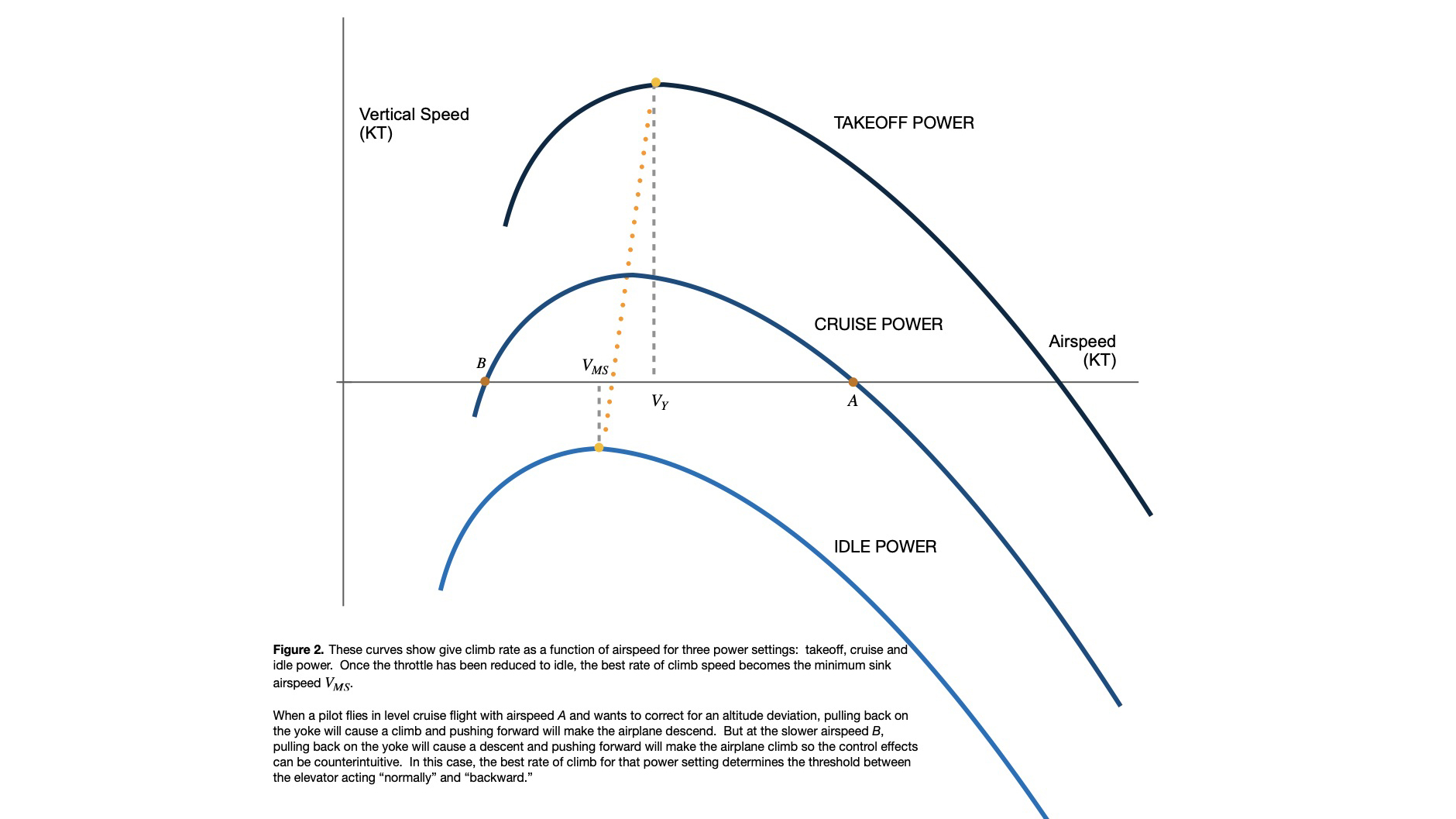
Consider a pilot who operates an airplane in cruise flight using a fixed power setting (see Figure 2), and let VY1 be the corresponding maximum rate of climb airspeed. At airspeed A, if the airplane is disturbed to a higher altitude, the pilot may push forward on the yoke, and the airplane will descend back to the cruise altitude. If the airplane descends, the pilot can pull back on the yoke and initiate a climb.
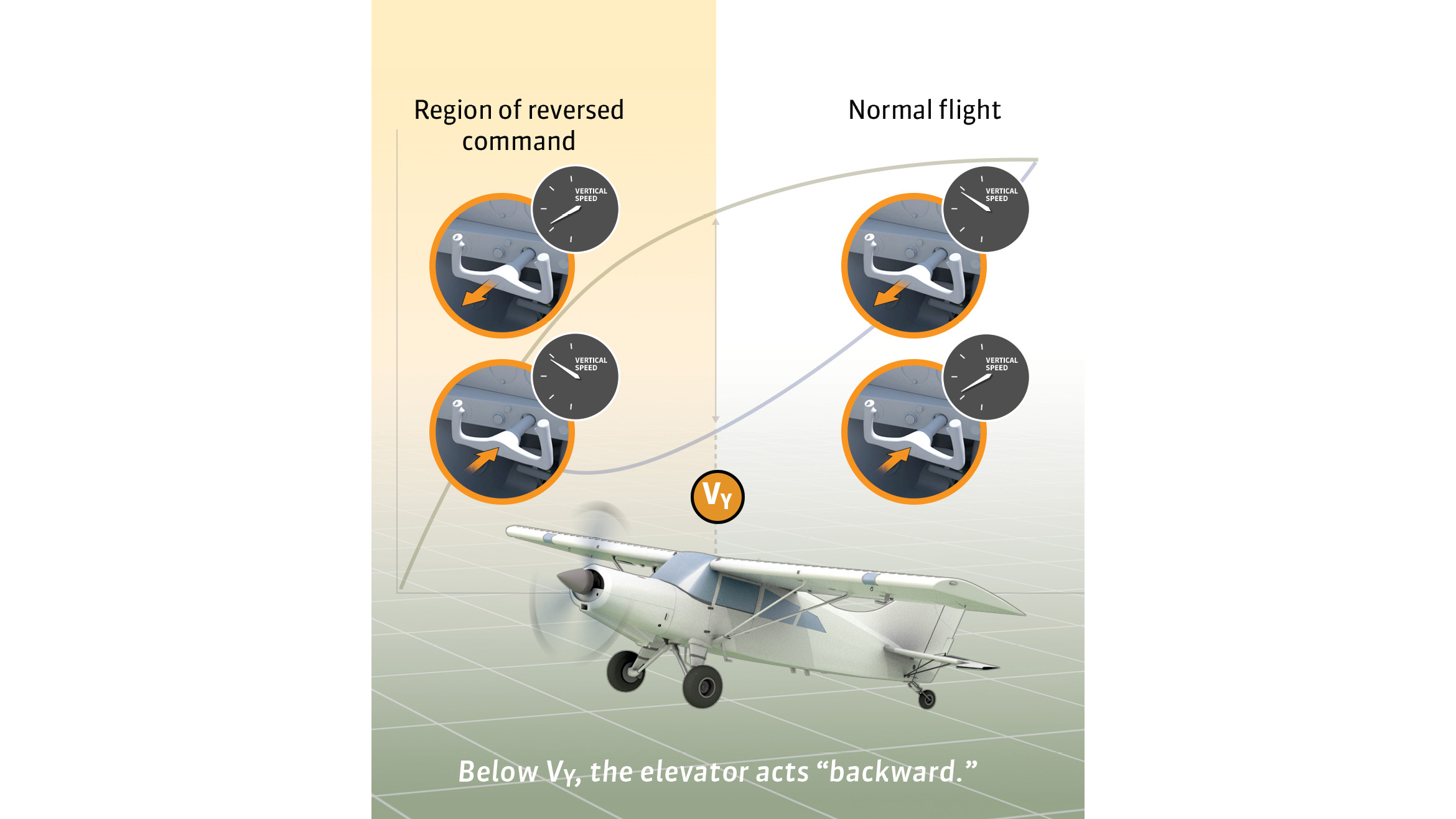
However, if the airplane flies with airspeed B and a gust pushes it to a higher altitude and the pilot pushes forward on the yoke, the airplane will tend to climb. More alarmingly, if the pilot corrects a downward deviation by pulling back on the yoke, the altitude will continue to decrease, and the pilot may stall the airplane. The effect of the yoke to correct altitude deviations is different on the two sides of this power curve. Thus, the best rate of climb airspeed is a worthy contender for defining the region of reversed command.
To summarize, flying below VME requires the addition of power, which can seem counterintuitive. But airspeeds above VME still may involve the elevator acting backward. Flying above VY, the pilot can rely on an intuitive response to applications of power and elevator inputs and enjoy airspeed stability as well.
Another attractive feature of VY as the determining airspeed is its availability, as it’s there in any POH, whereas I’m not familiar with any that publishes an airspeed for VME.
While the critical airspeed that defines the top range of the region of reversed command is important, I also asked pilots to share the phases of flight during which they use pitch to control airspeed and power to control altitude, and I was surprised to see how many restrict the technique to short final. After all, I use pitch to control airspeed in every phase except level flight.
On a typical flight, once I see rotation speed, I use pitch to hit the appropriate sequence of airspeeds (best angle VX, followed by best rate VY, then a cruise climb airspeed that promotes engine care) until I level off at my assigned altitude. Once there, I use pitch to maintain altitude, reduce the rpm to 2,300 and the manifold pressure to 23 inches, and wait for the airspeed to stabilize and accept the airspeed the atmospheric conditions and altitude allow. To begin a descent, I reduce the manifold pressure to, say, 20 inches, and allow the nose to fall and descend at an airspeed close to cruise. If I meet bumpy air on the way down, I pull back on the yoke and pitch for an airspeed closer to maneuvering speed. On the downwind leg of the pattern, 15 inches of manifold pressure gives me about 100 knots. Then I extend the gear, add flaps, reduce throttle abeam the numbers, and increase propeller rpm. I use pitch control to hit 80 knots until short final. To let power control airspeed in any phase other than level flight seems clumsy.
Interestingly, power controls altitude and pitch controls airspeed across the entire airspeed spectrum. Hurt emphasizes in his text that “power setting is the primary control of altitude in steady flight,” and that “angle of attack [pitch] is the primary control of airspeed.” Legendary Stick and Rudder author Wolfgang Langewiesche even calls the movable surfaces behind the horizontal stabilizer the flippers because, as he explains, the “elevator doesn’t elevate.”
While many pilots believe that pitch controlling airspeed and power controlling altitude is appropriate only to flight on the back side of the power curve, it’s a great technique on the front side too.


