The Gooney Bird made from gum
Wrigley called it Wasp
In the early 1890s, William Wrigley Jr. was a soap salesman. To encourage store owners to purchase the soap made by his father’s company, he tossed in free baking powder with each purchase. Soon, his customers became more interested in the baking powder than the soap. So, Wrigley switched to selling baking powder. Having learned the value of offering free premiums, Wrigley this time gave his customers free chewing gum. Wrigley’s giveaway gum soon became more in demand than his baking powder. This led him to purchase Zeno Manufacturing, the company from which he had been sourcing his gum. Some of his first few flavors—Juicy Fruit, Spearmint, and Double Mint—became legendary.
Wrigley was a marketing genius. In 1915, he mailed a stick of gum to every name in the U.S. telephone directory, dramatically expanding brand popularity and recognition. Chewing gum was no longer a novelty; it had become a national habit. Wrigley became one of the great entrepreneurs of the twentieth century. (As a noteworthy aside, the Wrigley company donated its entire production of chewing gum during World War II to the military.)
The Douglas DC–3 that eventually became a member of the Wrigley family began life in 1944 as a C–47, the military version of the DC–3 (see “The Immortal Airliner,” December 2025 AOPA Pilot). It was what Gen. Dwight D. Eisenhower considered the most important airplane used during the Allied victory of World War II. Thousands of them flew across the English Channel on D-Day and the bloody days that followed.
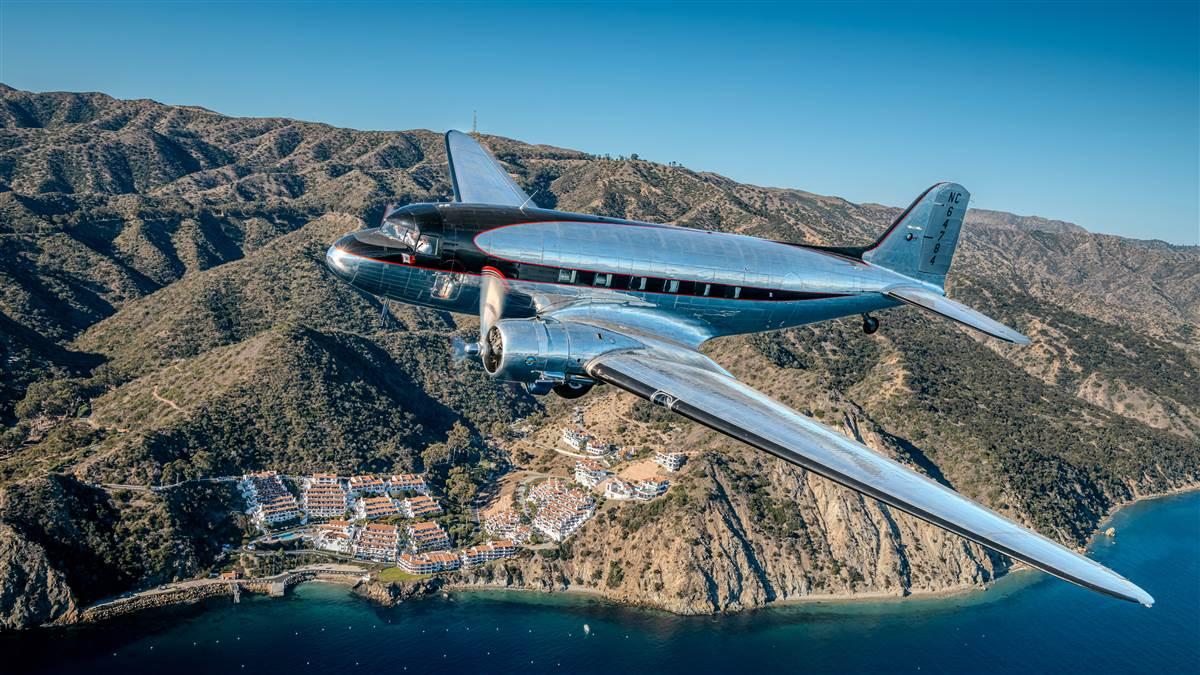
At war’s end, this airplane was converted to a civilian DC–3 (NC64784) and in 1946 was purchased from Phillips Petroleum by William’s son, Philip Wrigley. He christened it Wasp. It is unknown how Wasp got its name. Perhaps it was because the airplane was powered by a pair of 1,350-horsepower, 14-cylinder, Pratt & Whitney Twin Wasp radial engines. It might also be because the Wrigley family had a boat called Wasp or that Philip Wrigley’s oldest daughter, already a pilot, may have trained to join the Women Airforce Service Pilots with the hope of becoming a WASP.

Airport in the Sky
The Wm. Wrigley Jr. Company had become the world’s leading gum manufacturer and enabled Wrigley to make substantial investments. These included the Wrigley Building in Chicago, the Chicago Cubs baseball team, Wrigley Field, and Southern California’s Santa Catalina Island, which Wrigley converted into a world-class destination. Unfortunately, the island didn’t have an airport, so Philip Wrigley had one built large enough to accommodate a DC–3. Completed in 1946, it sits atop a 1,600-foot-tall mountain and is known as the Airport in the Sky.
Catalina Airport (AVX) is popular with general aviation pilots who fly “26 miles across the sea” to frequent the Airport in the Sky Restaurant for bison burgers. Several bison were brought to the island in 1924 to film The Thundering Herd. The animals were left behind, and the herd is now maintained at about 150 “buffalos.” Bison often can be seen roaming near the airport from the restaurant patio.
The airport was once served by United Airlines’ DC–3s, but a marine layer cloaked the mountaintop airport in fog too often to enable reliable service. Also, landing at the airport can be challenging for inexperienced lightplane pilots because of weather and terrain.

Return to glory
Following Philip Wrigley’s death in 1977, Wasp was donated to the Pensacola Naval Air Museum by his son William, but it eventually wound up in the hands of Beat Wertli, a Swiss individual who years later had the airplane flown to Bakersfield, California, where it sat idle for 18 years.
Enter Geoff Rusack, a Southern California attorney who in 1985 married William Wrigley’s daughter, Alison. Rusack learned to fly at Santa Monica Airport (SMO) in 1987, earned a pocketful of ratings, and logged 1,400 hours. The more he heard and learned about Wasp, the more passionate he became about trying to locate and buy the airplane. He wanted to “return it to its original glory.” Alison was ecstatic about the “thought of seeing the Wasp come home.”
Rusack eventually discovered the DC–3 sitting forlornly in Bakersfield and negotiated purchase of the airplane. He arranged with Paul Bazeley, founder of Aerometal International, to completely restore the airplane. Aerometal is based in Aurora, Oregon, and specializes in restoring, maintaining, managing, operating, and providing crews for vintage and historic aircraft, especially DC–3s (see “Making History Fly,” April 2025 AOPA Pilot).
Bazeley and his artisans spent nine months preparing the airplane to be ferried to Aurora. He and his team then spent nine years restoring Wasp to a pristine, near-new condition. They also reduced the airplane’s empty weight by 800 pounds by removing ancient and heavy avionics, cabling, ADF loops, and other equipment. With only slightly more than 4,000 hours, Wasp is the lowest time DC–3 in the world. Bazeley said that “flying that airplane is like flying a work of art.” Rusack added, “Hearing and feeling those engines being started sends shivers down my spine. Wasp is an aeronautical treasure.”
As part of a training exercise in 2019, about 200 sailors (Seabees) and Marines joined forces to replace Catalina’s aging and crumbling asphalt runway with concrete. The grand reopening of the airport took place on May 3, 2019, and first to touch down was Wasp. Alison Wrigley Rusack and two of her sons were on board. She said, “Wasp is part of our family history, and I have vivid memories of it growing up. It was both emotional and thrilling being aboard during her first flight home.”


Flying a Gooney Bird
Like all DC–3s, Wasp is an all-metal airplane except for the primary flight-control surfaces. These are fabric covered to save weight and facilitate field repair. The wing flaps are split, like those of a Cessna 310. On the DC–3, however, they span all the way from one aileron to the other (including under the fuselage). They increase lift by 35 percent and parasite drag by 300 percent.
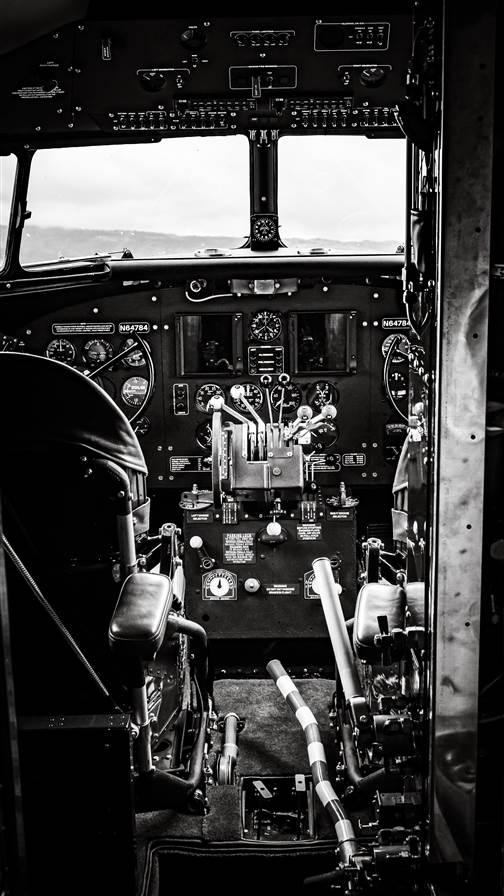
Climbing into the cockpit makes it obvious why a DC–3 pilot should not need an FAA medical certificate. Climbing the long and steeply sloped cabin several times a day without passing out should be a sufficient testament to good health.
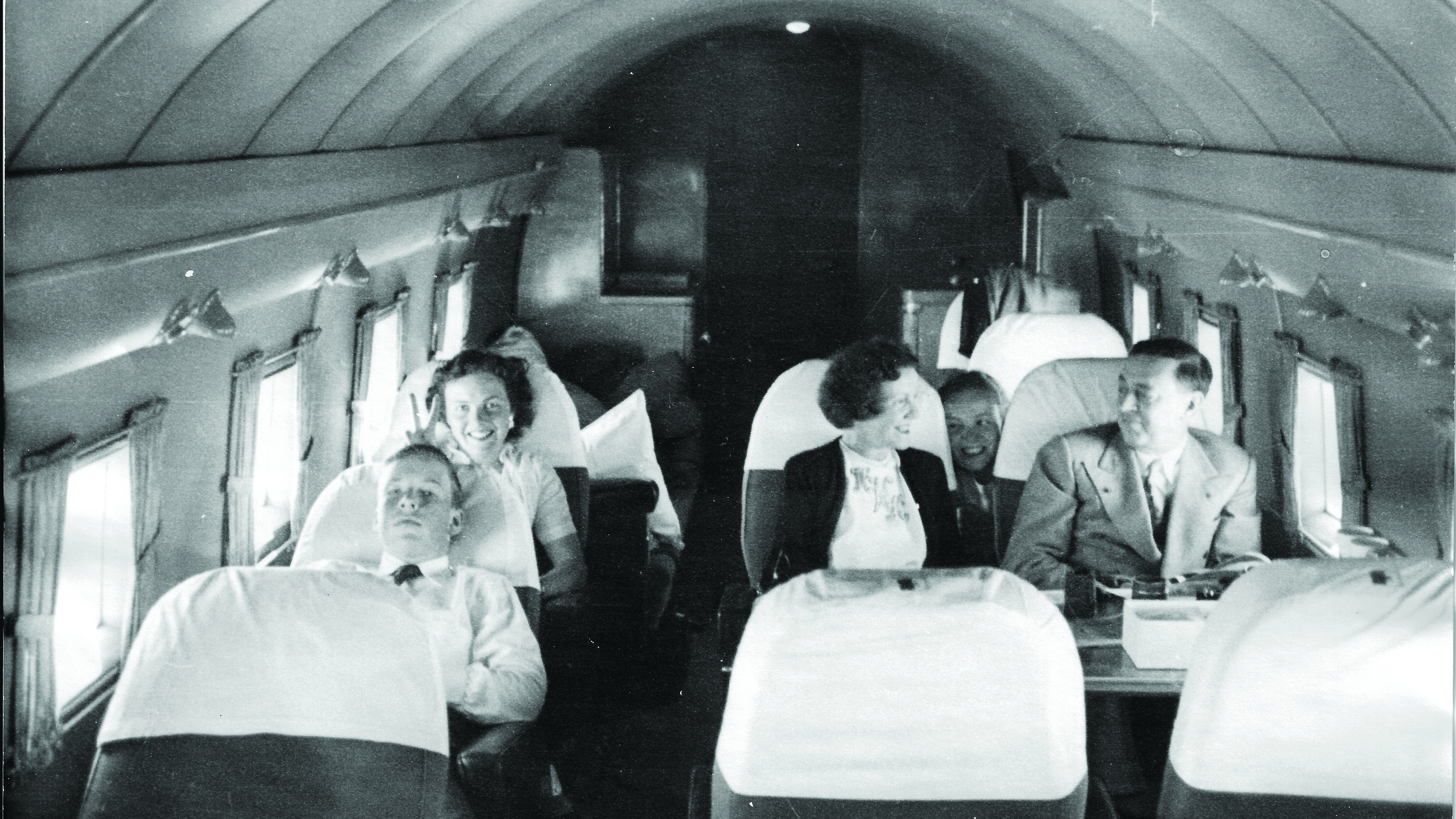
The DC–3 normally seats 21 passengers plus two pilots, but Wasp has a lush executive interior that seats 14.
Stirring an engine to life requires engaging the starter and primer switches, waiting for the propeller to turn through four revolutions, and then turning on the mags. With luck, the big radial will show signs of life, the signal to enrich the mixture. The Twin Wasp seems to awaken one cylinder at a time, belching and coughing great swarms of smoke.
When taxiing, Wasp moans and groans, and creaks and squeaks, as if it were a mechanized, prehistoric monster. Maintaining control of this oversized taildragger is not difficult if the tailwheel lock is engaged for the straightaways. Otherwise, the airplane has a mind of its own and weathervanes into the slightest crosswind. One also must be mindful of the 95-foot wingspan when taxiing in tight quarters. It is comforting to know that if the wing tips clear an obstacle while turning, so will the tail. Over-the-nose visibility is excellent, better than in most taildraggers.
When retracted, the main-gear tires extend 11 inches below the nacelles. The wheels remain free to rotate so that normal braking is available during a gear-up landing (not that this would be needed).
—Paul Bazeley
Wasp is a very hydraulic airplane. In addition to hydraulic brakes, wing flaps, and landing gear, hydraulic power operates the cowl flaps, autopilot, and—believe it or not—the windshield wipers.
After lining up for takeoff and locking the tailwheel, the throttles are advanced to 25 inches of manifold pressure with the brakes locked. Each pilot then cross-checks all engine indications. The brakes are then released, and the throttles are advanced to 52 inches and 2,800 rpm.
The pilot must forcefully push the nose down to an approximately level attitude. It takes a whopping 12-degree attitude change to lift the tail seven feet into the air to prevent the airplane from lifting off prematurely. Slight back-pressure is applied to the yoke at 84 knots, and the DC–3 becomes a graceful creature of the sky. Pilots affectionately refer to the DC–3 as a Gooney Bird, a large, seagull-like bird found on some South Pacific atolls and known for their awkward waddling but graceful flight.
Each cowling has a ring of 14 large cowl flaps that surround the big radials. They are wide open for ground operations but create so much drag that they must be closed to the trail position shortly before takeoff. They are fully closed for cruise. Failing to do this significantly reduces performance and produces noticeable airframe buffeting.
Like other Gooneys, Wasp is heavy on the controls and sluggish in roll but light in pitch. This airplane is not flown with fingertips. Trim tabs are a pilot’s best friend. The airplane is so sensitive to the movement of the center of gravity that experienced DC–3 pilots claim they can tell the weight of a “stewardess” walking toward the cockpit with coffee.
Flying the airplane can be a workout and gives one great respect for airline pilots of yore who battled weather and turbulence a hundred hours a month.
One would expect that the big, high-lift wings of a DC–3 would have docile stall characteristics. Not so. Stalls propagate from the wing tips and can result in strong rolling moments and substantial altitude loss. Recovery demands aggressive manipulation of the controls.

On a nice day, either pilot can slide open the side window and rest an arm on the windowsill as when driving a car. The shape of the front windshield creates a low-pressure zone near the side windows so that only a waft of air can be felt. Nor does the noise level increase with an open window. The din of a DC–3 assaults the ears equally well with windows open or closed.
In those carefree days of ecological ignorance, airline pilots flying DC–3s used to revise their manuals while en route. Each obsolete page was lifted out of its binder on the pilot’s lap. The reduced pressure outside the open window would remove the chart from between the pilot’s fingertips and send it carelessly to oblivion.
The DC–3 has a reputation for leaky windshields on rainy days. This has prompted more than one pilot to report, “Light rain outside; heavy rain inside.”
Although one can make three-point landings in a Gooney Bird, this is discouraged because dropping in such a heavy airplane can unduly strain the landing gear. Instead, wheel landings are the norm. Just pull off the power when about 10 feet above the ground. There is little or no tendency to drop as those big wings slice deeper into ground effect. There also is little tendency to bounce, which makes the DC–3 easier to land on the mains than many light airplanes.
Some experienced pilots claim they can land shorter in a DC–3 with the tail up than down. The procedure involves simultaneously applying aggressive braking and enough back-pressure on the yoke to prevent nosing over. Some even claim that this combination of brake and elevator control is so effective that—with a little help from a headwind, a forward center of gravity, and a smidgeon of power—a competent pilot can come to a halt with the tail suspended in the air.
Geoff Rusack has yet to check out in Wasp but will someday. “After all,” he says, “what pilot doesn’t want to fly a DC–3?”

Related Articles


