Bound to please
Rotax 916iS ups performance



I’m flying two S–21s back-to-back. First, a tailwheel SLSA built by Rans in 2019 to showcase the 180-horsepower Titan X-340 engine installation. After that, I’ll fly Rans’ newest demonstrator: an experimental amateur-built tundra-tire trike with a 160-horsepower turbocharged Rotax 916iS engine. Rans President Tony Dopita and Schlitter believe this will be the S–21’s most popular configuration.
Dopita will fly with me in the S–21, and he’s the perfect person for the job. Not only does Dopita manage production at Rans, but he also is typically the first person to fly each new Rans-built ready-to-fly airplane from the company’s private 1,200-foot-long grass runway.
Dopita explains the design goal of the S–21 was to create a backcountry airplane that “has a little bit of speed but still has a really respectable stall speed. A harmonized control feel, and being balanced, was definitely a design goal as well.
“A lot of people call the S–21 a bush plane, and I don’t think bush plane fits the 21. It’s more of a backcountry-capable airplane. You can outrun some weather systems if you have to. You’re not landing on gravel bars in 50 feet like a Super Cub, but you’re going into the backcountry, and you’re carrying 180 pounds of luggage, too.”


Flying the Outbound
The Randy S in Rans
My first impression after entering the S–21 is that the cabin feels very spacious with the convex door shape contributing five inches to the cabin’s 46.5-inch width. I sit partially reclined in the seat, which adjusts forward and upward so that shorter pilots can optimize both rudder pedal reach and visibility over the nose.
The trike’s instrument panel, wired and finished by Faribault, Minnesota-based SteinAir, includes capable VFR avionics in a logical layout: Dual 10-inch Garmin G3X Touch flight displays (with engine indication system) flank a Garmin G5 attitude indicator, Garmin GTR 205 com radio, and Garmin GFC 500 autopilot. Fully adjustable fresh air vents anchor both sides of the panel.
The left control stick has a handy radio frequency select button I use to toggle the standby frequency and listen to the AWOS. The stick also contains up and down elevator trim, autopilot disconnect, and push to talk switches.
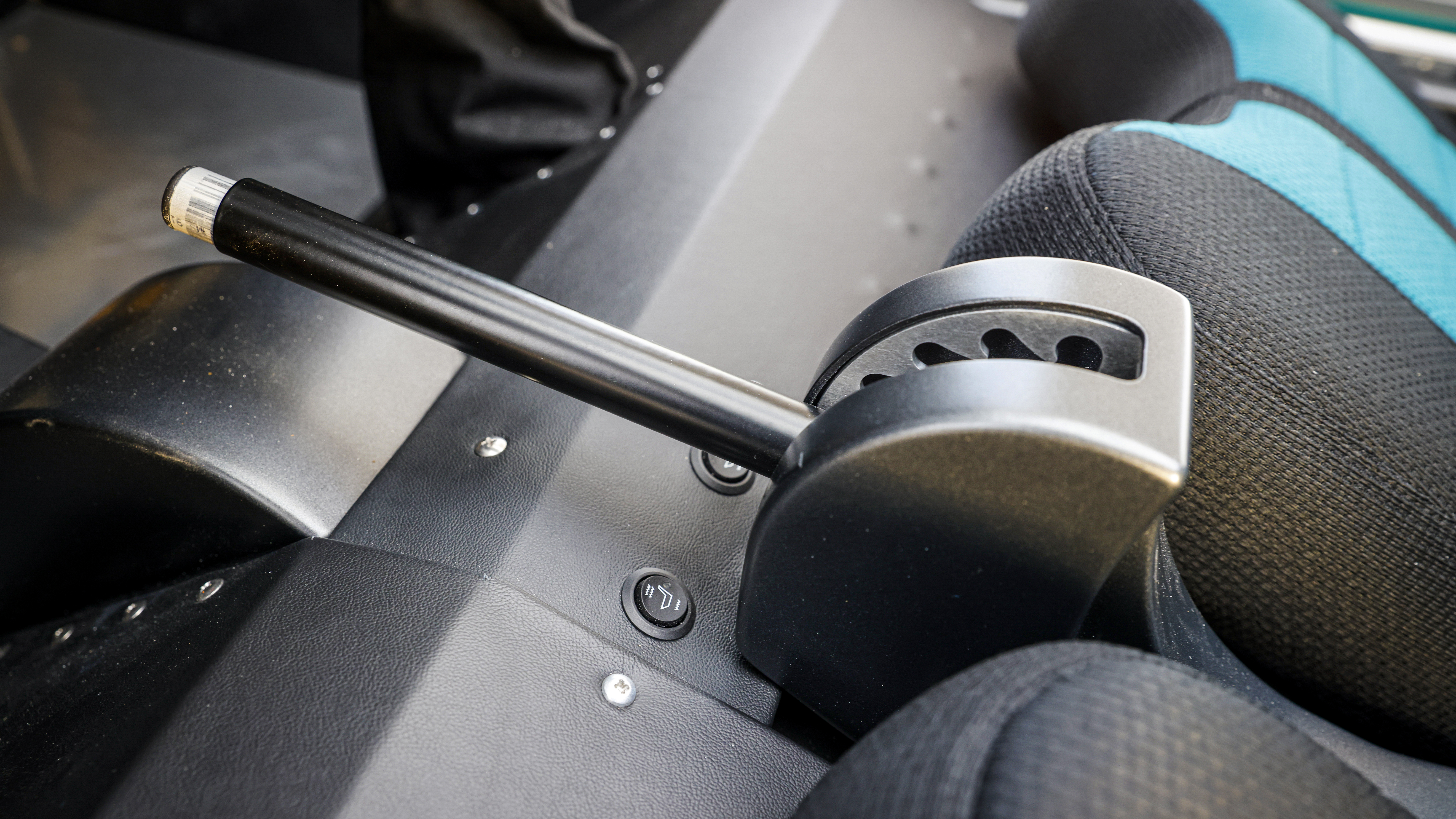
The heated seats—an option on the ready-to-fly’s and the first I experience on any aircraft—are so warm after five minutes on the high setting that I have to turn them down to low.
The trike has a free-castering nosewheel, so turns are made with differential braking. The G3X displays a taxi camera, which provides an expansive view in front of the aircraft and is a particularly useful safety feature when the airplane is in a tailwheel configuration.
I set the parking brake and perform an engine runup. The Rotax 916iS has full-authority digital engine control (FADEC), which eliminates the mixture control, but not the propeller control. We increase rpm to 2,500 and flip the Lane A and Lane B switches and the dual-redundant computer processors automatically confirm safe engine function.
Given many of the S–21’s high-tech features, it’s ironic that the fuel gauges remain simple sight gauge affairs with fuel running through a clear angled tube on the wing root and stenciled markings denoting gallons of fuel remaining.


SPEC SHEET
Rans Aircraft S–21 Outbound
Price as tested:
$300,000 (Rotax); $275,000 (Titan)
Specifications
Powerplant / Rotax 916iS, 160 hp; Titan X-340, 180 hp
Propeller / Constant speed; ground adjustable
Length / 22 ft 5 in
Height / 8 ft 7 in
Wingspan / 28 ft
Wing area / 141 sq ft
Wing loading / 13.47 lb/sq ft
Power loading / 11.25 lb/hp; 10 lb/hp
Seats / 2
Cabin width / 3 ft 11 in
Cabin height / 3 ft 8 in
Empty weight / 985 lb; 1,030 lb
Max gross weight, experimental / 1,800 lb
Max gross weight, LSA / 1,320 lb
Fuel capacity, std / 50 gal
Baggage capacity / 180 lb, 24 cu ft
Performance
Takeoff distance, ground roll / 325 ft
Rate of climb, sea level / 1,500 fpm
Cruise speed/endurance w/30-min rsv, std fuel (fuel consumption)
@ 75% power, best economy, 8,000 ft / 155 mph/5 hr (8 gph);
150 mph/4.5 hr (9 gph)
Landing distance, ground roll / 375 ft
Limiting and recommended airspeeds
VX (best angle of climb) / 70 mph
VY (best rate of climb) / 90 mph
VFE (max flap extended) / 80 mph
VNE (never exceed) / 215 mph
VS1 (stall, clean) / 50 mph
VSO (stall, in landing configuration) / 40 mph
For more information, contact Rans Aircraft.
 rans.com
All specifications are based on manufacturer’s calculations. All performance figures are based on standard day, standard atmosphere, sea level, gross weight conditions unless otherwise noted. Find more specifications in AOPA’s Aircraft Guide.
A typical takeoff entails setting one notch of flaps. The S–21 flap handle has four notches total, each representing approximately 10 degrees of flap travel. Because the 916iS is turbocharged and has a constant speed propeller—and the power spools up suddenly after you apply full throttle—it requires some care on takeoff to prevent overrevving the engine. Dopita advises holding the brakes while applying full power, then releasing the brakes after the turbo has spooled up. He also advises raising the nosewheel as soon as possible to reduce the potential for nosewheel shimmy with the large tundra tire installed.
Winds are nearly calm this morning as I taxi onto the runway at HYS—field elevation 1,999 feet. Applying full power, I feel a nice punch of turbo boost and pull the stick back to raise the nose. Whoa, not too much—the large, balanced elevator and relatively light 916iS (80 pounds lighter than the Titan X-340 version) create a sensitive pitch feel that is easy to overcontrol at these low speeds.
After an 8-second, 450-foot ground roll, the airplane lifts off at 40 mph and I establish the best rate of climb speed of 90 mph, which translates to a 1,300 feet per minute climb rate on this 32-degree Fahrenheit day.
After leveling off, the sight picture looks like we are descending because we have a fabulous view out of the front windshield. Thanks to carefully calibrated balance weights, the pully-actuated ailerons are quite sensitive and respond immediately to any control pressure, but once trimmed the airplane flies hands off. Schlitter, who designed several aerobatic Rans airplanes, prides himself on how well harmonized the S–21 flight controls are—requiring gentle nudges instead of large inputs.
The tailwheel airplane required almost no rudder input for left turns and just a bit for right turns. The trike version required just a bit more rudder than the tailwheel version, which Dopita attributes to the drag of the large nosewheel tire.
Steep turns reveal one of my favorite S–21 features: the visibility out of the Lexan skylight is spectacular. For a few seconds, I am mesmerized by the sweeping view—it is the most functional skylight design I have ever experienced.
At 4,500 feet msl, indicating 35 inches of manifold pressure and 5,300 rpm, we see an economy cruise airspeed of 131 mph true while consuming 7 gallons of fuel per hour. We push it to 40 inches and see 142 mph at just under 7.9 gallons per hour. Dopita said to expect 155 mph true airspeed at 14,000 feet, burning less than 8 gallons per hour.
Setting up for a power-off stall, I pull power and slow to the S–21’s best glide speed of 75 mph, then set full flaps and let the airspeed decay. The S–21 stalls at 46 mph indicated airspeed with no tendency for either wing to drop. During slow flight, the airplane is happy flying along at 50 mph with full flaps, with the stall warning system beeping slowly (the beeps increase in cadence approaching a stall).
I measure the S–21’s roll rate at about 45 degrees per second, and with positive 6 and negative 2-G load limits, you can have fun maneuvering the airplane without much fear of hurting the structure.
For the trike flight, Dopita expertly lands the trike airplane on Rans’ grass runway using no more than half of the runway length, its tundra tires and stout aluminum landing gear shrugging off any dips and undulations on the turf, and its tall stance keeping the propeller out of harm’s way.
In the tailwheel version, later, I enter downwind at 100 mph but need to execute a 360-degree right turn to maintain spacing from another airplane. I’m thankful again for the skylight and how much it increases my situational awareness—particularly during right turns. Even in a shallow bank, I can see the horizon and look for traffic through the skylight.
On downwind, I slow below the 80-mph maximum flap extended speed and start lowering the flaps as we slow first to 75 mph, then to 65 mph on final. I’m 60 mph over the fence and slowly bleeding the speed during the flare.
I land the tailwheel airplane in a three-point attitude on Hays’ concrete runway. The S–21’s great view out the window during the approach and landing and its predictable handling during rollout inspire confidence and make the landing a non-event. Taxiing back to Rans’ hangar, I can see over the nose by craning my neck just a little bit.


Build your own, or have Rans assist
S–21 kits and ready-to-fly aircraft are made here at Rans’ headquarters and production facility, and builders have plenty of options from which to choose to end up with their dream airplane. They can either build an S–21 themselves as an EAB, participate in Rans’ builder assist program so that they build part of their S–21 and Rans builds part of it, or have Rans build an SLSA aircraft. However, with the new MOSAIC rules replacing the existing light sport aircraft limitations with a new light sport category July 24, 2026, Rans’ SLSA program could very well change.
“For the ready-to-fly builder assist program they come for the first week and we build wings, work on fuselage tasks and airframe—check off those boxes—and then we send them home,” says Dopita. “We finish everything, get it painted, bring them back, and they’re here for two days when they put everything together—wings on, tail on, that kind of stuff. They’re basically here for seven days, and they’re the builder of the aircraft.”
“Right now, more are doing the builder-assist program,” he adds. “They want that 1,800-pound gross weight versus the 1,320 for the SLSA. When we can start building under the MOSAIC rules, it will be interesting to see if that changes or not.”


As customers are choosing which type of S–21 to build, Dopita says, “The main thing to consider, first and foremost, is budget. Can you afford the additional cost of having somebody else build most of your airplane? And then the second thing is, you have the skill set to do a lot of things and are you comfortable building? And then the last thing is, do you have the time to build? If you have everything to check the boxes to build at home, it’s a great project. If you don’t, we’re happy to build it for you.”
The Rans S–21 Outbound is an aircraft that is fully capable of providing backcountry adventure with enough speed to get somewhere off the beaten path. It’s a design from a proven manufacturer with decades of experience building single and two-seat light aircraft kits and deserves to be on the list of anyone looking to build their own backcountry dream machine. 


Related Articles


